
We Do Not Belong to This City!
(This story is dedicated to those young minds of the modern age who use scientific inventions and modern conveniences not for the collective good of humanity, but for selfish desires and personal gain. It is a symbolic tale whose characters represent different attitudes and moral realities of our society. Somewhere within these characters, every reader may discover a reflection of himself.)


Usuf Mir
At the foot of the mountains lay a small settlement where every morning arrived with the cheerful songs of birds, and every evening wrapped itself in a soft blanket of mist before sinking into silence. Vast green fields stretched far into the distance, cool winds swayed through the grass, and the fragrance descending from the hills made the village feel completely detached from the artificial world of the cities.
At the far edge of this quiet settlement stood a small wooden house where Sahil lived. He owned a few sheep, some goats, and a handful of rabbits. His life was simple, peaceful, and silent. During the day, he worked in the fields or sat beside the waterfall for hours, watching the flowing water in deep silence. He loved quietness more than noise, and perhaps that was why he always avoided the cities.
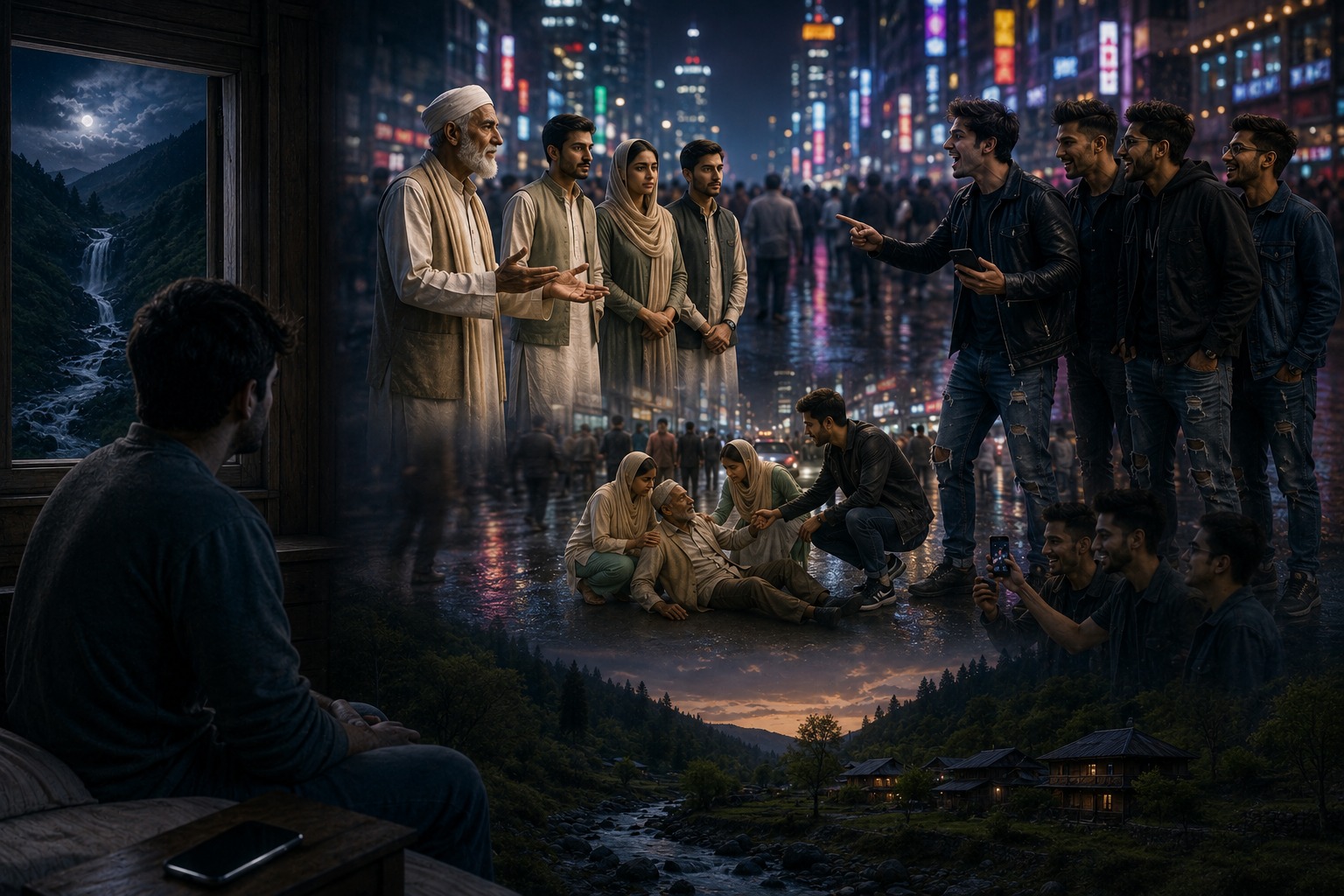
One night, while the entire village slept beneath the calm sky, Sahil left the window of his room open and drifted into sleep. Moonlight was scattered across the mountains, the wind moved gently through the silence, and the waterfall murmured softly in the darkness. In those deeply peaceful moments, he saw a strange dream.
He found himself standing inside a city overflowing with light but completely empty of peace. Towering buildings, colorful lights, endless traffic, ringing mobile phones, and restless crowds surrounded him from every side. Everyone seemed to be running somewhere, yet no one appeared to know where they truly belonged.
People smiled warmly at one another, but only moments later spoke badly behind each other’s backs. Somewhere, trust was being used for personal gain; elsewhere, innocent hearts were being trapped behind sweet words and false kindness. As Sahil wandered through the noise and confusion, his eyes fell upon two completely different groups standing by the roadside.
On one side stood an elderly man dressed in loose white clothes. His face carried an unusual calm, and his eyes reflected deep compassion. Beside him stood three young men — Ali, Mili, and Wali. Quiet, respectful, and composed, they looked untouched by the chaos around them, as if they belonged to a different world altogether.
On the other side stood a group of loud young men laughing carelessly. Torn jeans, untidy hair, expensive smartphones, and reckless conversations defined them. Among them was one particularly arrogant young man, accompanied by Ooni, Booni, and Toni. They mocked strangers passing by, recorded videos for amusement, and spoke to people with fake sweetness only to gain personal advantage.
Suddenly the young man burst into laughter. “Today I fooled that man perfectly,” he said proudly. “He called me his brother while I kept thinking about how to use him for my own benefit.”
Ooni, Booni, and Toni laughed loudly with him.
A strange uneasiness settled inside Sahil’s heart. The city lights appeared bright on the outside, yet hollow and dark within.
Just then, the elderly man slowly walked toward the young man.
“My son,” he said gently, “the happiness that comes from breaking someone’s trust never lasts for long.”
The young man looked at him mockingly and replied,
“Perhaps you belong to another time, old man. In today’s world, decent people do not survive for long.”
The elder listened patiently before saying in a calm voice,
“If survival demands the loss of your humanity, then only the body remains alive… not the human being.”
For a few moments, silence spread between them. Then the young man laughed again and said,
“If you people do not belong to this city, then why are you here at all?”
The elder looked toward the glowing skyline. A faint sadness appeared in his eyes.
“We did not come here to stay,” he said softly. “We only came to see what humanity has achieved in the age of progress… and how much of its humanity it has lost along the way.”
Ooni, Booni, and Toni exchanged amused glances.
“This old man speaks like a philosopher,” one of them whispered mockingly.
At that very moment, the young man’s phone buzzed. A smile immediately spread across his face.
“See? This is the real world,” he said proudly. “Another person is about to fall into my trap.”
The elder looked at him sorrowfully and asked,
“Why do you find happiness not in winning hearts, but in using people?”
“Because that is what success means today,” the young man replied without hesitation.
A few moments later, an old man stumbled and collapsed onto the road nearby. People walked past him without stopping. Some took out their phones and began recording videos, while others merely glanced at him before moving on.
“Make a viral video!” Ooni, Booni, and Toni laughed.
But the elder immediately rushed forward. Ali, Mili, and Wali quickly helped the old man and seated him safely by the roadside. The city continued moving at its usual pace. Cars kept passing, phones kept ringing, and crowds kept rushing forward, yet humanity itself seemed to be sitting silently at one corner, struggling to breathe.
The young man stood there quietly, watching everything. For the first time, the phone in his hand felt heavy. For the first time, his laughter felt empty.
The elder gently placed his hand on the old man’s head. There was such warmth in his eyes that it seemed he was comforting not a stranger, but someone deeply close to his own heart.
For several moments, the young man stood silently watching him. For the first time, confusion appeared upon his face. Amid the noise, the laughter, and the endless ringing of phones, he suddenly felt a strange silence growing within himself.
The elder slowly stood up and said to him,
“My son, progress and convenience are not evil in themselves. Evil begins when human beings use them not for humanity, but for selfishness.”
The young man lowered his eyes for the first time. His phone screen continued glowing in his hand, yet its light no longer felt meaningful.
After a long silence, he spoke in a broken voice,
“And if a person truly wishes to change… can he really change?”
The elder looked at him gently. There was softness in his eyes, but hope as well.
“A human being changes,” he said softly, “the day he begins hearing the voice of his conscience.”
At that very moment, the entire scene began to blur. The city lights faded. The young man looked frightened.
“Are you leaving?” he asked anxiously.
The elder replied softly,
“We do not belong to this city.”
And slowly, he disappeared into the mist along with Ali, Mili, and Wali.
Sahil suddenly woke up, breathing heavily. Outside, the same village rested peacefully beneath the mountains. The waterfall still flowed softly in the distance, and the silence of the night remained unchanged.
His phone screen was glowing beside him…
But for the first time in his life, he quietly turned it off.
Then he sat there for a long time, staring into the silent darkness while one sentence echoed again and again inside his mind:
“We Do Not Belong to This City.”
Comments are closed.