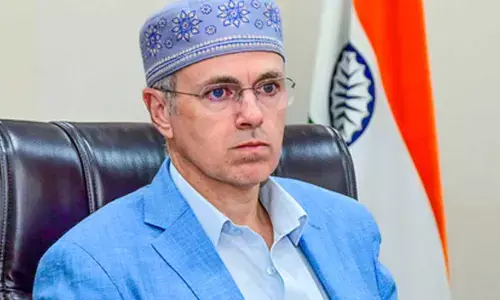
Srinagar, July 13: Jammu and Kashmir Chief Minister Omar Abdullah on Monday termed the denial of access to political leaders at the Martyrs’ Graveyard on July 13 as “unfortunate” and asserted that no restrictions could diminish the legacy of those killed in the 1931 uprising.
Speaking to reporters at the National Conference headquarters, Nawa-e-Subha, after paying floral tributes, Omar, as per Kashmir Convener, said the authorities had “failed to read the history” of Jammu and Kashmir before deciding to seal Mazar-e-Shuhada.
“It is unfortunate that those who fought against oppression and to protect the dignity of Jammu and Kashmir are today being denied tributes. Those who decided to seal Mazar-e-Shuhada should have first read the history of Jammu and Kashmir,” he said.
The Chief Minister pushed back against attempts to frame the July 13, 1931 movement as a religious struggle, insisting it was a fight against colonial rule and autocratic governance.
“This was not a religious fight. It was a struggle against oppression, for democracy, and against British paramountcy. Today, attempts are being made to present it as something else,” he said.
Asked about the restrictions, CM Omar said only a small number of people had intended to visit the graveyard, making the clampdown disproportionate.
“I don’t think more than 150 people would have gone there to pay tributes, yet they treated it as a threat. This itself contradicts the repeated claims that everything is normal,” he said.
CM Omar said those enforcing the restrictions were “temporary” while the people of Kashmir were permanent.
“Those who managed to stop us from going to Mazar-e-Shuhada today are here temporarily. The people of Jammu and Kashmir will remain here. If not today, then tomorrow or the day after, we will certainly go there and pay our tributes,” he said.
The Chief Minister also drew a comparison with previous years, pointing out that such restrictions were not imposed even during the Amarnath Yatra movement in the past.
“We are repeatedly told everything is normal, but the ground reality says otherwise. Earlier, such restrictions were never imposed during the Yatra. Today they are doing it,” he said.
The July 13 commemoration marks the death of 22 civilians in 1931 who were fired upon by the Dogra regime during protests against Maharaja Hari Singh’s administration. The site has since become a symbol of political resistance in Kashmir, with leaders across the spectrum gathering annually to pay respects.
This year, however, authorities sealed the Mazar-e-Shuhada cemetery in downtown Srinagar and restricted the movement of political leaders, citing law and order concerns. The decision has drawn sharp criticism from mainstream political parties, who see it as an attempt to dilute Kashmir’s historical narrative.


Comments are closed.