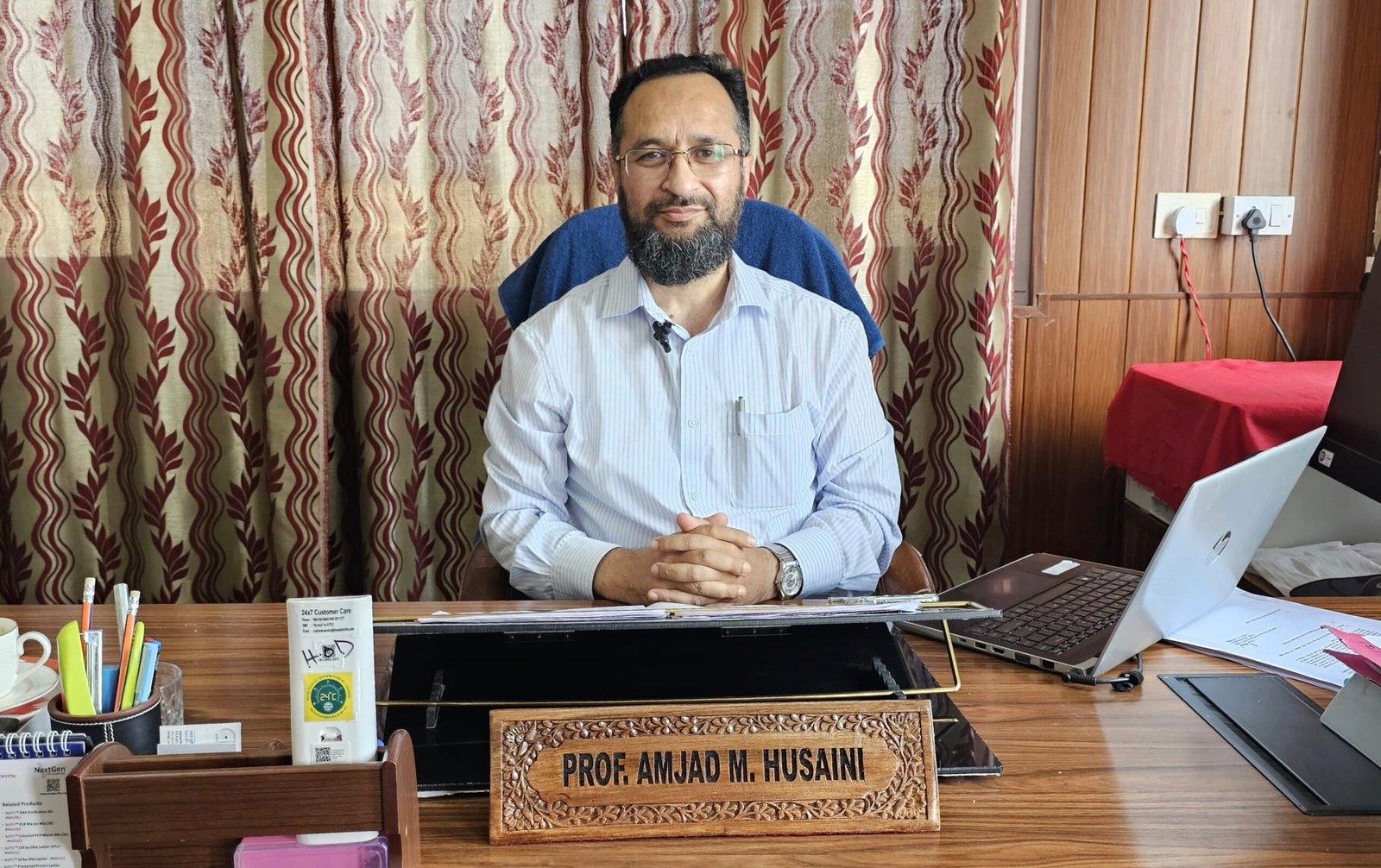
Pampore, Oct 12: Senior scientist at Sher-e-Kashmir University of Agricultural Sciences and Technology of Kashmir (SKUAST-K), Amjad Professor M. Hussani, has urged saffron growers and government agencies to ensure timely irrigation during the current growing season, warning that a shortage of moisture at a critical stage could significantly reduce production.
Hussani, who heads the Research Centre for Saffron and Seed Spices at Dusoo, Pampore, said irrigation was important after saffron corm sowing, which farmers completed in September, to support root development and flower initiation.
In an exclusive interview with The Kashmir Convener, he said saffron requires less irrigation than crops such as paddy but still needs adequate moisture at crucial stages of growth.
“If irrigation is not provided at this crucial stage, the corms may dry out and lose their stored nutrients, adversely affecting plant growth and flowering. Adequate soil moisture is essential for healthy and satisfactory flowering,” he said.
Hussani said timely irrigation could also help regulate soil temperature and support microbial activity, creating favourable conditions for corm development as the crop enters the flowering stage.
He warned that production could decline sharply in the absence of adequate irrigation. Under favourable conditions, yields could reach around 4–5 kilograms per hectare, while a lack of timely watering could bring production down to as little as 400 grams per hectare, he said.
Calling for immediate measures to improve irrigation facilities, Hussani suggested that farmers explore solar-powered systems similar to those being installed in high-density apple orchards. He said farmers with consolidated landholdings could explore available government schemes to establish irrigation facilities for their saffron fields.
He added that growers need not rely solely on conventional sprinkler systems, as alternatives such as rain guns could be considered depending on local requirements.
Hussani invited farmers and other stakeholders to visit SKUAST-K’s Advanced Research Centre for Saffron and Seed Spices at Dusoo to examine its irrigation facilities and explore suitable options for their fields.
He said irrigation infrastructure could be developed with government support or through individual initiatives, depending on farmers’ resources and requirements.
Saffron cultivation supports thousands of families in Pampore tehsil and remains closely associated with Kashmir’s agricultural identity. Hussani noted that Kashmir saffron has received Geographical Indication recognition, while the region’s saffron-growing heritage has also received recognition from the Food and Agriculture Organization.
He called for coordinated efforts by individual farmers, communities, Farmer Producer Organisations and government agencies to improve irrigation and protect the crop.
“We must work collectively to protect saffron, preserve Kashmir’s agricultural heritage and secure the future of this precious crop,” he said.


Comments are closed.