Srinagar, Nov 18: Jammu and Kashmir Chief Minister Omar Abdullah on Wednesday questioned the BJP-led Centre’s continued delay in restoring statehood to the Union Territory, demanding clarity on what constitutes the “appropriate time” promised by the government and suggesting that the decision could be linked to the BJP’s electoral ambitions in the region.
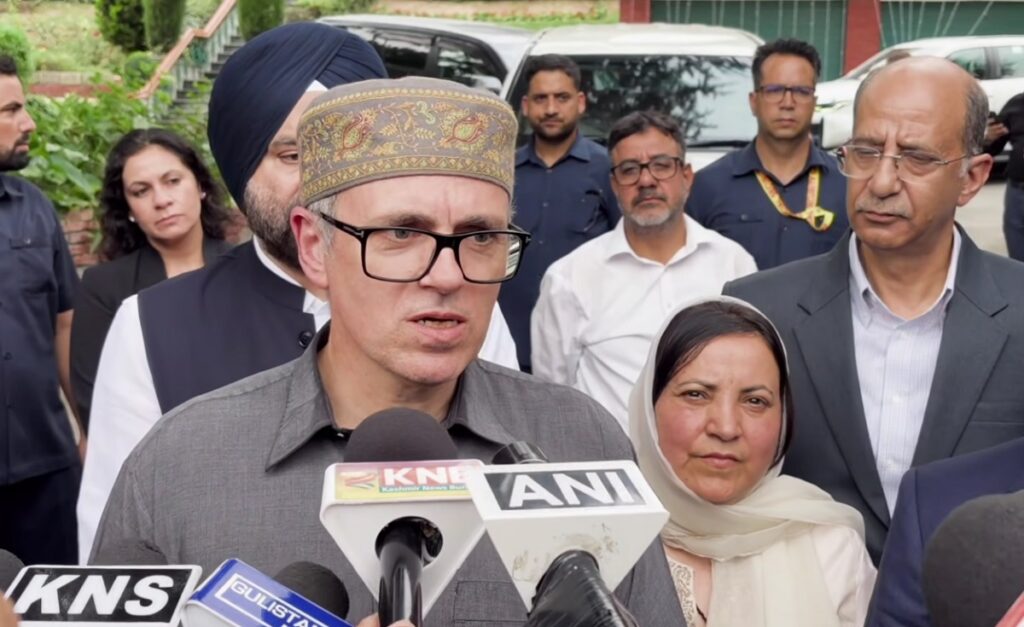
Addressing a public gathering in Mendhar area of Poonch district, CM Omar Abdullah as per Kashmir Convener said the Centre should openly acknowledge if it was unwilling to restore statehood until the BJP formed its own government in Jammu and Kashmir, instead of repeatedly offering assurances without specifying a timeline.
If it is your wish not to restore statehood until the BJP has its own chief minister in Jammu and Kashmir, then say it openly. Tell the people clearly so that they are not kept under any illusion, and we are not humiliated repeatedly, he said.
The remarks underline the growing political friction between the elected National Conference government and the Centre over Jammu and Kashmir’s constitutional and administrative status, more than six years after the erstwhile state was reorganised into two Union Territories following the abrogation of Article 370 in August 2019.
CM Omar Abdullah also questioned the basis on which the Centre was deciding when Jammu and Kashmir would be ready for restoration of statehood, arguing that the phrase appropriate time had remained undefined despite repeated commitments.
How can we say that the right time has come? What scale do you have on which you will weigh Jammu and Kashmir and decide that now the time has come to return its statehood? he asked.
Challenging the Centre’s apparent reliance on the security situation to defer statehood, the chief minister referred to the Pahalgam terror attack and other militancy-related incidents, questioning why his elected government should face the consequences of security developments over which it has limited administrative authority.
“There was an attack in Pahalgam. It was not our fault. We have no control over the police and no control over law and order. But we are told that because there was an attack, perhaps statehood cannot be restored,” CM Omar Abdullah said.
He argued that accountability should be fixed according to the responsibilities assigned to the elected government, rather than holding it responsible for departments and functions that remain outside its jurisdiction.
The things that are not in our hands, how can you blame us for those? The things for which you have given us responsibility, ask us about them, he said.
Omar Abdullah cited the implementation of central development schemes, including the Pradhan Mantri Gram Sadak Yojana (PMGSY) and Pradhan Mantri Awas Yojana (PMAY), as areas where his government’s performance could be assessed.
Ask us, did we obstruct the work of PMGSY? Did we obstruct the work of PMAY? he said.
The chief minister’s remarks reflect a central grievance of the National Conference government: while it has an electoral mandate and an elected Assembly, crucial subjects such as police and public order continue to remain under the administrative control of the Lieutenant Governor, who is appointed by the Centre.
Jammu and Kashmir lost its statehood on August 5, 2019, when the Centre announced the abrogation of Article 370 and subsequently reorganised the erstwhile state into two Union Territories — Jammu and Kashmir, with a legislature, and Ladakh, without one.
The reorganisation brought significant changes to the region’s administrative structure, with several powers previously exercised by the elected state government coming under the Centre’s direct control.
The Supreme Court, in its December 2023 verdict upholding the abrogation of Article 370, directed that Assembly elections be conducted by September 30, 2024, and said steps should be taken to restore statehood at the earliest.
Assembly elections were subsequently held in September and October 2024, paving the way for the formation of an elected government after nearly six years of central rule.
The National Conference emerged as the single-largest party with 42 seats in the 90-member Assembly, while the BJP secured 29 seats and became the principal Opposition. Abdullah subsequently took oath as chief minister.
However, despite the restoration of an elected government, Jammu and Kashmir continues to function as a Union Territory, with the division of powers between the elected dispensation and the Lieutenant Governor remaining a major source of political disagreement.
The National Conference had made restoration of statehood one of its principal electoral promises during the 2024 Assembly elections. The party has since repeatedly urged the Centre to fulfil its commitment, arguing that the existing administrative arrangement restricts the functioning of an elected government.
At Mendhar, the Jammu and Kashmir chief minister appeared to broaden that demand beyond an administrative disagreement, questioning whether the delay was being driven by political considerations rather than an assessment of the security situation.
We should not deceive ourselves or humiliate ourselves by repeatedly asking for statehood, CM Omar Abdullah said, reiterating that the Centre should make its position clear to the people of Jammu and Kashmir.

Comments are closed.