Srinagar, Oct 17: Since the abrogation of Article 370 in August 2019, Jammu and Kashmir has witnessed an infrastructure push spanning railway connectivity, highways, tunnels and aviation, with projects aimed at improving the region’s links with the rest of the country and reducing disruptions caused by difficult Himalayan terrain.
A senior official familiar with the Ministry of Roads and Transport told Kashmir Convener that the Udhampur–Srinagar–Baramulla Rail Link (USBRL), the Chenab railway bridge, Vande Bharat Express services and tunnels along strategic road corridors are among the projects changing how people travel to and within the Union Territory. An expansion of Srinagar airport and the development of freight terminals are also intended to improve access to markets beyond the region.
The transformation, however, extends beyond the construction of infrastructure. For a region where snowfall, avalanches and landslides have frequently disrupted transport, the test will be whether the new links can provide dependable year-round connectivity and reduce the cost and time involved in moving people and goods.
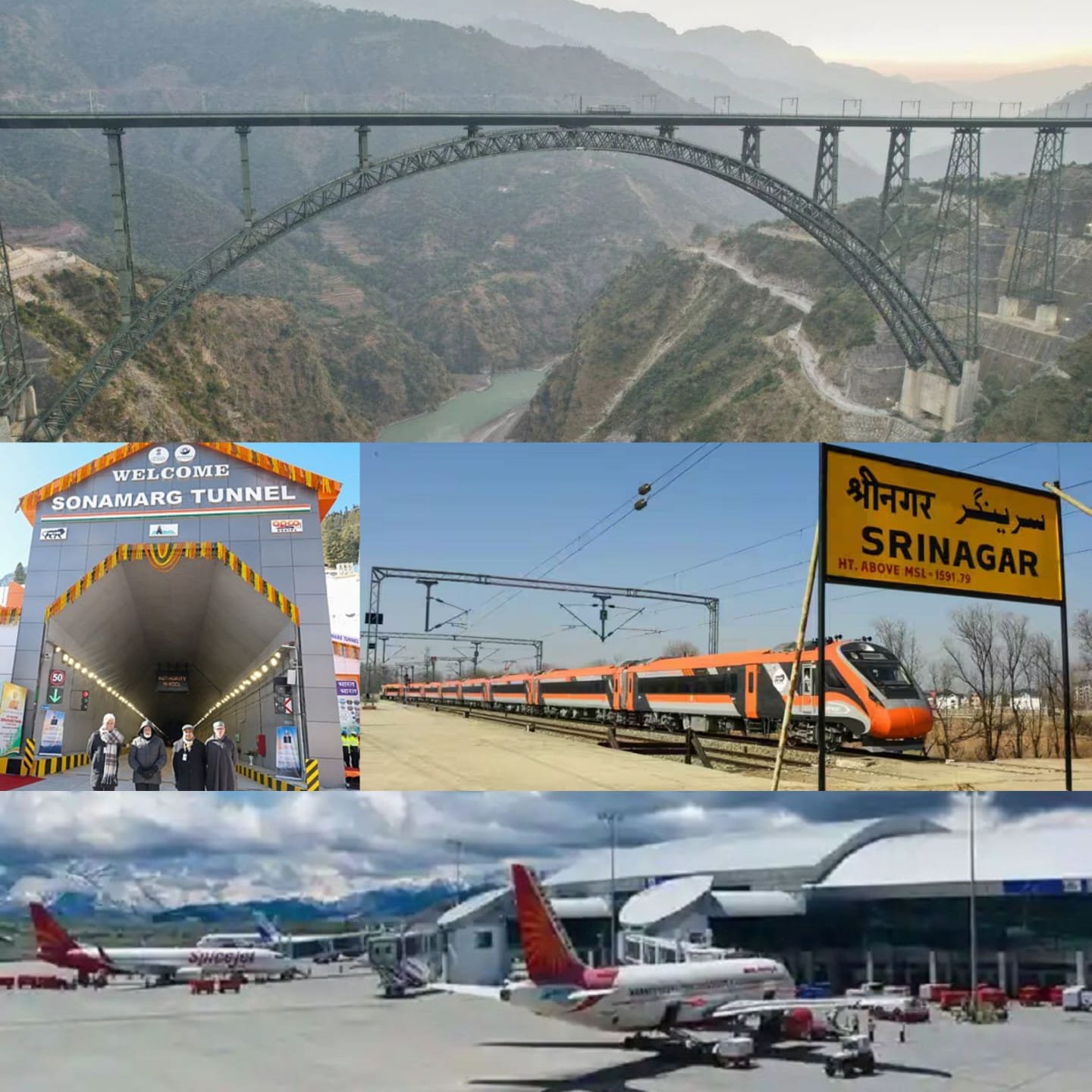
The 272-km USBRL, inaugurated in June 2025, has connected the Kashmir Valley to the national railway network. Built at a cost of Rs 43,780 crore, the project traverses mountainous terrain and includes 36 tunnels spanning 119 km and 943 bridges.
Its most prominent structures include the Chenab railway bridge, the world’s highest railway arch bridge, and the Anji Khad bridge, India’s first cable-stayed railway bridge. Together, they represent some of the most technically challenging engineering works undertaken for the railway network in the region.
The Chenab bridge, measuring 1,315 metres in length, stands 359 metres above the riverbed. Its 467-metre arch span has been designed to withstand strong winds and seismic forces, the official said.
The Anji Khad bridge is supported by a 193-metre-high inverted Y-shaped tower. The railway network also includes Tunnel T50, a 12.77-km passage between Khari and Sumber, equipped with a parallel escape tunnel and monitoring systems.
The introduction of Vande Bharat Express services has added a new dimension to passenger movement. The service between Shri Mata Vaishno Devi Katra and Srinagar began in June 2025 and was extended to Jammu Tawi in April 2026, with the journey between Jammu and Srinagar taking less than five hours, according to project details.
The trains have been upgraded from eight to 20 coaches and equipped to operate in extreme weather conditions. Snow-removal arrangements and seismic dampers are among the measures intended to support operations in the mountainous region.
The railway connection is expected to offer passengers an alternative to road travel and improve access to the Valley during periods when highways are disrupted. Its wider economic impact will depend on passenger demand, freight capacity, service frequency and the cost of transporting goods by rail.
Four railway stations in Jammu and Kashmir — Budgam, Jammu Tawi, Martyr Captain Tushar Mahajan at Udhampur and Shri Mata Vaishno Devi Katra — have been identified for redevelopment under the Amrit Bharat Station Scheme.
Other railway proposals include a third line between Jalandhar Cantt and Jammu Tawi, an additional line between Jammu and Katra, and a proposed railway connection linking Jammu and Reasi with Poonch.
According to project details, the annual average railway budget allocation for Jammu and Kashmir has increased from Rs 1,044 crore during 2009–14 to Rs 1,086 crore in 2026–27.
Road connectivity remains critical, particularly for routes linking Kashmir with Jammu and Ladakh. The Srinagar–Leh highway, which crosses some of the region’s most vulnerable stretches, has long faced disruptions due to heavy snowfall, avalanches and landslides.
The Sonamarg tunnel, also known as the Z-Morh tunnel, was inaugurated in January 2025. Built at a cost of more than Rs 2,700 crore, the 6.4-km tunnel provides an alternative to road stretches vulnerable to avalanches and landslides.
Further along the Srinagar–Leh highway, the 13.153-km Zojila tunnel is intended to improve all-weather access between Baltal and Minamarg. The project achieved a breakthrough in June 2026. Once completed, it is expected to reduce the journey between Sonamarg and Minamarg from around two hours to approximately 30 minutes.
The tunnel is planned to include ventilation systems, fire detection and suppression equipment, CCTV surveillance and avalanche protection infrastructure.
The Dr Syama Prasad Mookerjee Tunnel, which opened in 2017, has already reduced the road distance between Udhampur and Ramban by 31 km and travel time by about two hours.
The Delhi–Amritsar–Katra Expressway is another part of the effort to improve access to Jammu and the Vaishno Devi pilgrimage centre. Sections of the expressway were inaugurated in July 2026, with the completed stretches expected to reduce travel time between Delhi and Katra from about 14 hours to nearly six hours.
In August 2026, foundation stones were laid for 110 road projects covering 598.455 km under the fourth phase of the Pradhan Mantri Gram Sadak Yojana. Costing more than Rs 1,500 crore, the projects are expected to benefit 46,972 people in the Udhampur, Kathua, Doda and Kishtwar areas.
These projects are aimed at improving access to remote settlements, although their benefits will depend on construction timelines, road maintenance and the ability to keep routes operational during adverse weather, the official said.
Air connectivity is also being expanded. In February 2026, a Rs 1,677-crore expansion of the Civil Enclave at Srinagar International Airport was approved.
The proposed terminal will cover 71,500 square metres and is designed to handle 2,900 passengers during peak hours and 10 million passengers annually. The plan also includes 15 aircraft parking bays and a multi-level parking facility for 1,000 cars.
Airports at Udhampur and Kishtwar have also been proposed under the UDAN regional connectivity scheme. Their development, however, remains dependent on progress on the proposed projects.
For Kashmir’s economy, improved transport infrastructure could have implications for horticulture, handicrafts and other sectors that depend on reliable access to markets outside the region.
Apple growers, in particular, rely on timely transportation to avoid delays that can affect the quality and market value of perishable produce. Better rail and road connectivity could provide additional transport options, potentially reducing dependence on vulnerable road corridors during periods of disruption.
A Goods Cargo Terminal commissioned in Samba in 2024 is operational under the Gati Shakti Multi-Modal Cargo Terminal policy. In-principle approvals have also been granted for three more terminals in Kathua, Anantnag and Jammu districts.
For traders and manufacturers of pashmina shawls, handicrafts and other products, improved logistics could widen access to national markets. However, the extent of the gains will depend on freight rates, handling facilities, cargo capacity, service frequency and the availability of transport links between production centres and terminals, the official said.
The officials have noted that, taken together, the projects reflect a broader effort to integrate rail, road, and air transport in Jammu and Kashmir in the years following the 2019 constitutional changes.
The USBRL has established a direct railway connection between the Kashmir Valley and the national network, while road tunnels are helping to address some of the physical barriers that have historically restricted movement across the region. Airport expansion and cargo infrastructure are designed to complement these links by improving passenger capacity and the movement of goods.
At the same time, infrastructure construction alone does not guarantee seamless connectivity. The economic gains will depend on the completion of pending projects, the reliability and affordability of services, and whether transport improvements translate into lower logistics costs and better market access for local producers.


Comments are closed.