
Degrees without Jobs: Educated Women in Kashmir Still Waiting for Economic Independence

Years of education, competitive examination preparation and recruitment delays leave many women caught between academic achievement, unemployment and social pressure to marry

Mir Sabeen Gulrez


The question is no longer how many women are entering universities, but how many are finding meaningful employment after leaving them.

For a young woman in Kashmir, earning a degree after years of hard work, sleepless nights and academic dedication is more than an educational achievement. It is a promise to her family, which has invested in her education, and a hope that learning will open the doors to a career, dignity, confidence and economic independence.

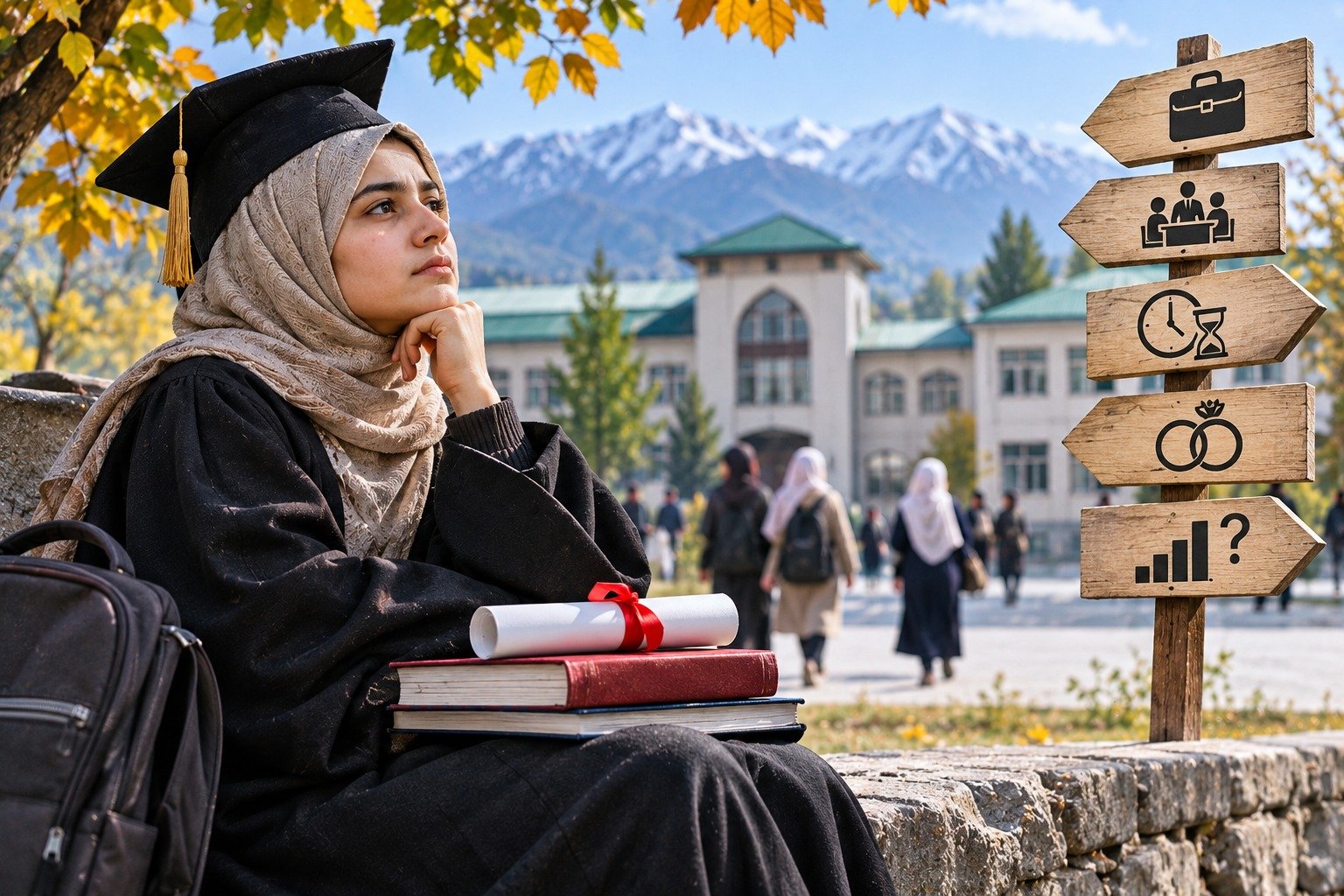
For many educated women across the Valley, however, that promise remains unfulfilled. While women’s education is widely celebrated and their achievements praised, the transition from classrooms to careers continues to be a difficult journey. Behind university degrees, postgraduate qualifications and professional certificates lie stories of unanswered applications, recruitment delays and competitive examinations that have become a prolonged test of patience.

For a graduate preparing for government recruitment, months can turn into years. Friends move ahead with their careers, while she continues checking employment portals, tracking recruitment notifications and preparing for another examination. Eventually, the uncertainty begins to extend beyond employment, bringing another pressure into her life: marriage.

For many, the struggle is not merely about finding a job. It is also about explaining to their families why years of education have not translated into financial independence, and why despite repeated attempts, employment remains elusive.

The private sector, which could offer an alternative to government employment, presents its own difficulties. Limited opportunities, modest salaries and concerns about workplace safety, transport and working conditions make it challenging for women to enter or sustain employment. Restrictions on relocating outside Kashmir, particularly in conservative households, further narrow the choices available to them.

The experience of educated women reflects a difficult contradiction. Educational attainment has expanded, but the opportunities to convert qualifications into meaningful employment have not kept pace for many graduates.

Years of preparation, followed by disappointment

For some women, the frustration of unemployment is compounded by the expectations surrounding their education.

“I completed my two professional degrees. Even after that, I tried my level best to crack competitive examinations, but unfortunately, Allah had other plans and I did not get through. Like other women, my parents also faced societal pressure and asked me to get married. I had no other choice left,” said Mrs Naveed.

She said that even after marriage, she continued trying to secure employment, but her efforts did not yield results.

Another postgraduate, Insha, expressed frustration over years of waiting despite acquiring higher qualifications.

“I completed my MA and MEd. What else should I need to get a job? Even after trying repeatedly for years, I am still jobless. When I look back at how dedicated and hardworking I was, I feel bad for the children who think that completing their degrees will automatically get them a job,” she said.

These accounts underline the emotional cost of prolonged unemployment. For women who have invested years in education and career preparation, the absence of opportunities can gradually erode confidence and leave them questioning the returns on their academic efforts.

A wider employment challenge

Data reported by several Kashmir-based news organisations on October 28, 2025, put the number of unemployed youth in Jammu and Kashmir at nearly 3.61 lakh. While the figure reflects a wider employment challenge, the experiences of educated women reveal how unemployment intersects with social expectations and gender-specific barriers.

In several households, a woman’s education is celebrated, but her decision to pursue a career can become a separate negotiation. Questions about working hours, commuting distances, workplace environments and family responsibilities often influence whether she is permitted or able to accept an employment opportunity.

Even women who manage to enter the workforce may find financial independence difficult to achieve. Insecure contracts, modest salaries and limited career progression can leave them struggling to establish a stable professional future.

Some are compelled to accept assignments far below their qualifications, while others turn towards home-based work or low-paying employment because they have few alternatives.

The problem cannot be attributed entirely to the absence of government vacancies. It also raises questions about the availability of private-sector employment, the relevance of educational courses to market requirements and the ability of institutions to connect graduates with actual employment opportunities.

Entrepreneurship: Opportunity or another struggle?

Government entrepreneurship and self-employment schemes are often presented as alternatives to conventional employment. While such initiatives can create opportunities, their effectiveness must be assessed through the experiences of women who seek to benefit from them.

Applicants frequently face procedural requirements, difficulties in accessing finance and challenges in establishing sustainable businesses. For some, the burden of bank instalments and financial losses can turn entrepreneurship into another source of uncertainty rather than economic empowerment.

Training programmes and financial assistance must therefore lead to sustainable income, market access and long-term business viability. Merely announcing schemes or recording registrations cannot establish whether women have achieved genuine financial independence.

Universities, meanwhile, have an important role in preparing students for the employment market. Career counselling, internships, industry linkages, skill-based learning and practical exposure can help graduates understand employment opportunities beyond conventional government recruitment.

Educational institutions must also encourage students to explore diverse career pathways while ensuring that their qualifications remain relevant to changing professional requirements.

Beyond degrees: The question of independence

In a society where patriarchal attitudes continue to influence women’s choices, education cannot be viewed merely through the number of degrees awarded or students enrolled in universities.

Its real value lies in whether it enables women to secure professional recognition, earn a sustainable income and make independent economic decisions.

Women’s participation in the workforce is not a favour extended by society. It is an essential component of economic development, household stability and social progress. When educated women remain unemployed, the loss extends beyond individual aspirations to the productive potential of the wider economy.

The experiences of women such as Naveed and Insha demonstrate that the journey towards employment can become a prolonged struggle, marked by repeated attempts, family expectations and diminishing opportunities.

The challenge, therefore, is not simply to encourage more women to pursue higher education. It is to ensure that education becomes a meaningful pathway to employment, professional dignity and economic independence.

The question is no longer how many women are entering universities, but how many are finding meaningful employment after leaving them.

Comments are closed.