New Delhi, Oct 08: India on Wednesday invoked the Pahalgam terror attack at the United Nations, saying the victims were not asked about their political orientation they were asked about their religion, as it accused Pakistan of shielding terror groups and running a campaign of misinformation and psychological warfare.
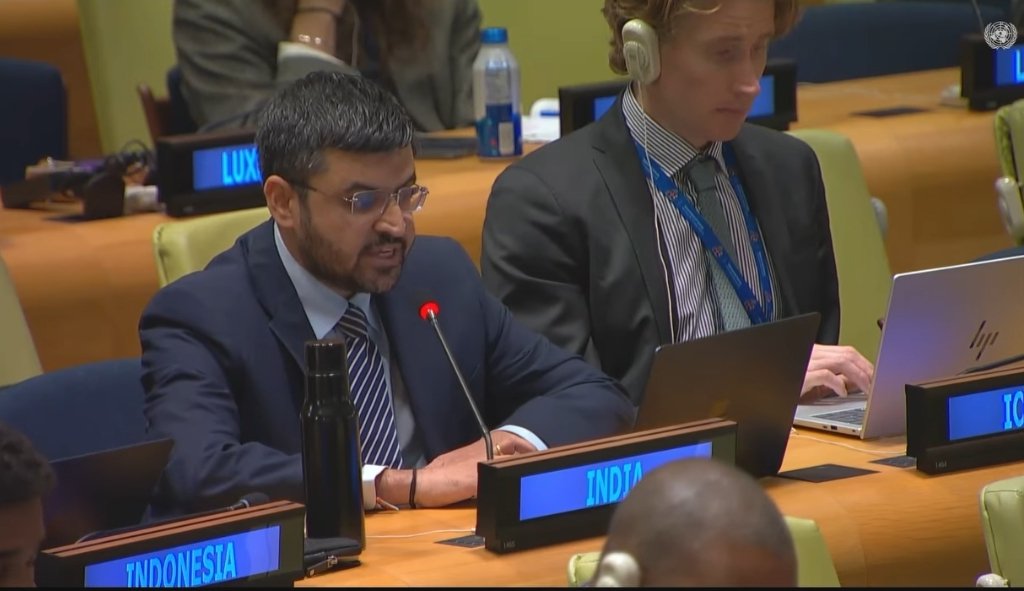
Speaking at the UN General Assembly’s Sixth Committee, India’s First Secretary Raghoo Puri as per Kashmir Convener said Pakistan has long portrayed itself as both a victim and a frontline state in the fight against terrorism while masking its own role in nurturing extremism.
Pakistan has presented itself as a frontline state in combating terrorism and as a victim, while masking the fact that the Frankenstein’s (monster) the Pakistani state has created and lost control over have moved from wreaking havoc in neighbouring countries to doing the same in Pakistan, Puri said.
He said the claim had been exposed recently by a provincial chief minister of Pakistan and referred to a 2018 interview by her father, a former prime minister, exposing this dark secret.
Puri hit out at Pakistan over its references to religious hatred and minority rights, pointing to the circumstances of the Pahalgam attack in Jammu and Kashmir.
The victims in Pahalgam were not asked about their political orientation they were asked about their religion, he said.
It is therefore deeply ironic that Pakistan speaks of combating religious hatred while allowing the conditions that enable it to persist and thrive, especially by fomenting cross-border terrorism, he added.
Puri was responding to remarks by Pakistan’s Deputy Permanent Representative Usman Jadoon. He rejected Pakistan’s claims about the outcome of Operation Sindoor, India’s military action following the Pahalgam terror attack.
“If bombed-out airfields and cratered runways look like victory to Pakistan, they are, of course, welcome to enjoy it,” he said.
After another intervention by the Pakistani delegation, Puri said Pakistan believes in the circular economy of words and narratives. If this much effort had actually been made in countering terrorism rather than narrative building, misinformation, and disinformation, the world would have been a better place.
But nothing more can be expected from a Form 47 government, he added, in a reference to Pakistan’s political system and electoral controversies.
Puri questioned Pakistan’s announcement of an enhanced reward for information leading to the arrest of Jaish-e-Mohammed chief Masood Azhar, who is listed as a terrorist by the UN.
Pakistan glosses over its state support for terrorism by announcing enhanced rewards for apprehending UN-listed head of Jaish-e-Mohammed, terrorist and mastermind of several attacks against my country, he said.
When the media can reach Masood Azhar and get confirmation from him about the success of Operation Sindoor, surely the Pakistani state knows his whereabouts, Puri added. Just a few months ago, Pakistani representatives used this forum to call the Jaish-e-Mohammed a defunct organisation. The world has seen the script play earlier, and we are clear-eyed that this time also it is going to be no different.
Puri warned that allowing terror groups to operate with political protection and giving perpetrators safe havens undermines international counter-terrorism efforts and the delivery of justice.
The world has not forgotten 9/11, and where its perpetrators, including Osama bin Laden, were caught,” he said, also invoking the 26/11 Mumbai attacks and the Pahalgam attack. The world has not forgotten 26/11, he said. The world has not forgotten Pahalgam.
Puri also flagged Pakistan’s alleged financial support for terrorism ahead of the Financial Action Task Force (FATF) plenary meeting in Paris from October 26 to 30.


Comments are closed.