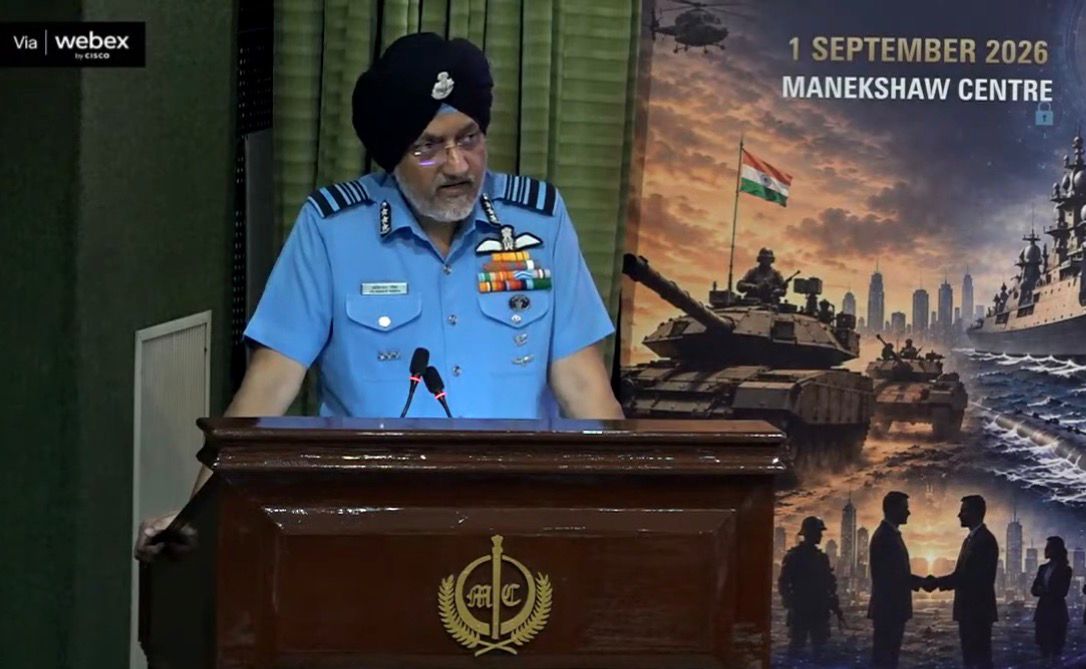
New Delhi, Sep 1: Chief of Integrated Defence Staff (CISC) Air Marshal Tejinder Singh on Tuesday asserted that there are no differences among the three services and urged the media and younger generation to shed perceptions of inter-service rivalry while discussing the armed forces.
Speaking at the second annual Trident Lecture organised by the Centre for Joint Warfare Studies (CENJOWS) in New Delhi, Air Marshal Singh said the Indian Armed Forces had won every conflict except 1962 and had done so together.
He said self-criticism was important, but the armed forces should be approached with confidence and faith based on their record of working together in times of conflict.
Drawing on his own experience, the CISC said that despite difficult situations, the three services had consistently come together to find solutions in the best interest of the nation. He urged the media and younger generation to keep this spirit of unity in mind while discussing the functioning of the armed forces.
Air Marshal Singh said the character of warfare was changing rapidly, with the traditional distinction between peace and war becoming increasingly blurred. He said economic security, technological competition, maritime resilience, critical infrastructure, supply-chain security and information integrity had become integral components of national security.
Referring to non-traditional challenges such as glacial lake outburst floods in Sikkim, he said such situations could demand a response on a war footing and highlighted the role of the armed forces in saving civilian lives during crises.
He noted that Headquarters Integrated Defence Staff will complete 25 years on October 1 and said India’s journey towards jointness had evolved through operational experience and strategic reforms, with the 1999 Kargil conflict serving as a defining moment.
The CISC credited General Bipin Rawat, India’s first Chief of Defence Staff, with turning jointness into a national strategic priority and said the process was subsequently carried forward by General Anil Chauhan and is now being taken forward under General Rajendra Subramani.
On future warfare, Air Marshal Singh said the battlespace had become increasingly complex and contested, with space, cyber, electronic warfare and cognitive domains becoming integral to military operations alongside land, air and maritime capabilities.
He said Headquarters IDS was formulating the Integrated Capability Development Plan to provide a long-term framework for capability development across domains, describing it as an important milestone in strengthening jointness. He also highlighted the growing role of artificial intelligence and quantum technologies in reducing decision-making cycles and shaping future military capabilities.
The Trident Lecture was organised by CENJOWS, a tri-services think tank functioning under the aegis of Headquarters IDS. Raksha Rajya Mantri Sanjay Seth also addressed the event and outlined seven key pillars of national security.


Comments are closed.