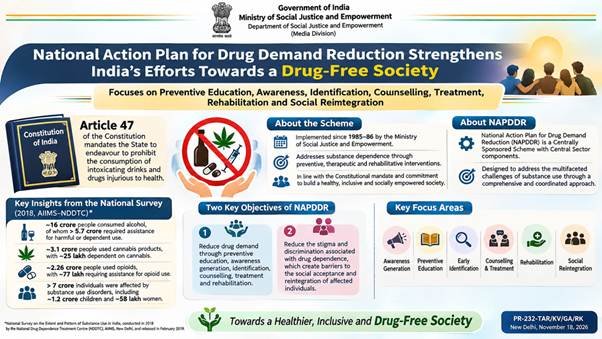
NEW DELHI, November 18: The Ministry of Social Justice and Empowerment is implementing the National Action Plan for Drug Demand Reduction (NAPDDR) to address substance abuse through preventive education, awareness generation, early identification, counselling, treatment, rehabilitation and social reintegration.
The Ministry has been implementing a scheme for the prevention of alcoholism and substance abuse since 1985-86, as part of its efforts to address substance dependence through preventive, therapeutic and rehabilitative interventions.
The initiative is aligned with Article 47 of the Constitution, which directs the State to endeavour to prohibit the consumption, except for medicinal purposes, of intoxicating drinks and drugs injurious to health.
A senior Ministry official said the scale of substance use in the country was highlighted by the National Survey on the Extent and Pattern of Substance Use in India, conducted in 2018 by the National Drug Dependence Treatment Centre (NDDTC), AIIMS, New Delhi, and released in February 2019.
According to the survey, approximately 16 crore people consumed alcohol in India, of whom more than 5.7 crore required assistance for harmful or dependent use. Around 3.1 crore people used cannabis products, while 2.26 crore used opioids.
The survey estimated that approximately 25 lakh people were dependent on cannabis, while nearly 77 lakh required assistance for opioid use.
It also found that more than seven crore people were affected by substance use disorders, including nearly 1.2 crore children and 58 lakh women, highlighting the need for sustained awareness, early intervention and accessible treatment and rehabilitation services.
The official said NAPDDR adopts a comprehensive and coordinated approach to address the challenges associated with substance use and has two key objectives: reducing drug demand through prevention, awareness, identification, counselling, treatment and rehabilitation; and reducing stigma and discrimination associated with drug dependence.
The Plan recognises that stigma often prevents individuals from seeking assistance and creates barriers to recovery and social reintegration.
Preventive education and awareness campaigns seek to inform individuals, families and communities about the harmful consequences of substance use. Early identification, timely counselling and access to treatment and rehabilitation facilities are also central to the programme.
The Ministry is also emphasising a compassionate and inclusive approach towards people affected by substance dependence, with efforts aimed at helping individuals recover, return to their families and communities, and participate meaningfully in society.
Through prevention, treatment, rehabilitation and social reintegration, NAPDDR seeks to strengthen the national response to substance abuse and contribute towards a healthier society. (PIB)


Comments are closed.