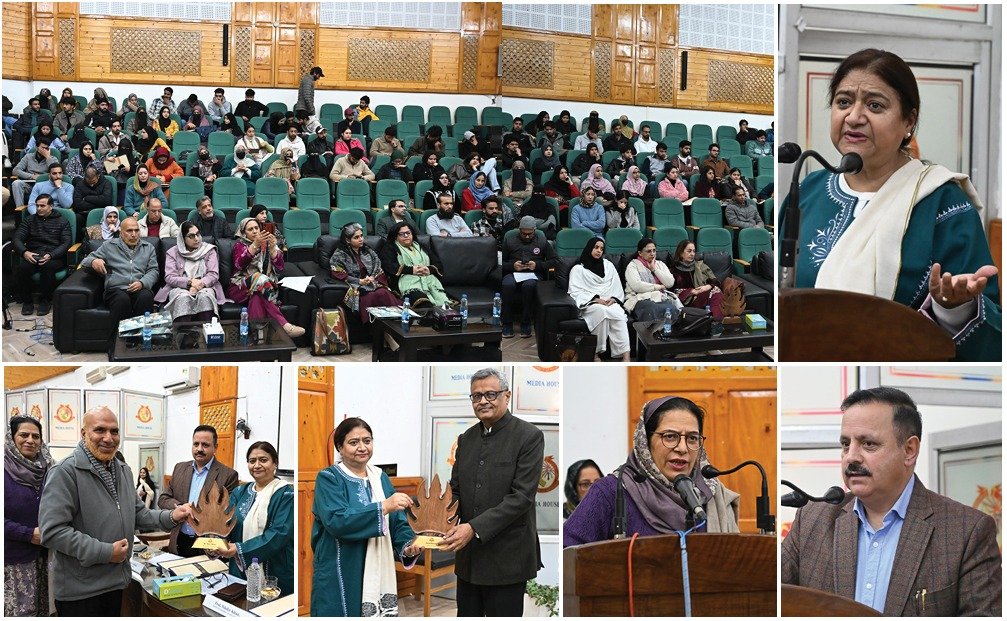
Srinagar, Nov 19: The two-day National Conference titled “Reimagining the Subaltern in the Age of AI: Media, Representation and Inclusive Communication” organised by the Media Education Research Centre (MERC), University of Kashmir, concluded on Thursday with discussions focusing on artificial intelligence, media representation, knowledge inclusion and the role of marginalised communities in shaping their own narratives.
Dr. Rashid Maqbool, Assistant Professor, MERC, conducted the proceedings of the valedictory session, introducing the speakers and inviting them to address the gathering.
The presentations traced the changing representation of women across traditional, modern and digital media, exploring concepts such as the male gaze, voyeuristic gaze and female gaze.
It examined the portrayal of Kashmiri women in traditional media, the themes of domesticity and objectification in modern media, and women’s representation on the big screen. The students also discussed how AI can reproduce existing stereotypes and biases.
In her concluding remarks, Prof. Aaliya Ahmed, Head, MERC, thanked the guests, participants, faculty members, scholars, and students. Reflecting on the conference deliberations, she emphasised the need to give historically marginalised communities greater agency in how they are represented and heard. She said, “The deliberations over these sessions have encouraged us to look beyond the technological possibilities of AI and reflect more deeply on the questions of knowledge inclusion and human agency.”
Journalist and author Amit Baruah appreciated the quality of the research paper presented at the conference and commended the participants for their research and engagement with the conference theme. Describing AI as an “intern” whose work must always be verified, he emphasised the importance of human judgement and critical evaluation while using the technology.
On day one, while addressing the audience, he spoke about growing internet penetration and the increasing dominance of AI-generated content on social media platforms.
He observed that news consumption has increasingly shifted from reading to watching, raising concerns about audiences relying on short-form videos and algorithm-driven content instead of engaging with in-depth information.
Emphasising the importance of human intervention in journalism, he said, “Gatekeeping is extremely important and can be done only by humans.” He also called for robust safeguards as AI presents challenges different from those posed by earlier technologies.
Guest of Honour, Prof. Manzoor Ahmad Malik, Director, Admissions, University of Kashmir, in his special remarks, drew parallels with earlier technological developments, including the Industrial Revolution. He stressed that scientific advancements require critical scrutiny, pointing to their potential to widen inequalities and cause widespread harm.
Addressing concerns surrounding AI, he said, “We have concerns with AI, and we need to address them, but we have to live with this technology and adapt, while also making sure it is used ethically.”
Special Guest, Prof. Sabeha Mufti, Dean, School of Social Sciences, University of Kashmir, spoke about the close relationship between media and society. She raised concerns about data sovereignty, digital divides and the possibility of AI reinforcing existing inequalities, while stressing that strong writing and clear communication remain essential despite changing media formats.
Special Guest, Prof. Majid Zaman, Controller of Examinations, University of Kashmir, highlighted the growing intersections between academic disciplines. Cautioning against excessive dependence on AI tools, he emphasised the importance of independent thinking, extensive reading, creative writing and experiential learning. He also called for stronger collaborations between academia and industry.
The session concluded with the presentation of certificates to participating scholars and participants. Prof. Malik Zahra Khalid proposed the vote of thanks, expressing gratitude to the guests, speakers, faculty members, organising team, staff and sponsors for their contributions to the successful conduct of the conference.
The two-day conference brought together academicians, researchers, students and media professionals to discuss AI, representation and social inclusion, highlighting the importance of human agency and marginalised voices in the evolving technological landscape.
The conference seeks to examine how artificial intelligence is reshaping media, communication and knowledge production, with particular attention to the representation of marginalised communities and the challenges of ensuring inclusive participation in a technology-driven society.
Earlier, on day one, in her inaugural address, KU Vice-Chancellor Prof. Nilofer Khan said technological progress should align with the values of social responsibility, equity, and inclusion, and its benefits must reach all sections of society.
“Technology should help bring more voices into the conversation and ensure that different experiences and perspectives are heard,” she said.
Registrar KU, Prof. Naseer Iqbal, said media institutions must move beyond their conventional role of disseminating information and actively engage with issues affecting different sections of society.
On the occasion, former MERC faculty member Nasir Mirza and Dr Muslim Jan, former Editor at MERC and Media Coordinator KU, were also felicitated in recognition of their contributions to the growth and development of the varsity’s media department.


Comments are closed.