
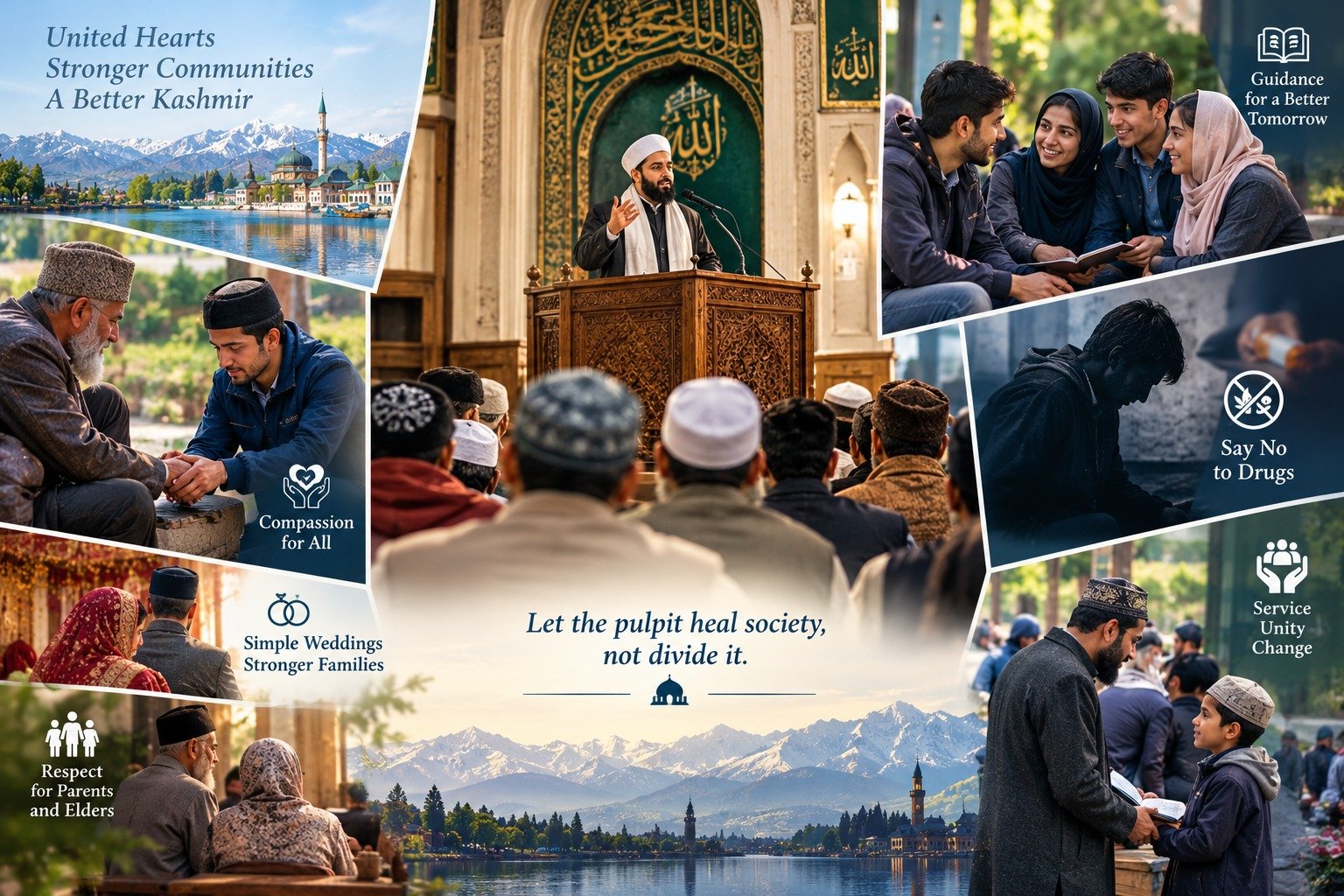
Let the Pulpit Heal Society, Not Divide It
Why Kashmir needs sermons that inspire social reform, compassion and collective responsibility


Dr Rizwan Rumi
Let the pulpit remind us that faith must be visible in our conduct, that religious knowledge carries a responsibility towards humanity, and that the strength of a community lies not in the intensity with which its members condemn one another, but in the sincerity with which they work to correct themselves and serve others.
A society is shaped not only by its institutions, laws and political leadership, but also by the ideas it embraces, the values it practises and the voices it chooses to listen to. In Kashmir, where religion remains an important part of everyday life, the pulpit occupies a particularly significant place in the social and moral landscape. Every Friday, thousands of people gather in mosques to listen to sermons, seeking spiritual guidance, moral clarity and direction for their lives. This gives religious scholars, particularly the Ulama and Imams, an opportunity to influence society in ways that extend far beyond the walls of a mosque.
The question worth asking is whether we are making the fullest use of this influence.
At a time when our society is confronting numerous challenges, from drug abuse among young people and growing family tensions to extravagant marriage customs, social intolerance, neglect of the elderly and the erosion of mutual respect, religious discourse can become an important instrument of constructive change. The pulpit can help awaken consciences, challenge harmful practices and encourage people to become more responsible towards their families, neighbours and communities.
This is not an argument against religious debate, nor is it an attempt to diminish the importance of theological differences. Differences in interpretation have existed throughout Islamic intellectual history. The concern arises when disagreements become a source of persistent hostility, when group identities take precedence over shared responsibilities, and when ordinary people are left with little guidance on the practical problems affecting their everyday lives.
Kashmir is already a society carrying the weight of numerous divisions and difficulties. What it needs is not another layer of bitterness, but more spaces for reflection, reconciliation and collective improvement. The pulpit can be one such space.
The Quranic call for unity and wisdom
Islam provides a clear foundation for this approach. In Surah Aal-e-Imran, verse 103, the Quran instructs believers to hold firmly together and not become divided. The verse recalls how God brought hearts together and transformed former hostility into brotherhood. Its message offers a profound reminder that unity and reconciliation are not peripheral concerns; they are central to the moral life of the community.
Similarly, Surah An-Nahl, verse 125, calls for inviting people to the way of the Lord with wisdom and good instruction. This principle has particular relevance to religious communication. A sermon is not merely an opportunity to speak; it is an opportunity to guide. The manner in which a message is delivered can determine whether it encourages reflection or provokes resentment, whether it brings people closer to moral understanding or pushes them further apart.
Religious scholarship carries responsibilities alongside its authority. Knowledge becomes socially meaningful when it helps people understand their obligations, correct their mistakes and treat others with justice. A sermon that encourages honesty in business, compassion towards the poor, respect for women, care for parents and reconciliation between estranged families can leave an impact that continues long after the congregation has dispersed.
The Prophet Muhammad (peace be upon him) described religion as sincere counsel. In Sahih Muslim, Hadith 55, this principle is expressed through the Arabic word nasihah, referring to sincerity and well-wishing towards God, His Book, His Messenger, Muslim leaders and the wider Muslim community. This understanding of religion points towards guidance that seeks the welfare of people rather than the humiliation of opponents.
The challenge, therefore, is to ensure that religious knowledge consistently finds expression in the everyday conduct of society.
When sermons meet the realities of everyday life
Consider the growing concern surrounding drug abuse. Families dealing with addiction often face fear, embarrassment and social stigma. A young person struggling with substance dependence may need medical treatment, counselling, family support and a path towards rehabilitation. Religious leaders can play an important role by discouraging substance abuse while also reminding communities that those struggling with addiction should not be abandoned or reduced to the worst chapter of their lives.
A sermon that encourages parents to communicate with their children, urges communities to support rehabilitation and reminds young people that their lives retain value even when they make mistakes could help create a more compassionate response to this challenge. Religious guidance cannot replace professional treatment, but it can help remove the stigma that often prevents people from seeking it.
Marriage customs offer another area where the influence of the pulpit could make a tangible difference. In many families, weddings have become associated with financial competition, elaborate arrangements and expectations that place considerable pressure on parents. Families may feel compelled to spend beyond their means simply to satisfy social expectations. The consequences can include debt, anxiety and, in some cases, the postponement of marriage itself.
Islamic teachings emphasise simplicity, responsibility and the avoidance of wastefulness. Religious scholars can use sermons to encourage dignified and affordable marriages, challenge the glorification of extravagance and discourage customs that turn a joyful occasion into a financial burden. Such guidance should not be limited to general statements about simplicity; it should also address the social pressure that prevents families from practising it.
The same is true of women’s rights. Islamic teachings establish rights relating to marriage, inheritance and dignity, yet social customs can sometimes obstruct the exercise of those rights. Surah An-Nisa, verse 7, explicitly recognises an obligatory share of inheritance for women. This provides a clear basis for reminding families that denying a daughter her rightful inheritance is not a harmless tradition but a violation of a right recognised by the Quran.
If sermons regularly addressed such matters, they could help families reconsider practices that have persisted for generations. A daughter should not have to surrender her rights merely to preserve family relations, nor should religious language be used to justify an injustice that religious teachings themselves prohibit.
Domestic discord, disrespect towards elderly parents, the humiliation of vulnerable people and the mistreatment of workers also deserve attention. These issues may not always generate public controversy, but they shape the moral health of a community every day. A society cannot claim to be guided by religious values while remaining indifferent to the suffering that takes place within its homes and neighbourhoods.
Beyond group identities and mutual accusations
Another concern is the manner in which religious disagreements are sometimes communicated in public. Debate, clarification and the study of differing interpretations have their place in a tradition as intellectually rich as Islam. Scholars must be free to explain their understanding of religious texts and engage in serious discussion. The objective should not be to silence disagreement or demand uniformity of thought.
However, there is a meaningful difference between explaining a position and turning disagreement into hostility. When religious gatherings become occasions for attacking personalities, questioning the sincerity of entire groups or reinforcing divisions among ordinary believers, the wider purpose of moral guidance risks being overshadowed.
The Quran’s call to unity should encourage scholars to reflect on the consequences of their words. The task is not necessarily to eliminate every disagreement, which may be neither possible nor desirable, but to ensure that disagreements are handled with knowledge, restraint and respect.
The Prophet Muhammad (peace be upon him) said, as recorded in Sahih al-Bukhari, Hadith 6018, that whoever believes in God and the Last Day should not harm their neighbour and should speak what is good or remain silent. This teaching offers a useful standard for public religious discourse. It reminds believers that speech carries moral consequences and that faith must influence how they treat others.
Religious authority is most constructive when it gives people reasons to become more honest, patient, compassionate and responsible. It loses some of its social value when the audience leaves a gathering more concerned with the shortcomings of another group than with correcting its own conduct.
The responsibility for improving public discourse does not rest with scholars alone. Listeners, community organisations and religious institutions must also encourage thoughtful engagement rather than reward provocative rhetoric. Respectful disagreement is possible, and a mature religious culture should be able to accommodate it without sacrificing the bonds that hold a community together.
The social questions that deserve a place on the pulpit
Imagine if, over the course of a year, Friday sermons consistently addressed the concerns that affect families and communities across Kashmir. One sermon might examine the responsibility of parents to protect children from harmful influences. Another could discuss the importance of education, the dignity of labour and the need to treat workers fairly. Others could address wastefulness, environmental responsibility, care for the elderly, the rights of orphans, the importance of keeping promises and the duty to help families facing hardship.
The Quran itself repeatedly draws attention to social responsibility. Surah Al-Ma’un, for instance, condemns the neglect of orphans and the failure to encourage feeding the poor. Its message reminds believers that religious observance cannot be separated from concern for the vulnerable.
This principle has particular relevance to a society in which families may struggle with financial hardship, illness, unemployment or the cost of education. Mosques can become centres of community solidarity, helping identify families in need, connecting them with legitimate assistance and encouraging charity to be offered with dignity rather than public humiliation.
Imams can also help foster a culture of educational responsibility. Parents should be encouraged to invest in their children’s learning, support girls’ education and create homes where curiosity and knowledge are valued. Young people should be reminded that education, professional integrity and service to society are compatible with religious commitment.
Environmental responsibility deserves similar attention. Kashmir’s rivers, lakes, forests and other natural resources are not merely scenic assets; they sustain lives and livelihoods. Sermons could encourage people to avoid littering, conserve water, protect public spaces and recognise that environmental neglect affects future generations. The language of stewardship and accountability can help connect religious values with the practical task of protecting the places we inhabit.
These are not departures from religious concerns. They are opportunities to translate moral principles into everyday action.
From weekly sermons to sustained social reform
For this vision to become meaningful, it must go beyond occasional appeals. Mosques and religious institutions could encourage a more deliberate approach to community guidance, with sermons addressing different social concerns throughout the year. Local scholars could consult educators, doctors, counsellors and social workers to better understand issues such as addiction, mental health, family conflict and educational neglect.
Such cooperation would not diminish the role of religious scholarship. It would help ensure that spiritual guidance is informed by an understanding of the challenges people face and that communities are directed towards appropriate professional support when necessary.
Religious institutions could also encourage voluntary initiatives such as assistance for financially vulnerable students, support for families dealing with addiction, mediation in family disputes where appropriate, and discreet help for elderly people living without adequate care. These efforts should respect privacy, avoid public shaming and operate within the limits of the institutions’ expertise.
There is also room for greater coordination among scholars from different backgrounds on shared social concerns. They may not agree on every theological question, but they can still work together to discourage drug abuse, support education, promote affordable marriages, protect vulnerable people and encourage peaceful coexistence. Cooperation on these matters does not require anyone to abandon sincerely held beliefs. It requires recognising that many social responsibilities are shared.
The objective should not be to turn every sermon into a discussion of social problems or to reduce the spiritual purpose of Friday prayers to a programme of community development. Worship, theology and spiritual reflection remain essential. The point is to recognise that spiritual guidance and social responsibility need not compete with each other. They can strengthen one another.
A call for reflection, not confrontation
It would be unfair to suggest that the Ulama have remained absent from social reform. Many religious scholars have contributed to education, charitable work, family guidance and community welfare, often without seeking recognition. Their work deserves acknowledgement. The appeal here is to build upon such contributions and give greater collective attention to the social potential of religious guidance.
The influence of a sermon should not be measured only by the size of the congregation or the intensity of its response. It should also be reflected in what happens afterwards. Does a person return home more respectful towards their spouse? Does a family reconsider an unjust practice? Does a businessman become more honest in his dealings? Does a community become more willing to help a struggling young person? Does a congregation become more compassionate towards people with whom its members disagree?
These may be difficult outcomes to measure, but they offer a meaningful way to think about the social value of religious discourse.
Kashmir needs religious voices that remind people of their duties alongside their rights, their responsibilities alongside their disagreements, and their common humanity alongside their differences. It needs sermons that address not only what believers should avoid, but also what they should actively do to improve the lives of others.
The pulpit has the potential to become a source of healing in a society that has too often experienced division. Its words can encourage families to choose simplicity over display, compassion over stigma, justice over inherited prejudice and dialogue over hostility. Such an approach would not weaken religion’s place in society; it would demonstrate how deeply its ethical teachings can shape public life.
Ultimately, the question is not whether religious scholars should speak about social reform. It is how their considerable moral influence can be used more consistently to advance it.
Let the pulpit remind us that faith must be visible in our conduct, that religious knowledge carries a responsibility towards humanity, and that the strength of a community lies not in the intensity with which its members condemn one another, but in the sincerity with which they work to correct themselves and serve others.
Let our pulpits become places from which society learns not merely how to disagree, but how to live together; not merely how to identify the faults of others, but how to confront its own; and not merely how to speak about faith, but how to translate its teachings into justice, compassion and meaningful social change.
Let our pulpits become places from which society learns not merely how to disagree, but how to live together; not merely how to identify the faults of others, but how to confront its own; and not merely how to speak about faith, but how to translate its teachings into justice, compassion and meaningful social change.
Comments are closed.