Srinagar, Sep 17: Kashmiri apples and other perishable goods could get faster rail movement with the Vande Bharat goods train, which is currently undergoing trials and is expected to become operational within two months, a top official of the Integral Coach Factory (ICF), Chennai, said.
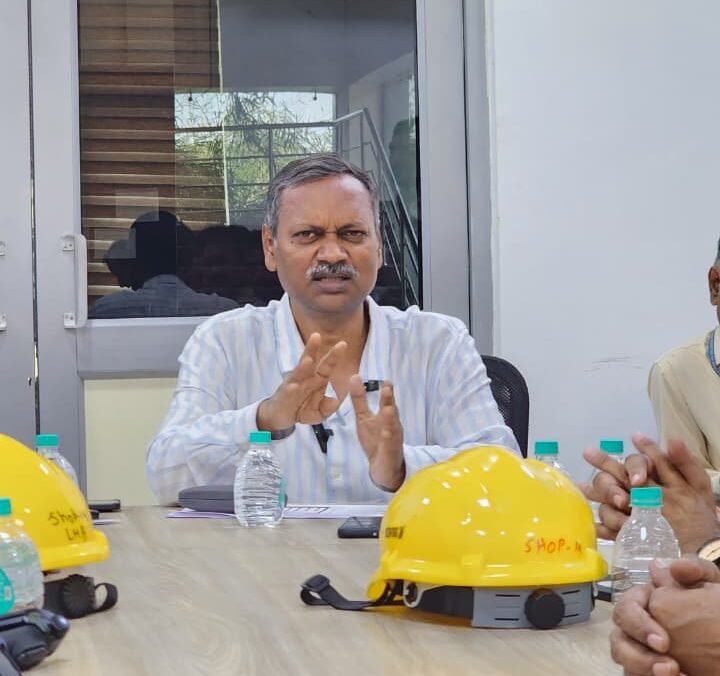
In an interaction with Kashmir Convener during a media tour organised by the Press Information Bureau, Srinagar, Anupam Chouhan, Chief Workshop Engineer at ICF Chennai, said the Vande Bharat goods rake would operate at speeds of 130-140 kmph, significantly higher than conventional goods trains, which have an average speed of 30-35 kmph.
“The goods train does not have a high average speed. It runs at 30-35 kmph. The Vande Bharat goods train will run at 140-130 kmph… It has high-speed parcel items, perishable items, lightweight items. But it needs to reach fast from one city to another,” Chouhan said.
He said the Railway Board had ordered two Vande Bharat goods rakes on a trial basis for high-speed parcel and perishable goods movement, catering to logistics demand from commercial entities such as Flipkart and Amazon.
“We have sent one rake. It is being trialed now. As soon as the trial is completed… within two months, I think it should be operational,” he said.
On the production of passenger trains, Chouhan said ICF would begin production of sleeper variants of Vande Bharat trains by the end of this year.
“We are going to make a sleeper. At the end of this year, we are going to start the production of a sleeper,” he said, explaining that cell manufacture is completed at the facility before the coaches move to furnishing after painting and ventilation.
The official said the government had placed an order for 200 Vande Bharat trains to be built across three facilities — ICF, Titagad and Latur.
“Rajdhani is being planned to be replaced by Vande Bharat sleepers. All the Shatabdis are also to be replaced by Vande Bharat chair cars,” he said.
This year, ICF will produce four chair cars and four sleepers, while 17 sleeper rakes are targeted for 2027. Amrit Bharat version 3, with AC coaches, is also in the pipeline, with 16 rakes to be released this year.
“The government is saying to stop the normal LHB at the end of next year and make Vande Bharat and Amrit Bharat, so that we can reach the phase gradually,” he said.
Responding to a question on whether Vande Bharat rakes would be customised for Kashmir’s harsh winters, Chouhan said no specific direction had been received so far.
“For J&K, a train is already running, and DEMU is also running. For that, a specific requirement is that heating elements should not be freezed. We were told about a defogger and water lines, lavatory lines — we have heating in water lines,” he said.
“According to the allocation, if we want J&K area, then these features should be there. We haven’t got that clarification yet. ICF has not yet got the direction as to how many trains apart from Vande Bharat…”
On the satellite-based Kavach system, he said work was underway on a shield system that is a Systematic Train Protection System (ATP).
“The shield will be on the track and on the train. It is a satellite-based system. Any obstructions — the satellite tracks and gives a signal to the cab. The driver will do the braking, the aspect of the signal will change. Otherwise, the shield system itself will apply the automatic brake, even if the driver fails,” he said.
Highlighting the difference between Vande Bharat and Rajdhani, Chouhan said Vande Bharat uses 50 percent powering, with every alternate coach having a traction motor drawing power from overhead equipment, enabling faster acceleration and more effective braking.
“In Rajdhani, a locomotive is used for hauling. In Vande Bharat, every alternate coach is having a traction motor which powers the wheel and the coach,” he said.
On interiors, he said the design includes first AC coupes with two-berth and four-berth compartments, second AC with four-berth coupes, and chair cars in executive (2×2) and (3×2) configurations, with laptop charging and upgraded furnishing.
Chouhan said ICF had received an order to design coaches capable of 250 kmph for the Ahmedabad-Mumbai high-speed rail corridor, with some coaches to come from Japan.
“BEML has also been asked to make. BEML has started. Maybe within one year, they will make. We are working on the design. We think we will start production next year. The first two rakes will be made by mid-June,” he said, adding that prototype rakes undergo inspection by the Commissioner of Railway Safety before induction.
Asked whether ICF had received orders for bullet-proof or IED-proof coaches amid security concerns in Kashmir and Manipur, Chouhan said, “We have not received an order for a train. We have not received an order for a coach. It is not in our purview.”
With approximately 8,700 employees at ICF, Chouhan said the Railway Ministry allocates a separate training fund in the budget, while the HR department ensures workers are updated with modern techniques.
“We send them for training. There is a separate training fund. Our HR department is there. Yes, we provide relevant training,” he said.
Asked about his vision for Vande Bharat’s footprint on Indian Railways, Chouhan said, “In our country, there are different travel requirements. So, it is not only for Vande Bharat. Have you seen Amrit Bharat? So, Amrit Bharat has AC, non-AC…”


Comments are closed.