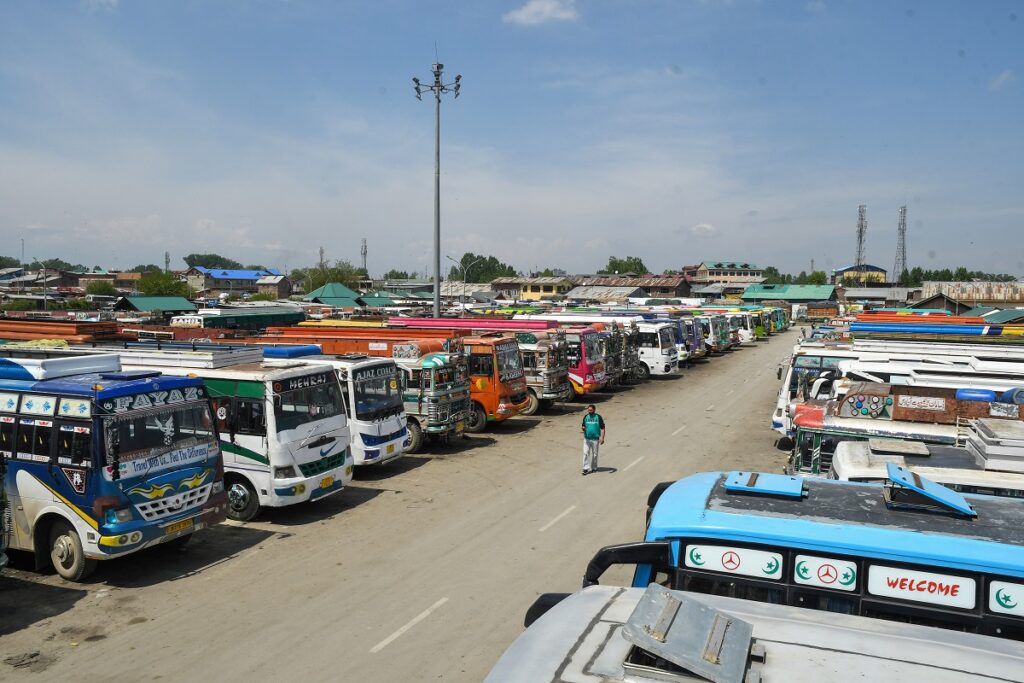
Srinagar, April 20: Normal life was thrown out of gear across large swathes of Kashmir on Monday as a Valley-wide ‘chakka jam’ called by private transporters against the government’s proposed expansion of Smart City bus services to district routes left thousands of commuters, including students and job aspirants, stranded for hours.
From the northern town of Kupwara to the southern districts of Pulwama and Anantnag, roads that usually remain chock-a-block with traffic wore a deserted look.
In Srinagar, the city’s commercial hub Lal Chowk saw minimal vehicular movement, while key thoroughfares such as the Maulana Azad Road, Residency Road, and the airport link road reported thin traffic as private buses, mini-buses, and inter-district cabs stayed off the tarmac. Auto-rickshaws and government-run buses, however, plied as usual, officials said.
The protest, called by the All Jammu and Kashmir Transporters’ Welfare Association on Monday, was triggered by the government’s plan to introduce 200 additional Smart City buses on inter-district routes — a move that operators say will cannibalise their existing business.
“Our bread and butter is at stake,” said Ghulam Hasaan Dar, a transporter who has been plying a bus between Srinagar and Sopore for two decades. “If the government runs its own buses on our routes, how will we feed our children? We are not against development, but this expansion will push thousands of us out of business overnight.”
Another protester, Habibullah, who operates a Tata Magic cab on the Srinagar-Baramulla route, added: “The government says it wants to give cheap transport to people. But what about us? We have loans on these vehicles. This is a matter of survival, not just profit.”
The strike caused widespread misery, especially for daily-wage workers and students. At the Pantha Chowk intersection, a key transit point on the outskirts of Srinagar, dozens of commuters were seen waiting anxiously for any mode of transport.
“I work in a private hotel in Srinagar and need to go home to my family in Kangan. There is no bus, no cab. I have been waiting for over two hours. Nobody cares about small people like us,” said Riyaz Malik, a commuter.
Students were among the worst hit. Several candidates who were scheduled to appear for examinations at the cluster University could not reach the campus in time. Following the disruption, university authorities announced that a special examination would be conducted for affected students.
“I had prepared for months for this exam. I left home at 7 am but could not find any transport from Baramulla. Now they say there will be a special exam, but my whole schedule is disturbed,” said Zainab, a postgraduate student.
Transporters’ leader Shabir Ahmad Matta, president of the association, squarely blamed the government for the public inconvenience, alleging that repeated pleas for dialogue had been ignored.
“This ‘chakka jam’ is against the expansion of bus services under the Smart City project to other districts. Recently, the transport minister said 200 more buses will be brought. We are against that, and we condemn it,” Matta told Kashmir Convener.
“We had told the government not to go ahead with the move. We also told the officials to address our concerns — about route rationalisation, fare structures, and livelihood protection — but they did not. Their inaction has led to this public inconvenience,” he added.
Matta warned that the proposed expansion into areas such as Pulwama, Kangan, and Sopore has triggered existential fears among private operators. “We are not opposing the Smart City project in the city. Let them run as many buses inside Srinagar. But don’t enter district routes. That is our only source of income.”
Protesting operators said the extension of government-backed bus services to district routes could threaten the income of thousands of families dependent on private transport.
They demanded that the government roll back the decision, citing uncertainty and potential loss of business for private operators.
Officials, however, maintained that the expansion is aimed at providing affordable and reliable public transport to peri-urban and rural populations. “The Smart City bus service has been a success in Srinagar. The idea is to decongest roads and reduce pollution by offering a viable alternative to private vehicles,” a transport department official said, speaking on condition of anonymity.
Efforts to reach Transport Minister for a comment remained unsuccessful till the time of filing this report.


Comments are closed.