New Delhi, July 24: India on Friday successfully hosted the 3rd BRICS Ministerial Meeting on Disaster Risk Reduction (DRR) under its BRICS Chairship 2026, with member countries unanimously adopting a Joint Statement to accelerate implementation of the BRICS Disaster Risk Reduction Work Plan (2025–2028) and deepen cooperation for building disaster-resilient societies.
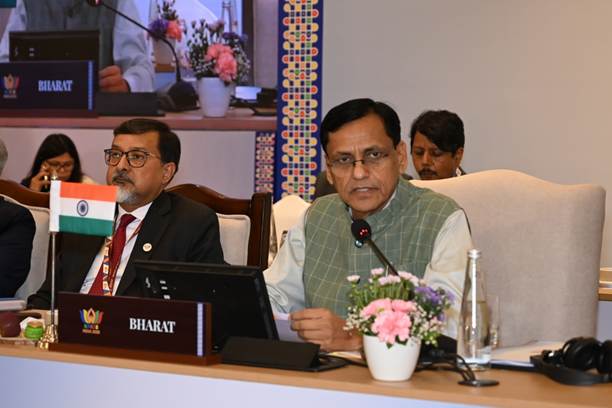
The meeting, organised by the National Disaster Management Authority (NDMA) under the Ministry of Home Affairs, was chaired by Minister of State for Home Affairs Shri Nityanand Rai and attended by ministers and heads of delegation from BRICS member countries.
Addressing the meeting, Rai said the evolution of BRICS cooperation—from the Udaipur Declaration (2016) to the Kazan Declaration (2024) and the establishment of the BRICS Disaster Risk Reduction Group (DRRG)—demonstrates the growing recognition of disaster risk reduction as a key pillar of sustainable development, climate resilience and human security.
He said India’s BRICS Chairship theme, “Building for Resilience, Innovation, Cooperation and Sustainability,” reflects a practical and action-oriented approach to strengthening international collaboration. The Minister also appreciated Brazil for elevating the BRICS Disaster Risk Reduction Group to the ministerial level.
Highlighting India’s leadership in disaster management, Rai said the country’s people-centric disaster risk reduction strategy is guided by Prime Minister Narendra Modi’s Ten-Point Agenda for Disaster Risk Reduction. He outlined five strategic priorities under India’s Chairship aimed at advancing the BRICS DRR Work Plan through enhanced cooperation in science and technology, early warning systems, resilient infrastructure, nature-based solutions and community resilience.
The meeting featured a high-level policy dialogue on “Advancing Climate-Smart and Disaster-Resilient Infrastructure Systems: Partnerships, Innovation and Financing for Resilient Development,” where participants discussed innovative financing, resilient infrastructure, emerging technologies and global partnerships to address growing climate and disaster risks.
A ministerial roundtable on accelerating implementation of the BRICS DRR Work Plan (2025–2028) enabled member countries to exchange experiences and identify practical measures for strengthening institutional cooperation, capacity building and knowledge sharing.
As part of India’s Chairship, six flagship knowledge products were launched to support evidence-based policymaking, institutional strengthening and practical implementation of disaster risk reduction initiatives across BRICS countries.
The ministers also agreed to strengthen practical cooperation through regular technical exchanges, joint projects, simulation exercises, expert exchanges and annual thematic workstreams to promote innovation and measurable outcomes in disaster resilience.
The successful conclusion of the meeting reinforced BRICS’ collective commitment to advancing resilient, inclusive and sustainable development through enhanced international cooperation in disaster risk reduction. (PIB)


Comments are closed.