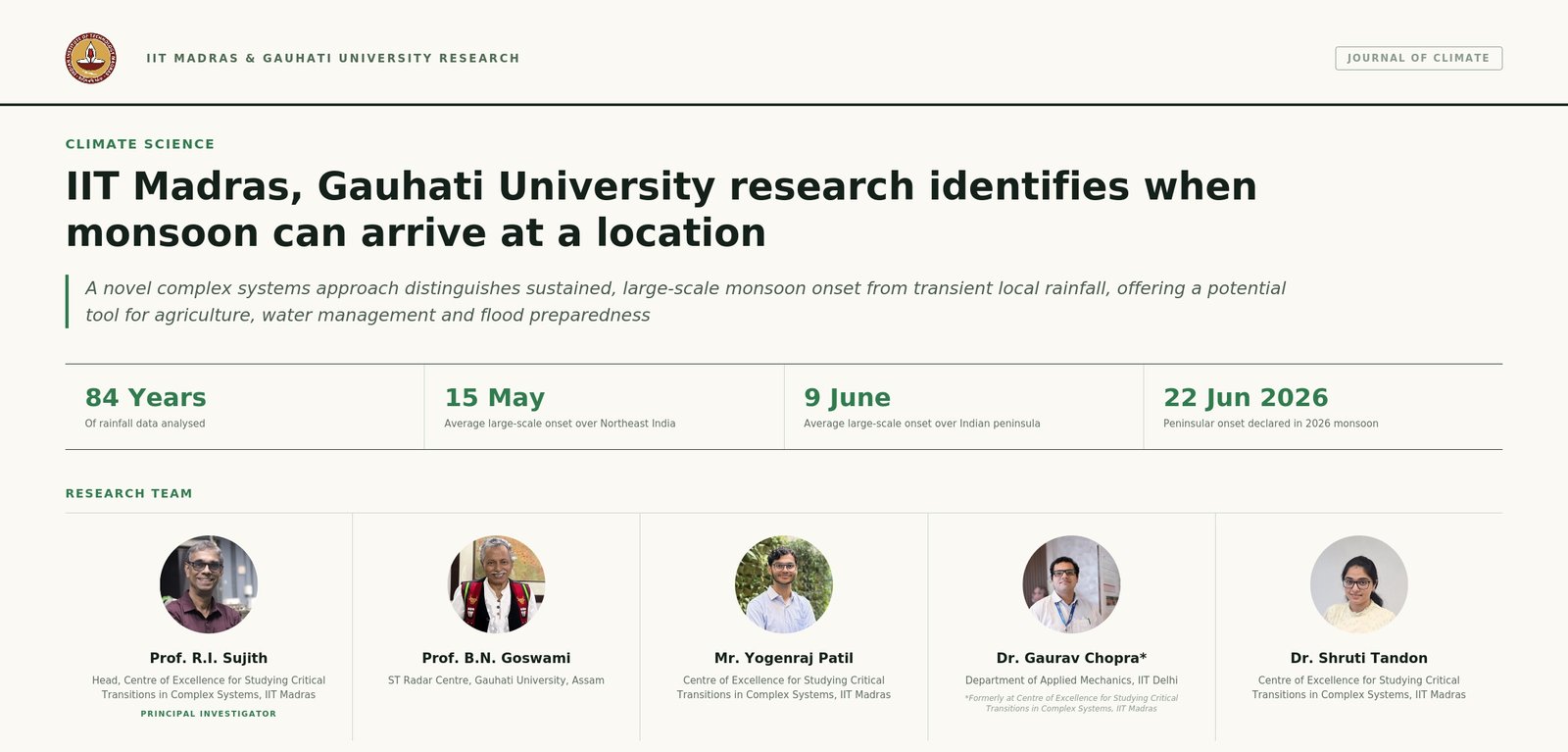
CHENNAI, November 10: Researchers from the Indian Institute of Technology Madras (IIT Madras) and Gauhati University have developed a new method to identify when the monsoon arrives at a particular location by distinguishing sustained, large-scale rainfall patterns from temporary local showers.
In a statement issued to Kashmir Convener on Tuesday, an official spokesperson said the study introduces a climate-network approach that tracks how clusters of local rainfall onsets across India develop and connect to form a larger monsoon system. Researchers say the method could complement existing monsoon forecasting practices and help improve decisions related to agriculture, water-resource management and flood preparedness.
The findings have been published in the Journal of Climate, a peer-reviewed journal of the American Meteorological Society.
The paper was co-authored by Yogenraj Patil, Gaurav Chopra, Shruti Tandon and Professor R. I. Sujith of IIT Madras’s Centre of Excellence for Studying Critical Transitions in Complex Systems, along with Professor B. N. Goswami of Gauhati University.
The researchers treated geographical locations as nodes in a climate network, with links representing spatial connections between areas experiencing local rainfall onset. By tracking the formation and expansion of these clusters, they identified when local rainfall became part of the larger monsoon system.
Professor R. I. Sujith, Head of the Centre of Excellence at IIT Madras, said the first rainfall at a location does not necessarily mark the arrival of the monsoon. Instead, the study identifies large-scale onset when local rainfall becomes part of the largest interconnected cluster of rainfall onsets, indicating its association with the broader monsoon system.
He said the approach could help avoid false indications of monsoon arrival and give farmers more reliable information for sowing decisions, while supporting policymakers in planning for food security and water-resource management.
The researchers said the distinction was important because local rainfall, particularly during pre-monsoon thunderstorms, can occur well before the sustained monsoon system reaches an area.
Professor B. N. Goswami of Gauhati University said the method was intended to complement, rather than replace, conventional operational definitions of monsoon onset. Its key feature, he said, was linking rainfall observations at individual locations with the larger-scale organisation of the monsoon.
Using 84 years of rainfall data, the researchers found that the climatological large-scale onset occurs around May 15 over Northeast India and June 9 over the Indian peninsula.
The onset is marked by a sudden increase in the size of the largest cluster of interconnected rainfall events, followed by its continued spatial expansion and northward progression across the country.
The study also found that the large-scale onset over the Indian peninsula is followed by northward rainfall progression associated with the first pulse of the monsoon intraseasonal oscillation (MISO), providing an additional indication of the establishment of the broader monsoon system.
Applying the method to the 2026 monsoon, the researchers identified June 22 as the date of large-scale onset over the Indian peninsula. The subsequent northward progression of rainfall was reflected in heavy rainfall episodes reported in Mumbai by June 24 and Delhi by July 1.
The researchers said the approach brings together network science, complex systems and meteorology to address the challenge of identifying a large-scale weather system at specific locations.
By connecting local rainfall patterns with the collective development of the monsoon, the method could provide additional information for decisions in agriculture, water management and flood preparedness.


Comments are closed.