


Mohammad Muslim
“Unlike ornate monuments, Hazratbal draws its power from meaning rather than decoration. Its simplicity reflects the depth of devotion it inspires among the people.”
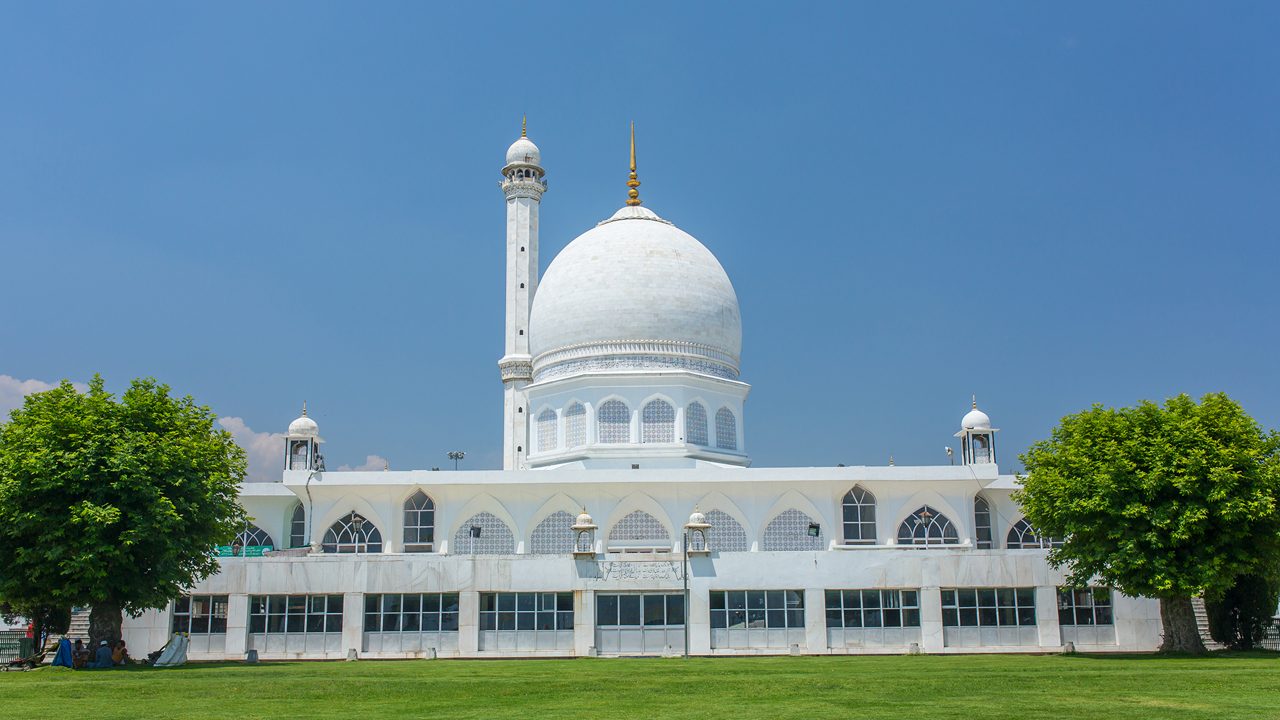
Srinagar has an extensive legacy rooted in religion, culture, and history. One such important religious site is the Hazratbal Shrine, situated on the serene northern side of Dal Lake. Constructed using pure white marble, the shrine stands out due to its elegance and importance. Unlike other shrines, it does not have any elaborate designs or decorations to attract visitors. Instead, its appeal lies in its content and significance to the local residents. In their eyes, the Hazratbal Shrine is a symbol of their religious identity, linking their beliefs with their daily lives. With its open courtyard and the reflection of its dome on the lake, the shrine functions as a living entity. Year-round, it operates not as a relic of the past but as a place of continuing devotion.
The significance of the Hazratbal Shrine is attributed to the sacred object of faith contained therein and popularly referred to as the Moi-e-Muqqadas, a hair strand of the Prophet Muhammad. This artifact provides the central religious significance of the shrine in the region. The history of the sacred object can be traced to the Mughal era when it was taken to Kashmir by a noble family, before being placed under public custody. It created a major religious hub out of the shrine. There are particular times when the sacred object is displayed at which time devotees flock the place in large numbers. They patiently await their turn to view the sacred object, driven by faith than any other thing.
Hazratbal Shrine’s architectural design is characterized by simplicity and elegance. White marble has been used in the construction of the shrine, lending the building an elegant look, which stands out amid the rest of the buildings in the vicinity. The dome located centrally in the building is the dominant feature, which makes it possible for all eyes to be drawn towards it. In contrast to most old Mughal buildings, there is no unnecessary decoration in the shrine. There is ample space to accommodate crowds and prevent chaos. The interior part of the shrine is not too complicated, helping to keep the focus on the religious importance of the place. There are spacious passages and courtyards, which help facilitate movement on peak days.
The Hazratbal Shrine serves as an important venue on account of the occurrence of significant Islamic festivities in Kashmir. For instance, festivals like Eid-e-Milad-un-Nabi are characterized by many devotees coming from various areas in Kashmir. The shrines act as the centres for celebrations and reflections. Devotees engage in praying, preaching, and readings in an orderly fashion. There is proper management of the crowds to ensure order. In spite of the number of devotees visiting the place, there is respect shown in their behaviour. The level of order shows how much respect is accorded to the venue. The venue acts as the centre for strengthening communal ties. Members of the family and even generations get to participate in the event as well.
However, the shrine has also seen incidents that played a key role in shaping the modern history of the region. One of such incidents took place in 1963, when the sacred relic was reported to have been stolen. The incident soon caused an uproar all around. There was no doubt that the level of public agitation would be high since this event was perceived as very important in the lives of the people. The recovery of the relic would bring comfort to many. It proves that the importance of the shrine in contemporary Kashmir cannot be underestimated. This is because it has both religious and sentimental value.
There are various aspects of the location that make the Hazratbal Shrine more prominent. The shrine is located near the Dal Lake which creates a favourable environment for it. First of all, the reflecting surface of the water adds a sense of harmony to the view. Also, there are the Zabarwan mountains that create a perfect background for the shrine and make its setting complete. Moreover, since the water surface of the lake and the Zabarwan mountains exist at the same time, people feel that they are part of the shrine’s identity. Indeed, visitors of the shrine usually stay at the Dal Lake after praying, and therefore, become witnesses of shikara boats passing by.
The Hazratbal Shrine is economically important for the region owing to its continuous influx of visitors. People from diverse regions make visits to the shrine at Srinagar. This increase demands for modes of transport, food service provision, and other businesses in the vicinity. This ensures that local businessmen, traders, and tour guides benefit from the influx of tourists in the region. Year-round economic activity ensures that the region is never out of business. However, the continuous flow of people presents certain difficulties in terms of management. Continuous efforts must be made to ensure that the environment is kept clean, and the crowds are managed efficiently.
Hazratbal Shrine is a living testament of heritage that is still operating in the present day. It is not stuck in time. It changes while retaining its essential function. The holy relic still takes centre stage. The building acts as a meeting place. The community preserves contact. This is what makes it strong. For the tourists, their experience is tangible. They step into a space inspired by faith. They see an orderly arrangement without coercion. They sense a history heavy with meaning without having to be told. For scholars studying it, the shrine is a means to understand the relationship between faith and physical space, and how it affects identity and economy, as well as the collective psyche of people in Srinagar.
Comments are closed.