

Guardians of the Seas: How Indigenous Warships Are Redefining India’s Maritime Power

S Ahmad


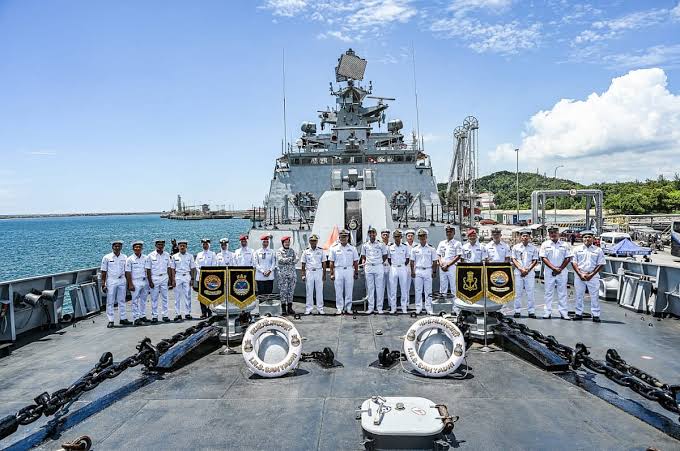
Project 17A is the Indian Navy’s advanced stealth frigate programme to build seven next-generation guided-missile warships. These frigates are designed for multi-mission operations, including anti-air, anti-surface, and anti-submarine warfare. Project 17A reflects India’s growing strength in self-reliant warship design and construction.

India’s rise as a global power is often discussed through the lens of its economic growth, technological innovation, or geopolitical influence. Yet one of the country’s most consequential transformations is unfolding far from public view—across the vast waters of the Indian Ocean. As global commerce increasingly depends on secure sea lanes and maritime rivalries intensify across the Indo-Pacific, India’s naval modernisation has become a strategic imperative rather than a matter of prestige.

The recent commissioning of four indigenously designed warships within a month—INS Dunagiri, INS Sanshodhak, INS Agray and INS Mahendragiri—is more than a routine expansion of the Indian Navy. It represents the emergence of a new maritime doctrine built on self-reliance, technological sophistication and layered security. These vessels belong to three distinct yet complementary classes—the Nilgiri-class stealth frigates, the Sandhayak-class survey vessels and the Arnala-class anti-submarine warfare shallow water craft—each designed to perform specialised roles while collectively strengthening India’s maritime architecture.

At a time when the Indian Ocean has become one of the world’s most strategically contested regions, these indigenous platforms signal India’s transition from a nation that once depended heavily on imported warships to one capable of designing and building complex naval assets at home. More importantly, they illustrate how maritime security is increasingly intertwined with economic resilience, technological capability and diplomatic influence.

India’s geography itself explains why naval strength has become indispensable. The country possesses a coastline stretching over 11,000 kilometres and an Exclusive Economic Zone covering nearly 2.4 million square kilometres. Nearly 90 per cent of India’s trade by volume and a significant portion of its energy imports move through the sea. Every container ship carrying manufactured goods, every tanker transporting crude oil and every merchant vessel linking India with global markets depends upon secure maritime routes.

These waters are also witnessing unprecedented geopolitical competition. The Indo-Pacific has emerged as the centre of global strategic attention, with competing naval deployments, expanding maritime infrastructure and growing concerns over freedom of navigation. Piracy, illegal fishing, maritime terrorism, cyber threats to shipping infrastructure and underwater surveillance have added newer dimensions to traditional naval challenges.

Protecting such vast maritime interests requires far more than large warships patrolling distant waters. Modern naval security demands a layered force where every platform performs a specialised function while contributing to an integrated maritime strategy. This philosophy is reflected in the induction of the Nilgiri, Sandhayak and Arnala classes.

The Nilgiri-class stealth frigates represent the offensive edge of India’s naval capability. Developed under Project 17A, these guided-missile frigates are among the most technologically advanced warships ever built in India. Measuring nearly 149 metres in length and displacing around 6,670 tonnes, they combine speed, firepower and stealth in a single platform.

Unlike conventional warships, stealth frigates are designed to minimise detection. Their angular superstructures deflect radar waves instead of reflecting them. Special materials reduce radar signatures, while engineering innovations minimise infrared emissions and underwater noise generated by propulsion systems. The objective is not invisibility but ambiguity—making the vessel appear much smaller, harder to detect and more difficult to target.

Stealth has become one of the defining characteristics of twenty-first century naval warfare. In an era where satellites, drones and sophisticated surveillance systems constantly monitor the oceans, reducing a ship’s electronic footprint can significantly enhance its survivability. Modern conflicts increasingly reward those who detect the adversary first while remaining undetected themselves.

Project 17A builds upon decades of indigenous naval design experience. Earlier, India relied substantially on imported warships, particularly from the Soviet Union and Russia. The Talwar-class frigates reflected this dependence. The introduction of the Shivalik-class under Project 17 marked India’s first indigenous stealth frigate programme. The Nilgiri-class represents the next stage in this evolutionary journey, integrating improved sensors, advanced combat management systems, BrahMos supersonic cruise missiles, medium-range air defence systems, sophisticated sonar arrays and multi-role helicopters.

The significance of these ships extends beyond combat capability. They embody India’s growing confidence in designing frontline warships through the Navy’s Warship Design Bureau while leveraging the expertise of domestic shipyards such as Mazagon Dock Shipbuilders Limited and Garden Reach Shipbuilders and Engineers Limited. Indigenous content exceeding seventy-five per cent demonstrates how India’s defence manufacturing ecosystem has matured over the past decade.

If stealth frigates represent the sword of maritime power, survey vessels constitute its eyes and memory.

Maritime dominance begins not with weapons but with knowledge. Every naval operation, submarine deployment, amphibious mission or commercial voyage depends upon accurate understanding of the ocean floor. Hydrography—the science of measuring and mapping seas—forms one of the least visible yet most essential aspects of naval preparedness.

The Sandhayak-class survey vessels significantly strengthen India’s hydrographic capabilities. Equipped with advanced multibeam echo sounders, side-scan sonar systems and autonomous underwater vehicles, these ships map seabeds with extraordinary precision. Their surveys produce nautical charts that enable safe navigation not only for Indian naval units but also for merchant shipping traversing busy maritime corridors.

This capability assumes increasing importance as India seeks to expand port infrastructure, develop offshore energy resources and promote the Blue Economy. Accurate seabed mapping facilitates construction of ports, underwater communication cables, offshore wind farms and oil exploration projects. It also supports disaster preparedness by improving understanding of coastal geography and underwater hazards.

Hydrographic diplomacy has emerged as another important dimension of India’s maritime engagement. Indian survey teams have mapped thousands of square kilometres of waters belonging to friendly nations across the Indian Ocean. These efforts strengthen regional partnerships while enhancing navigational safety for all maritime users. Such cooperation reinforces India’s image as a responsible maritime power committed to collective security rather than unilateral dominance.

The Sandhayak-class also demonstrates remarkable operational flexibility. Besides hydrographic missions, these vessels can support helicopter operations, serve as hospital ships during emergencies and participate in humanitarian assistance and disaster relief operations. Their value becomes particularly evident following cyclones, tsunamis or maritime accidents when rapid hydrographic assessment becomes essential for relief operations.

Closer to India’s coastline, another challenge demands specialised solutions.

Submarines have become one of the most potent instruments of naval warfare. Modern submarines can operate silently for extended periods, threatening merchant shipping, naval installations and strategic assets. Detecting them in shallow coastal waters presents unique operational difficulties. Larger destroyers and frigates often face manoeuvrability constraints in confined littoral environments, necessitating dedicated anti-submarine platforms.

The Arnala-class Anti-Submarine Warfare Shallow Water Craft addresses precisely this requirement. Designed specifically for operations in shallow waters, these agile vessels employ waterjet propulsion instead of conventional propellers, enabling exceptional manoeuvrability. Equipped with advanced sonar systems, lightweight torpedoes and anti-submarine rockets, they form the first line of defence against underwater threats approaching India’s coastline.

Their induction replaces ageing anti-submarine corvettes while substantially strengthening coastal security. As larger naval combatants focus on blue-water operations, Arnala-class vessels ensure effective surveillance and protection of littoral regions, harbours and critical coastal infrastructure. Their role becomes increasingly important as underwater technologies evolve and submarine deployments become more frequent across the Indo-Pacific.

These vessels also reflect an important shift in naval planning. Modern maritime security recognises that threats can emerge anywhere—from distant oceanic waters to shallow coastal approaches. Layered capability therefore becomes essential, ensuring that every operational environment receives appropriate attention through specialised platforms.

Perhaps the most remarkable aspect of these three warship classes is not merely their technological sophistication but their indigenous origin.

For decades, India’s defence preparedness remained constrained by dependence on foreign suppliers. Critical technologies, complex platforms and major combat systems often required imports, limiting strategic autonomy while increasing long-term costs. The transformation underway today reflects a deliberate effort to reverse that dependence through sustained investments in indigenous research, design and manufacturing.

The Navy’s Warship Design Bureau has emerged as a symbol of this transformation. From conceptual design to detailed engineering, Indian naval architects now develop sophisticated warships capable of meeting international standards. Domestic shipyards have similarly evolved from assembling imported designs to constructing technologically complex platforms with increasing indigenous content.

The economic implications are equally significant. Building warships domestically creates employment across an extensive industrial ecosystem. Project 17A alone engaged hundreds of micro, small and medium enterprises supplying specialised components ranging from electronic systems and steel structures to cables, sensors and precision equipment. Thousands of direct and indirect jobs have been generated while strengthening India’s manufacturing capabilities.

This industrial ecosystem extends well beyond defence. Technologies developed for naval applications frequently find civilian uses in shipbuilding, engineering, metallurgy, automation and advanced manufacturing. Investments in indigenous defence production therefore contribute to broader industrial modernisation and technological self-sufficiency.

India’s growing defence exports further illustrate this changing landscape. Defence exports have reached record levels, with Indian shipyards now executing orders for foreign governments. The transition from importer to exporter enhances strategic credibility while opening new economic opportunities. Warship exports also deepen diplomatic partnerships, particularly with countries seeking affordable and reliable maritime capabilities.

Maritime security today extends beyond military preparedness into economic development.

The concept of the Blue Economy recognises oceans as engines of sustainable growth. Fisheries, offshore energy, maritime transport, coastal tourism, seabed resources and marine biotechnology collectively contribute significantly to national economies. Protecting these assets requires secure waters, reliable navigation and resilient maritime infrastructure.

Survey vessels enable safe shipping channels. Stealth frigates protect sea lanes from external threats. Anti-submarine craft safeguard coastal waters and ports. Together they create conditions necessary for economic activity across maritime domains.

India’s strategic doctrines reflect this integrated vision. The SAGAR initiative—Security and Growth for All in the Region—emphasised regional maritime cooperation across the Indian Ocean. Its evolution into MAHASAGAR expands this approach, recognising that maritime security and economic prosperity increasingly depend upon collaborative engagement with partners across the Global South.

Naval platforms therefore serve not only as instruments of defence but also as tools of diplomacy. Indian warships routinely participate in humanitarian missions, disaster relief, evacuation operations, joint exercises and goodwill visits. Survey assistance, maritime training and capacity building further strengthen relationships with friendly countries. Such engagements reinforce India’s role as a preferred security partner while promoting stability across one of the world’s most dynamic maritime regions.

The commissioning of INS Dunagiri, INS Sanshodhak, INS Agray and INS Mahendragiri should therefore be viewed not as isolated naval events but as milestones in India’s broader strategic journey. They represent confidence in indigenous innovation, investment in national capability and commitment to safeguarding maritime interests through self-reliant strength.

History reminds us that great trading civilizations have invariably depended upon strong maritime foundations. India’s ancient ports connected Asia, Africa and Europe centuries before modern globalization. Today, as supply chains, energy security and digital connectivity increasingly converge across the oceans, maritime capability once again occupies the centre of national strategy.

The guardians of India’s maritime frontiers are no longer merely symbols of naval power. They are embodiments of technological progress, industrial confidence, economic resilience and strategic foresight. Built in Indian shipyards by Indian engineers using increasingly indigenous technologies, they reflect a nation that is steadily redefining its place in the global maritime order.

As the Indian Ocean assumes greater geopolitical significance, these vessels will patrol shipping lanes, map unexplored waters, deter underwater threats, deliver humanitarian assistance and strengthen regional partnerships. Their presence will be measured not only in tonnes of displacement or missile ranges but also in the confidence they inspire—in sailors defending the nation’s interests, industries advancing self-reliance and partners looking to India for stability.

The oceans have always shaped India’s destiny. By investing in indigenous maritime capability today, India is ensuring that it remains prepared not only to protect its shores but also to navigate the opportunities and uncertainties of an increasingly interconnected maritime century.


The article is based on the inputs and background information provided by the Press Information Bureau (PIB). Author is Writer, Policy Commentator. He can be mailed at kcprmijk@gmail.com

Comments are closed.