

S Ahmad
Many of India’s 10.4 crore Scheduled Tribes derive 20–40% of their annual income from Minor Forest Produce (MFP). Historically, tribals sold this produce to middlemen at distress prices, earning below the cost of their own labour. To address this, the government runs the Pradhan Mantri Janjatiya Vikas Mission (PMJVM). The mission organises tribals into community-owned Van Dhan Vikas Kendras (VDVKs), moving them from raw produce sellers to value-adding entrepreneurs. So far, 4,172 VDVKs have been sanctioned, linking 12.48 lakh tribal members to the scheme. The government also buys MFP at a pre-determined Minimum Support Price (MSP). PMJVM provides enterprise funding and helps tribals access markets through fairs, e-commerce platforms, and exhibitions.
For millions of tribal families living in and around India’s forests, the forest is not simply a landscape to be protected or a source of ecological wealth to be conserved. It is a workplace, a marketplace, a food reserve and, often, the foundation of household income.
Honey, mahua flowers, tamarind, tendu leaves, bamboo, lac, medicinal plants, herbs and dozens of other minor forest produce have sustained forest-dwelling communities for generations. These products may appear small and dispersed when viewed individually, but collectively they form an important part of India’s rural and tribal economy.
For many tribal households, Minor Forest Produce (MFP) contributes between 20 and 40 per cent of annual income. Yet the people who collect these products have historically captured only a small portion of the value eventually generated by them. The familiar problem has been one of unequal bargaining power: gatherers collect, sort and carry the produce, but intermediaries often determine the price.
The result is a paradox. A product gathered from the forest through considerable physical labour can travel through several layers of the market and acquire significant commercial value, while the person who harvested it remains the weakest participant in the value chain.
Changing this equation is at the heart of the Pradhan Mantri Janjatiya Vikas Mission (PMJVM).
The significance of the mission lies not simply in providing support to tribal communities, but in attempting to change their economic role—from raw-produce gatherers into owners and participants in community enterprises. It seeks to bring together procurement, processing, skills, technology, finance and marketing so that a greater share of the value generated by forest produce remains with the communities that depend on it.
This is an important shift in the way tribal development can be approached.
For decades, welfare policy in remote tribal regions has often been understood primarily through the language of assistance: subsidies, infrastructure, basic services and social protection. All remain essential. But sustainable economic empowerment requires something more. It requires communities to acquire productive assets, bargaining power, market knowledge and ownership.
The PMJVM’s Van Dhan Vikas Kendra model attempts to provide precisely that bridge.
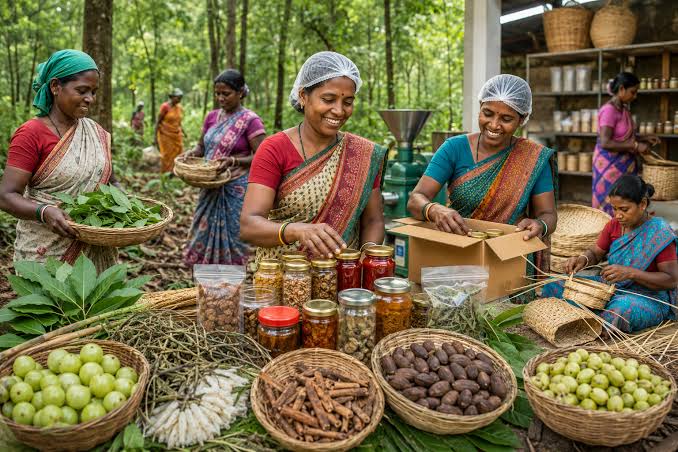
The underlying idea is relatively simple. Instead of an individual forest gatherer selling raw produce to an intermediary at whatever price is offered, tribal communities can organise themselves into groups, process the produce, improve its quality, package it and take it to larger markets.
That transformation—from gathering to value addition—can make an enormous difference.
Consider honey. Selling raw honey provides one level of income. Cleaning, grading, processing, branding and packaging it for an urban consumer creates another. The same principle applies to tamarind, turmeric, ginger, bamboo products, medicinal herbs, fruit-based products and other forest-linked commodities.
The real economic opportunity, therefore, is not simply in collecting more forest produce. It is in capturing more of the value created after collection.
PMJVM, launched in 2021-22, is designed around this principle. It builds on the Van Dhan Yojana launched in 2018 and organises tribal gatherers into community institutions known as Van Dhan Vikas Kendras. Under the model, self-help groups are clustered together, generally bringing together about 300 tribal members in a Kendra, with at least 60 per cent of members required to belong to Scheduled Tribe communities.
As of July 31, 2026, 4,172 VDVKs had been sanctioned, of which 2,911 were functional, linking 12.48 lakh tribal members to the initiative. Reported sales through these Kendras stood at around Rs 168 crore.
These figures are significant because they indicate that the model is moving beyond a purely conceptual framework. But the larger question is how far this network can evolve into sustainable community-owned businesses.
That will depend on what happens after the initial mobilisation.
The first critical component is procurement. A farmer or forest gatherer who has no certainty about the price of his or her produce is vulnerable to distress sales. The Minimum Support Price mechanism for Minor Forest Produce seeks to address this vulnerability by creating a price floor.
The government has notified MSP for 87 MFP items under PMJVM. TRIFED, through state implementing agencies, undertakes procurement at the predetermined price irrespective of fluctuations in market prices. Since 2013-14, state governments have procured 2,67,954 metric tonnes of MFP worth Rs 693.98 crore under the scheme.
The importance of MSP in this context is somewhat different from the way it is usually discussed in the agricultural debate. For forest gatherers, the issue is not simply production. Their livelihood depends on access to a naturally occurring resource, seasonal collection and the ability to sell that resource in a market where they may possess little information or negotiating strength.
An assured procurement mechanism can therefore prevent the most vulnerable producer from being forced into a sale at an unfair price.
But MSP alone cannot transform the tribal forest economy.
If communities continue selling raw produce, much of the potential value will still be captured elsewhere. That is why processing and enterprise development are the second essential pillar.
VDVKs provide primary processing equipment such as cutting and sieving tools, decorticators, dryers and packaging equipment depending on the locally available produce. Training is provided in scientific harvesting, sustainable collection and value addition. Working capital can be facilitated through financial institutions, banks and the National Scheduled Tribes Finance and Development Corporation.
Storage and transportation support further help address practical problems that frequently undermine rural enterprises.
This matters because the economics of forest produce are heavily influenced by timing and quality. A product that is properly dried, stored and packaged can command a substantially better price than one sold immediately in an unprocessed form. But an individual gatherer may not possess the equipment or storage capacity required to wait for a better market.
A community enterprise can.
This is where the VDVK model has the potential to become more than another government scheme. If managed effectively, the Kendras can become local economic institutions—places where collection, processing, training, storage and marketing are connected.
The market side is equally important.
Producing a better product does not guarantee that consumers will buy it. Tribal enterprises need access to buyers, market intelligence, branding and distribution channels. The traditional haat remains important in this ecosystem. There are more than 5,000 haats in tribal areas, many of which are being modernised with permanent structures, storage facilities, drinking water, shade and weighing equipment.
But the market cannot stop at the local haat.
A tribal enterprise producing high-quality honey or a distinctive food product should have the possibility of reaching consumers in Delhi, Mumbai, Bengaluru or even overseas markets. This is why e-commerce and digital platforms can be transformative when combined with adequate training and logistics.
TRIFED’s role in providing market intelligence, including information on daily rates and e-commerce opportunities, can help communities make better commercial decisions. Branding, exhibitions, festivals, artisan melas and geographical indications can similarly help distinguish tribal products in increasingly crowded markets.
The potential is considerable because tribal products possess something that modern consumers increasingly value: provenance.
A product that is natural, locally sourced and connected to a particular community or landscape can command a premium when its quality, authenticity and story are properly communicated.
India should therefore look at tribal forest produce not merely as a welfare category but as part of the country’s emerging natural and cultural economy.
The global market is increasingly interested in products that are sustainable, traceable and rooted in local communities. India’s tribal regions possess an enormous reservoir of such products. The challenge is to convert that inherent advantage into commercial value without destroying the ecological and cultural foundations on which it rests.
That last point is critical.
A successful tribal forest economy cannot mean extracting forests more aggressively in pursuit of higher income. The long-term prosperity of forest communities depends on the health of the forests themselves. If overharvesting, unsustainable collection or commercial pressure damages the resource base, the economic model will eventually undermine itself.
Sustainability therefore cannot be an additional component of tribal enterprise. It must be built into the business model.
Training in scientific harvesting practices, resource management and regeneration needs to accompany value addition. Communities that own the economic enterprise should also have a strong stake in preserving the forest resources on which the enterprise depends.
This creates a potentially powerful convergence between livelihood security and conservation.
The Forest Rights Act of 2006 recognised the rights of tribal and other traditional forest-dwelling communities to collect and sell non-timber forest produce. The legal recognition of these livelihood rights is important because forest conservation and community welfare should not be treated as opposing objectives.
Indeed, communities with secure economic interests in sustainable forest management can become important partners in conservation.
The Provisions of the Panchayats (Extension to the Scheduled Areas) Act, or PESA, also recognises ownership rights of tribal Gram Panchayats over minor forest produce in Scheduled Areas. The broader policy challenge is to ensure that these rights translate into genuine economic agency on the ground.
Legal rights on paper are necessary. Institutional capacity determines whether those rights become meaningful.
This is why the community ownership element of VDVKs deserves particular attention.
A central danger in development programmes is that beneficiaries can become passive recipients rather than economic decision-makers. The strongest version of the VDVK model would avoid that outcome by ensuring that tribal members have genuine ownership, transparent accounts, a voice in business decisions and a fair share of profits.
The ultimate measure of empowerment should not simply be the number of people enrolled in a scheme. It should be the number of people who gain durable economic control over an enterprise.
This is particularly relevant for tribal women.
In many forest economies, women perform a large share of collection, processing and marketing work. Yet unpaid or informal labour does not always translate into ownership or independent income. A community enterprise that formally recognises women’s economic contribution can change that equation.
The Nyigamane, Ho Yorbe, Medumhagdum VDVK in Arunachal Pradesh’s Leparada district provides an illustrative example. Established in October 2021 with 300 women self-help group members and farmers, the Kendra processes locally available forest and agricultural produce into marketable products.
King chilli and bamboo shoot pickles, turmeric and ginger powders, pineapple jam and pineapple and orange squashes are examples of products developed through the enterprise. The VDVK has recorded sales of Rs 11 lakh since 2022-23.
The financial figure is important, but the more significant transformation may be institutional. The women are not merely workers producing goods for someone else’s brand. They jointly own the enterprise and have a stake in the brand itself.
That distinction matters.
Economic empowerment is strongest when women participate in decisions about production, pricing, investment and profits. It is not enough to create employment if ownership remains elsewhere.
The Arunachal example also demonstrates another advantage of the model: it can reduce dependence on seasonal agriculture by creating opportunities to process and sell products throughout the year.
This is precisely where India’s tribal development strategy can become more ambitious.
The country should not think of tribal communities only in terms of what they lack. It should also recognise what they possess: knowledge of local ecosystems, traditional processing techniques, distinctive crops, unique forest products and cultural traditions that can have genuine economic value.
The challenge is to combine this traditional knowledge with modern technology, packaging, quality control, branding, finance and market access.
That combination can create a distinctly Indian model of rural enterprise—one that is neither purely subsistence-based nor detached from local communities.
But scaling this model will require realism.
Not every VDVK will immediately become a profitable enterprise. Some products will have limited markets. Some communities will face logistical constraints. Quality standards can be difficult to maintain. Access to working capital may remain uneven. Digital commerce requires reliable connectivity, packaging and delivery systems. And community institutions need managerial capabilities that cannot be created through one-time training.
The policy response should therefore focus increasingly on enterprise sustainability rather than simply numerical expansion.
The next generation of VDVKs should be evaluated on indicators such as annual turnover, profitability, member income, repeat buyers, market diversification, women’s ownership, value addition and sustainable harvesting practices.
Clusters of successful enterprises could mentor newer VDVKs. Strong brands could be developed around specific regions and products. Common processing facilities could reduce costs. Partnerships with food companies, retailers, hotels and e-commerce platforms could create predictable demand.
Financial institutions also have a role. Working capital remains one of the biggest constraints for small enterprises. Credit products designed around the seasonal nature of MFP collection and processing could help community businesses move beyond grant dependence.
States, too, need to become active partners. Forest, tribal welfare, rural development, agriculture, horticulture, industries and tourism departments often operate through separate institutional structures. A forest product enterprise, however, does not fit neatly into one department.
The future of the tribal forest economy requires convergence.
A honey producer may need forest rights, processing equipment, food certification, packaging, transport, finance and an online marketplace. A bamboo enterprise may require design expertise, machinery, skilled workers and access to construction or handicraft markets. A medicinal herb enterprise may need scientific validation, quality testing and regulatory compliance.
The ecosystem has to be designed around the enterprise rather than around the boundaries of government departments.
There is also a larger national economic argument.
India’s growth cannot be inclusive if large parts of its tribal population remain confined to low-value segments of the economy. Bringing tribal communities into formal value chains can increase household incomes, generate local employment and reduce the need for distress migration.
It can also strengthen rural economies by ensuring that more value is retained where the resource is collected.
This is the real promise of value addition.
If raw tamarind leaves a village for a modest price but a processed, packaged and branded tamarind product returns to the market at several times that value, the question is who captures the difference. The objective of a community-owned enterprise should be to ensure that a larger share of that value remains with the people and institutions at the source.
The same principle applies across India’s tribal belt.
The country has an opportunity to build a forest economy that is simultaneously commercial, community-owned and environmentally responsible.
Such an economy would also fit naturally into India’s broader development ambitions. The idea of a Viksit Bharat cannot be reduced to urban infrastructure, industrial corridors or technological progress. Development becomes meaningful when economic opportunity reaches communities living in remote forests and difficult geographies.
For tribal India, prosperity should not require abandoning the forest economy. It should mean making that economy more productive, fair and sustainable.
That requires moving beyond the old model in which a forest gatherer is simply a supplier of cheap raw material.
The gatherer can be an entrepreneur.
The self-help group can become a company-like community enterprise.
The local haat can become the first node in a national supply chain.
A traditional product can become a recognised brand.
And the forest itself can remain a living economic asset rather than being reduced to a source of extraction.
PMJVM provides the institutional framework for this transformation. Its future success, however, will depend on how deeply the framework is embedded in local communities and markets.
India now needs to build on the early momentum. More VDVKs should become functional, existing ones should become commercially sustainable, women’s ownership should deepen, and successful products should find national and international markets. Most importantly, tribal communities should remain at the centre of decision-making.
The goal should never be to turn every forest product into a mass commodity. Some products and traditions derive their value precisely from their uniqueness and local identity. The objective should instead be to create fair markets in which communities can decide what to produce, how much to harvest, how to process it and where to sell it.
That is what makes the tribal forest economy different from conventional extraction.
Its greatest asset is not simply the forest product. It is the relationship between the community, the forest and the knowledge accumulated over generations.
If policy can strengthen that relationship while adding technology, finance and market access, India can create a development model in which conservation and prosperity reinforce one another.
The journey from forest produce to forest prosperity will not be completed by a single scheme, a single institution or a single market intervention. It will require sustained investment, local capacity, transparent community ownership and patient institution-building.
But the direction is clear.
For too long, the people who gathered India’s forest wealth were often the least rewarded in its commercial journey. The next chapter should reverse that imbalance.
The forest can continue to provide livelihood without being depleted. Tribal communities can become producers rather than price-takers, entrepreneurs rather than intermediaries’ suppliers, and owners rather than mere participants in the value chain.
That is the deeper promise of the Pradhan Mantri Janjatiya Vikas Mission.
India’s tribal economy does not need to be brought into development by leaving its forests behind. It can move forward by turning the knowledge, resources and enterprise already present in those forests into a source of dignity, ownership and sustainable prosperity.
Comments are closed.