
From Connectivity to Empowerment: How Digital Infrastructure is Changing Kashmir

Shakeela Rahman


“Connection, in other words, is not the same as access. The network may reach a village, but that does not mean it has reached everyone inside it—especially the woman who sits behind the boundary wall.”

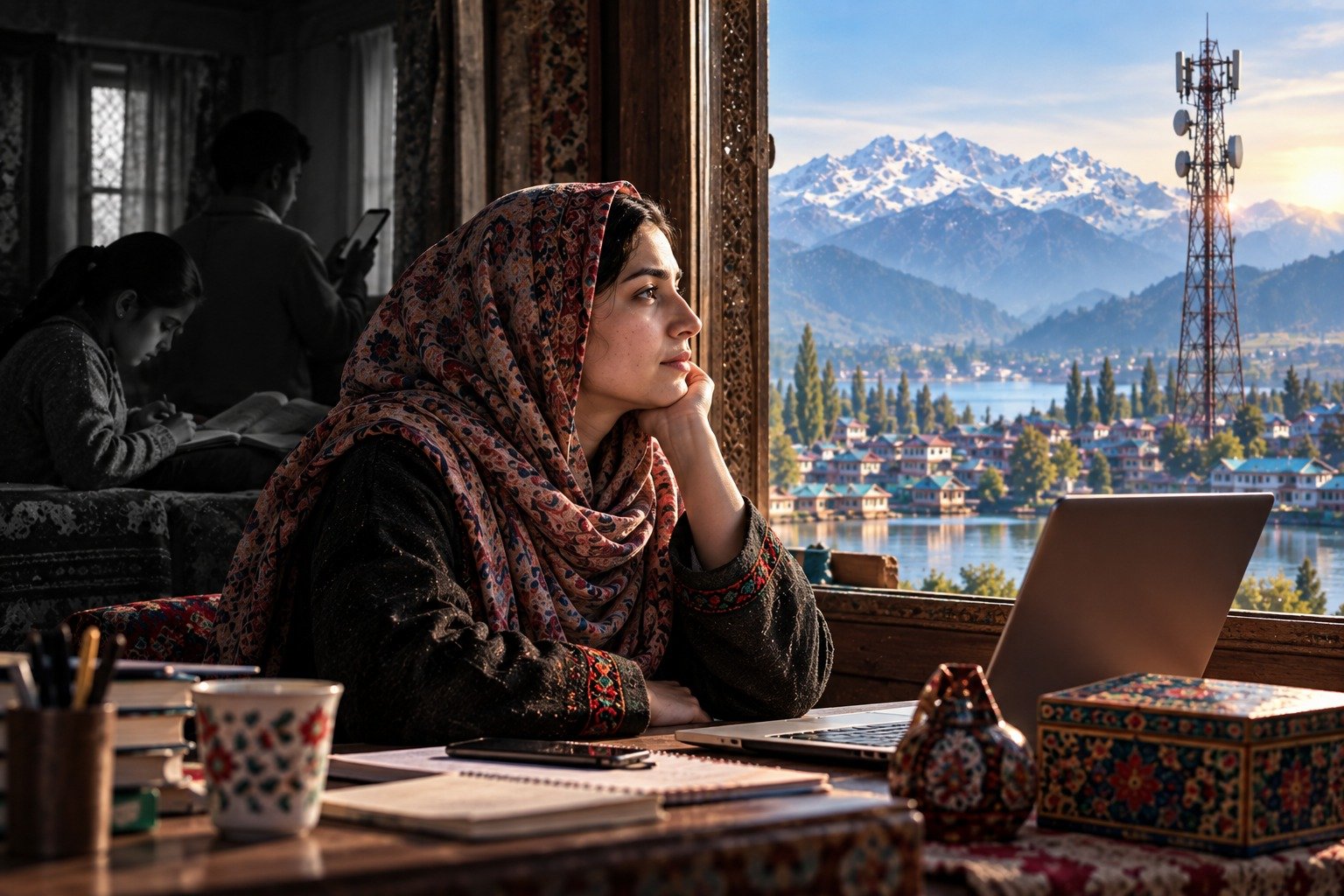
There is an unspoken belief carried within our approach to development: that connectivity is a technical matter. Lay the fibre, raise the tower, auction the spectrum, and empowerment will follow automatically. Once the network reaches a village, we assume it has reached everyone inside it. As if a connection that arrives at a boundary wall, also enters the room where a woman sits.

The figures from Jammu and Kashmir tell a more complicated story. According to the Telecom Regulatory Authority of India, by the end of 2025 the Union Territory had roughly 78 telephone connections for every hundred people, and more than twelve million wireless subscribers. On paper, that sounds like a region that has arrived in the digital age. But the same data shows that rural tele-density stands at around 55 per hundred, against about 129 in urban areas.

Broadband, in J&K as nearly everywhere else in India, is overwhelmingly mobile; wired connections remain a few hundred thousand in a population of over thirteen million. Connection, in other words, is not the same as access.

National surveys have long shown that far fewer women than men have ever used the internet, about a third of women against well over half of men. Studies based on health survey data suggest that in rural J&K, fewer than four in ten women have ever been online at all, even as cities like Srinagar and Jammu surge ahead on 4G and now 5G.

I have observed, over the last few months, what this gap looks like from inside a home. A woman in her late thirties, in a village in north Kashmir, makes her living as a craft seller. From a spare room in her house, she keeps the work of local artisans: papier-mâché boxes and baubles, walnut-wood trinkets, small painted items whose craft goes back centuries.

For years her entire market was the tourist season: what the middlemen took to Srinagar sold, and what they did not take sat in boxes until the following spring. For years, too, the household had one smartphone, her husband’s. Her children, during the periods when schools closed and classes moved online, would study by the window, catching the faint Wi-Fi signal of a neighbour’s house, because the home itself had no connection the family could reliably use.

Then, through a self-help group linked to a Common Service Centre, she received training and, eventually, her own smartphone with a working data connection. She learnt to photograph the papier-mâché in good daylight, to list her pieces on WhatsApp groups, on Instagram and on an online marketplace, to pack the fragile items in layers of newspaper and send them by courier to Delhi, Mumbai and, once, to a buyer in Dubai.

She opened a bank account in her own name and learnt to accept payments directly into it, no middleman’s cut, no waiting for the tourist season to decide her income. She watches videos at night on how other sellers photograph and price their work, and has quietly raised her prices, because buyers now find her instead of the other way round. What she earns is no longer pocket money. It is a visible share of the household’s income, and with it has come something harder to measure: she speaks more at meetings, and her daughter now assumes, rather than asks, that she will go to college.

What stayed with me, however, was her hesitation at the beginning. When the phone was first placed in her hands, she said it was not meant for women like her, and for weeks she would wrap it in cloth each evening and return it to her husband’s shelf. I began to realise that the network had reached her village years before it reached her. Girls here are raised with the understanding that the digital world is a male space: a brother’s phone is normal, a son’s phone is necessary, but a daughter’s phone is a subject of suspicion. A woman is socialised to feel like a guest even in cyberspace, connected only on borrowed permission.

This is where our definition of connectivity begins to reveal its psychological consequences. A connection that can be switched off by someone else’s displeasure is not really hers. So, the question becomes a troubling one: if a woman’s access lives or dies with the goodwill of the household, is she connected at all?

Economic affordability, although essential, cannot be the entire answer. Data in India is among the cheapest in the world, and government programmes have extended 4G and 5G to thousands of once-uncovered villages. Yet alongside affordability there is another gap we rarely discuss: the permission structure inside homes, and the psychological preparedness of women to treat the digital world as their right rather than their privilege. Digital literacy programmes that train women in file formats but never touch the belief that they do not belong online address only half the problem.

The consequences of ignoring this extend to children as well. In a region where schools have repeatedly shifted online and where Kashmiris know the fragility of connectivity better than almost anyone, having lived through some of the longest internet shutdowns ever imposed anywhere, it is very often the mother who mediates between the child and the classroom.

I am not arguing that connectivity is a cure-all, or that an app can substitute for schools, hospitals and jobs. Nor am I romanticizing the internet, which carries its own dangers for women, from harassment to surveillance. My question is different.

Why do we measure connectivity in towers, gigabytes and coverage maps, and so rarely whether a woman can use it without asking anyone?

Why is the unpaid digital labour she performs, listing products, chasing payments, packing parcels, managing the family’s schedules and health appointments over the phone, treated as idle scrolling rather than work?

And why does a woman’s visible success online so often become a moral verdict on her, “she is always on her phone”, rather than an occasion to ask why so many others are still kept offline?

This is where Amartya Sen’s idea of development as freedom becomes worth reflecting upon. Sen argued that development must be judged not by the instruments placed in people’s hands; it is the capabilities those instruments genuinely expand: what a person is actually free to do and to be. A smartphone in a village is an instrument. A woman free to use it, without seeking permission, is a capability. Infrastructure alone is the first; it is never, by itself, the second.

A woman needs not only towers and fibre, but the psychological assurance that the connection is hers; digital literacy that builds confidence and not just skills; affordable data and safe online spaces; and a social culture that does not treat her phone as a borrowed object resting on someone’s shelf.

Where does a woman’s connection belong, psychologically? Only when this question is addressed at both the individual and societal level can we meaningfully speak of empowerment and, ultimately, of families whose mothers can teach as well as feed, of villages whose daughters assume rather than request, and of a Kashmir where the network that reaches the boundary wall finally reaches the woman inside the house.

The question is also for girls who are yet to grow up: if one day she is handed a connection that can be taken back, how does she make sure she is not merely a guest online? The answer lies in building a life where digital access is a part of her education, work, and voice rather than a privilege granted and revoked.


Author can be reached at shakeelarehman43@gmail.com

Comments are closed.