
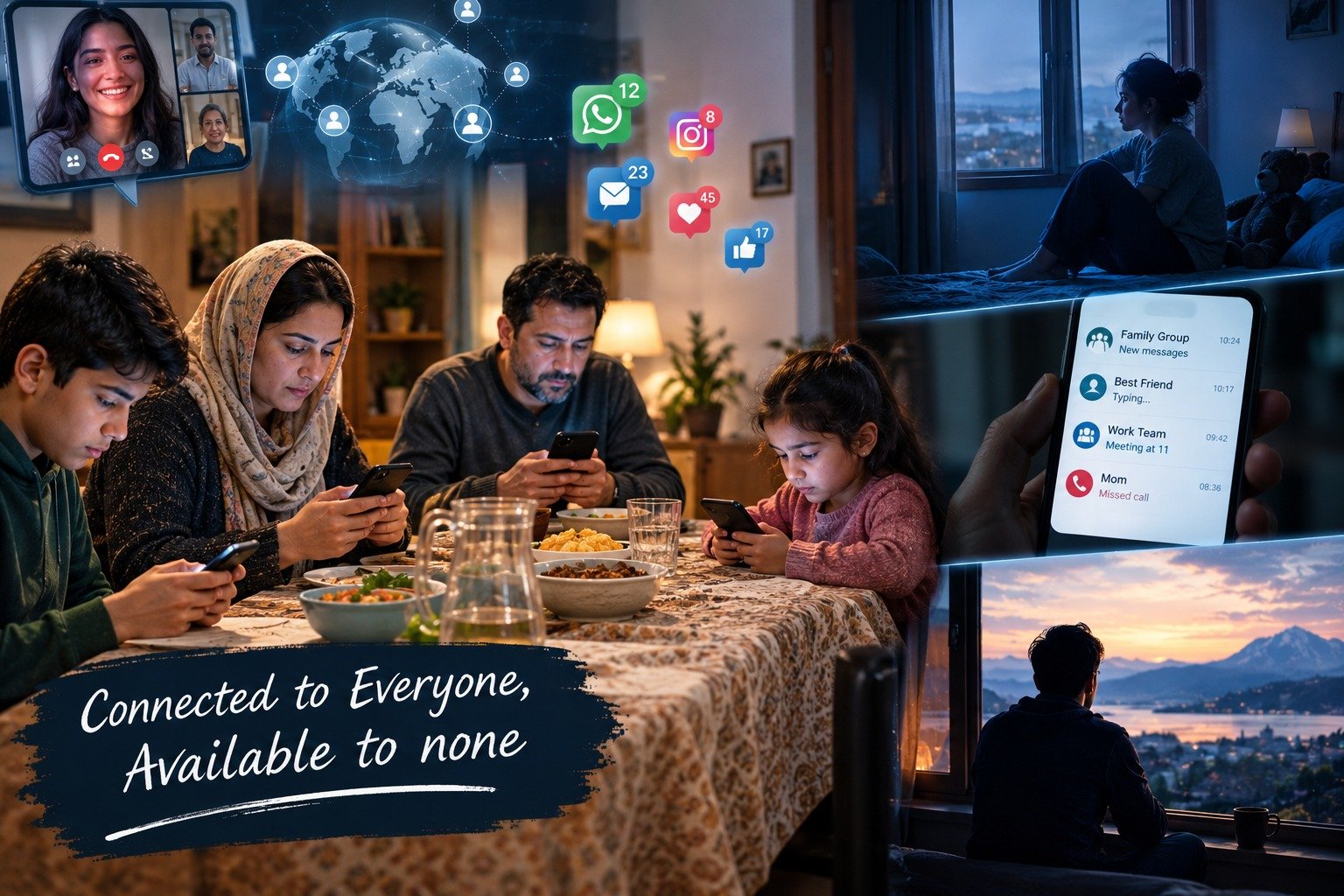
Connected to Everyone, Available to none

The paradox of living in a digitally connected yet emotionally distant world

Sadakat Nazir


Technology can bring a person to our screen, but only attention, empathy, and effort can make them feel that they truly matter. We have learned how to reach almost everyone. Perhaps it is time we learned how to be there for someone.

 We live in a time when reaching someone takes only a few seconds. A message can cross continents instantly, a video call can bring distant faces onto our screens, and social media allows us to remain updated about the lives of hundreds of people. Yet, somewhere between these endless notifications and constant conversations, the meaning of human connection seems to be changing. We have more ways to communicate than any generation before us, but are we really listening to one another?


Consider an ordinary gathering. Friends sit around the same table, family members share the same room, and conversations begin and end with a phone in someone’s hand. Everyone is physically present, yet attention is scattered across distant conversations, online updates, and notifications that can rarely wait. We share the same space without necessarily sharing the same moment.


 Technology itself is not the problem. It has brought families closer across distances, helped people find support, and created opportunities that were once unimaginable. For many, a simple message or video call is the only way to remain close to loved ones. Digital communication is valuable, and dismissing its benefits would be unfair.


The concern begins when convenience replaces effort, when a quick reaction becomes a substitute for genuine concern, and when being reachable is mistaken for being emotionally available. A person may respond to dozens of messages throughout the day and still struggle to have one meaningful conversation. We may know what someone ate, where they travelled, and how their day appeared through a photograph, yet remain unaware of the worries they have never expressed. We witness one another’s lives in fragments, often mistaking these fragments for understanding.

 Perhaps the most uncomfortable part of this reality is that emotional distance does not always appear as silence. Sometimes, it exists in conversations where nobody is truly listening. It exists when someone speaks about a difficult day and receives a distracted response, or when a person gathers the courage to express something painful only to realise that the listener’s attention is elsewhere. Over time, these small moments matter.

Relationships are rarely sustained by grand gestures alone. They grow through ordinary acts of attention: remembering what someone said, asking a question and waiting for the answer, putting a phone aside, or noticing when a familiar smile no longer feels genuine. There is also a contradiction in how we understand availability today. We expect immediate replies, become anxious when messages remain unanswered, and sometimes measure affection through response times. Yet, when someone is physically beside us, we may offer them only a fraction of our attention.

We demand access to people without always offering them our presence. Of course, not every unanswered message signals indifference. People have responsibilities, personal struggles, and a legitimate need for privacy. Constant availability is neither realistic nor healthy. The point is not that we must always be accessible, but that the people who matter deserve more than our distracted presence whenever we do make time for them.

The answer, therefore, is not to abandon technology or romanticise a past that was not perfect. It is to become more conscious of how we use the tools designed to connect us. It means recognising that a conversation deserves attention, that listening is an act of respect, and that a relationship cannot be maintained through notifications alone.

Perhaps we do not need more contacts, more followers, or more conversations. We need more moments in which people feel heard without having to compete with a screen. We need the courage to ask how someone is doing and the patience to stay for an honest answer.

In the end, connection should be measured not by how many people we can reach, but by how deeply we are willing to engage with them. Technology can bring a person to our screen, but only attention, empathy, and effort can make them feel that they truly matter. We have learned how to reach almost everyone. Perhaps it is time we learned how to be there for someone.

Comments are closed.