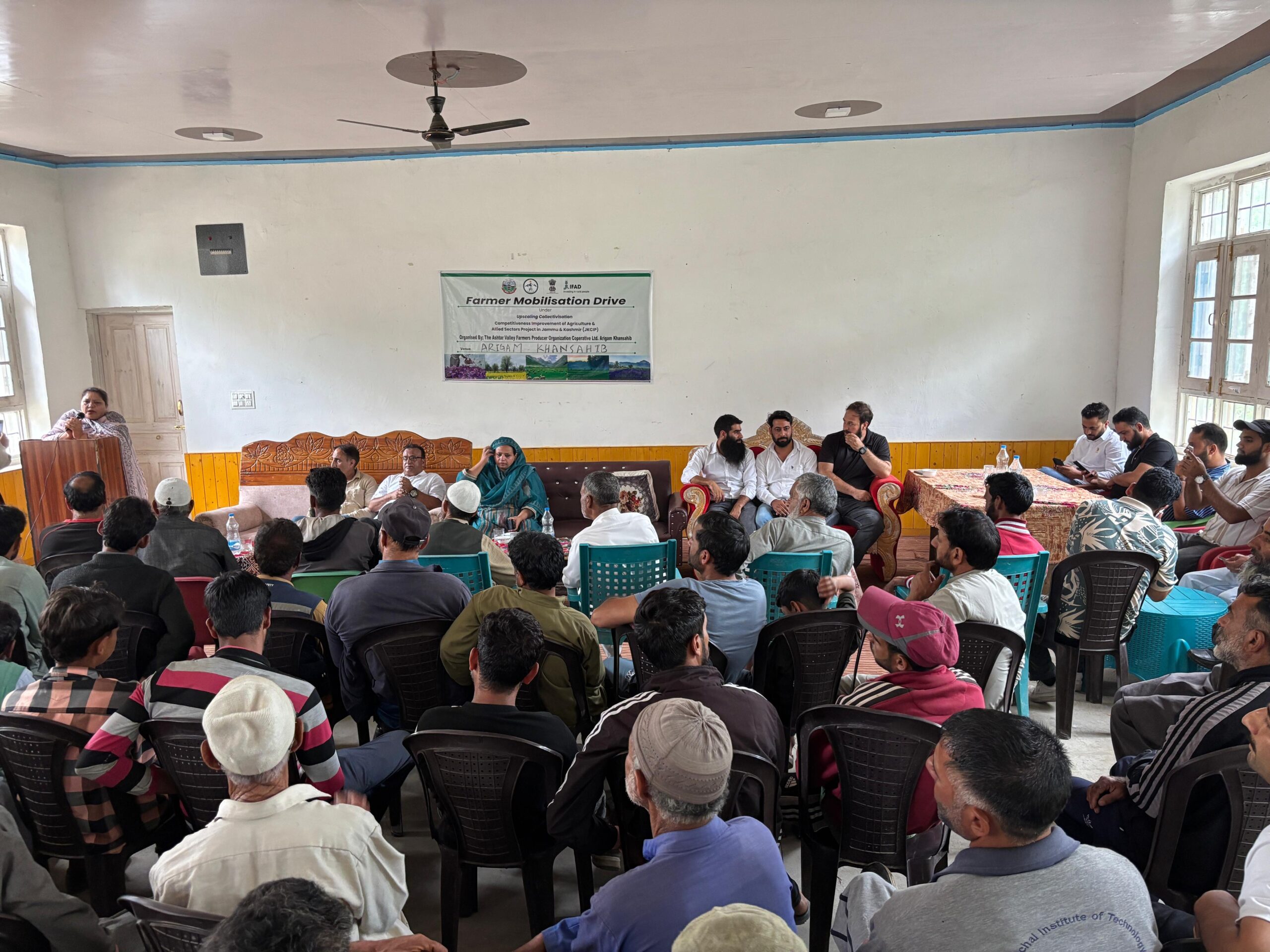
BUDGAM, JULY 29: More than 200 farmers participated in a major Farmer Producer Organisation (FPO) mobilisation drive in Budgam as SKUAST-K intensified efforts to strengthen farmer collectives under the IFAD-supported Jammu and Kashmir Competitiveness Improvement of Agriculture and Allied Sectors Project (JKCIP).
The programme, organised by The Ashtar Valley Farmer Producer Organisation Cooperative Ltd., Arigam Khansahib, focused on expanding farmer membership and promoting collective farming enterprises as a pathway to higher incomes, improved market access and sustainable agricultural growth.
The event brought together officials associated with the JKCIP collectivisation programme, FPO development officers from several districts, scientists, extension experts and members of the Ashtar Valley FPO.
Addressing the gathering, Prof. (Dr.) Raihana Habib Kanth, Director Extension and Dean, Faculty of Horticulture, SKUAST-Kashmir, said that FPOs are emerging as powerful institutions for transforming agriculture by enabling farmers to access quality inputs, modern technologies, institutional credit, value addition facilities and organised markets through collective action.
She urged farmers to actively join producer organisations and leverage opportunities being created under the IFAD-backed JKCIP, adding that SKUAST-K remains committed to providing technical support, capacity building and extension services to strengthen farmer-led institutions across Jammu and Kashmir.
Speaking on the occasion, Prof. Bilal Ahmad Lone, Head, KVK Budgam, highlighted the importance of scientific
farming, collective marketing and skill enhancement in improving farm profitability and rural livelihoods.
Dr. Mohammad Iqbal Bhat, Coordinator, Upscaling Collectivization Component, JKCIP, SKUAST-K, outlined the project’s strategy for building strong and self-reliant farmer organisations. He said enhanced farmer participation and membership are critical for creating sustainable producer collectives capable of addressing production, aggregation and marketing challenges.
An interactive session held during the programme saw farmers seeking information on FPO membership, governance mechanisms, business planning and market opportunities. Experts responded to the queries and encouraged eligible farmers to join the growing collective of farmers.
The mobilisation drive forms part of ongoing efforts under JKCIP to expand and strengthen farmer-owned institutions, with a focus on improving competitiveness, market integration and income generation in the agriculture sector.


Comments are closed.