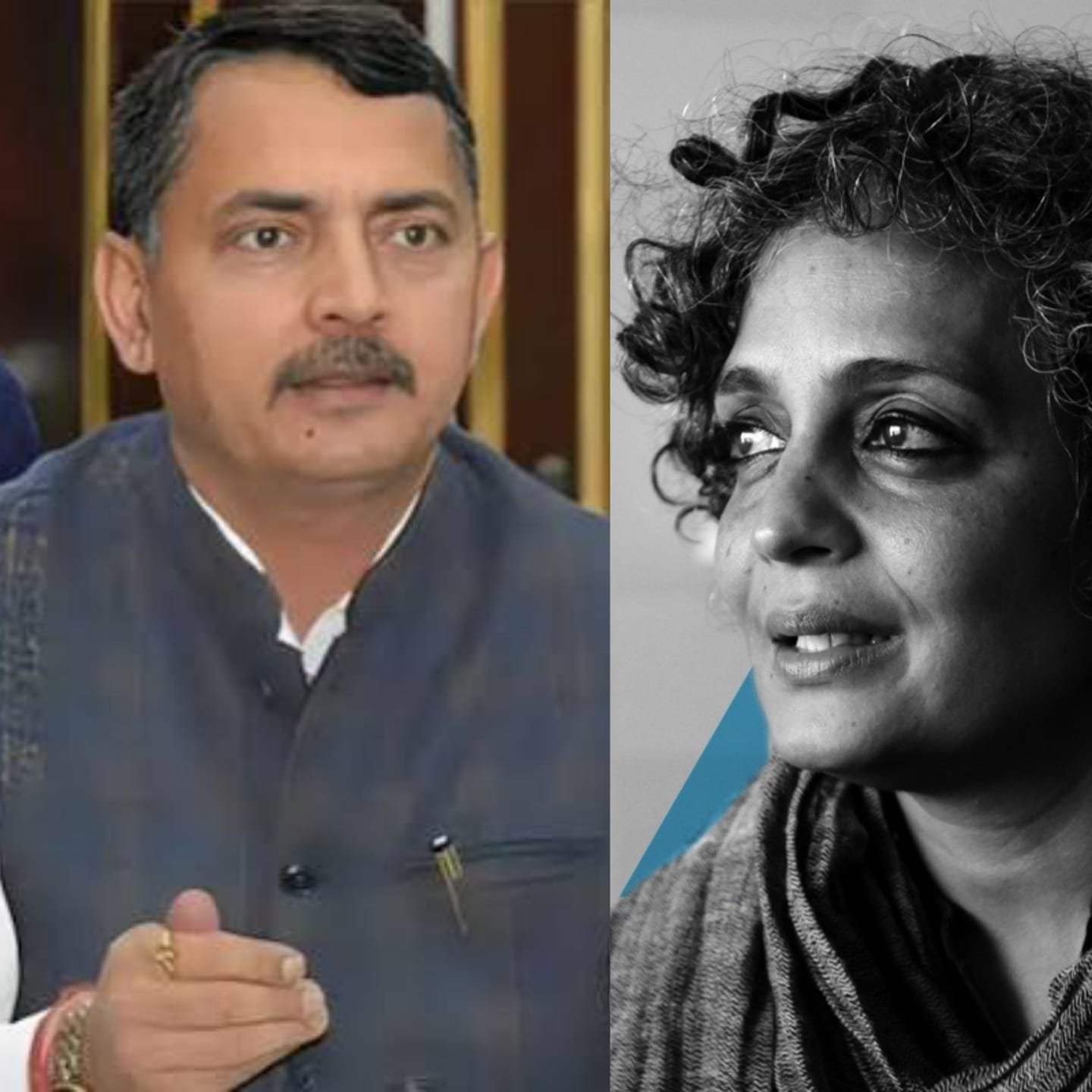
Srinagar, Sep 29: A BJP MLA on Tuesday invoked a passage from writer Arundhati Roy’s Supreme Court affidavit while speaking in support of a government Bill seeking to decriminalise and rationalise certain offences in Jammu and Kashmir — a reference that stood out given that Roy has frequently been criticised by his own party and a book by authored by her is banned in Kashmir.
BJP MLA Ranbir Singh Pathania said he welcomed and supported the Bill introduced by Chief Minister Omar Abdullah, but flagged some apprehensions about its provisions. Making his point on the burden of criminal proceedings, he quoted from Roy’s affidavit: “The process of the trial, and all that it entails, is as much, if not more, of a punishment than the sentence itself.”
Roy had made the observation in her 2001 affidavit before the Supreme Court in a contempt case arising from protests linked to the Narmada dam project. She argued that the legal process itself could amount to a punishment, saying that “the process of the trial and all that it entails” could be as burdensome as, or even more so than, the eventual sentence.
MLA Pathania’s reference came during the debate on L.A. Bill No. 16 of 2026, which seeks to amend certain enactments to decriminalise and rationalise offences, besides repealing certain enactments. The legislation is aimed at reducing the burden of criminal provisions in regulatory and procedural matters and promoting ease of living and ease of doing business.
The invocation of Roy, a writer who has often been a contentious figure in political discourse, was unusual in the Assembly debate. Pathania cited the passage specifically in the context of the burden of legal proceedings while articulating his concerns over the Bill.
His remarks thus brought a reference from a Roy Supreme Court affidavit into a debate centred on decriminalisation and the question of whether criminal proceedings should continue to be attached to certain violations.
The Bill was passed by a voice vote in the legislative assembly.


Comments are closed.