
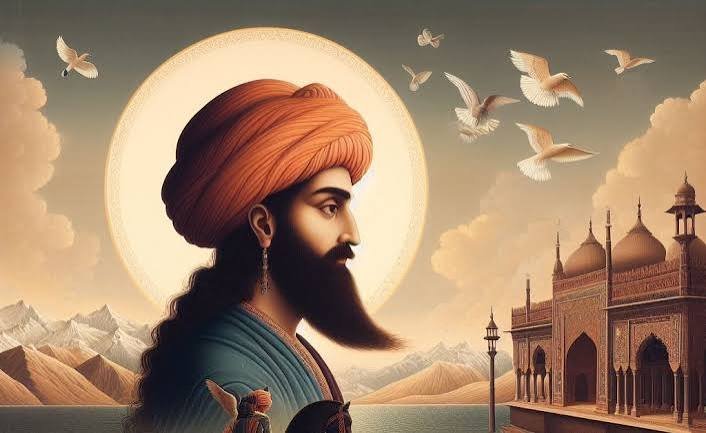
Beyond Religious Boundaries: Tulsidas, Dara Shikoh & India’s Spiritual Heritage
From the composition of the Ramcharitmanas in 1574 to the Persian translation of the Upanishads in 1657, two remarkable chapters of Indian history reveal the enduring spirit of intellectual and spiritual exchange


Dr.Khwaja Iftikhar Ahmed
India’s civilizational history is distinguished not merely by the antiquity of its religious traditions but also by the remarkable manner in which different communities, languages and philosophical schools have interacted with one another. Across centuries, Indian society has witnessed individuals who recognised that spiritual wisdom and cultural knowledge could transcend the boundaries of religion, language and political identity. Two such remarkable figures were Goswami Tulsidas and the Mughal prince Dara Shikoh.
Though they belonged to different generations and intellectual traditions, their contributions represent important chapters in India’s shared cultural and philosophical heritage. The historical significance of Tulsidas’s Ramcharitmanas becomes particularly interesting when viewed against the political background of sixteenth-century India. The great Hindi poet-saint began composing this celebrated epic in 1574 CE, corresponding to Vikram Samvat 1631, during the reign of Mughal Emperor Akbar (1556–1605). This date is not merely a traditional historical estimate. Tulsidas himself refers to Vikram Samvat 1631 in the Bal Kand of the Ramcharitmanas (1.34.2–3), providing an important chronological reference for the beginning of his composition.
The political circumstances of this period also deserve appreciation. Akbar’s reign witnessed significant developments in administration, art, literature and cultural interaction. His policy of Sulh-i-Kul, generally understood as universal peace or tolerance, reflected an approach that sought to maintain harmony among different religious communities. Akbar encouraged intellectual discussions involving scholars from different traditions and supported the translation of important Indian texts into Persian. His court became an important centre of cultural and intellectual activity. Although there is no established evidence of direct royal patronage to Tulsidas, the broader atmosphere of literary activity and engagement with different traditions forms an interesting backdrop to the period in which the Ramcharitmanas emerged.
According to the traditional account, Tulsidas began writing the epic in Ayodhya on the occasion of Ram Navami, the ninth day of the Chaitra month. Written in Awadhi, a language accessible to ordinary people, the Ramcharitmanas presented the story of Lord Rama in a form that connected deeply with the cultural and spiritual consciousness of Indian society. It subsequently became one of the most influential works of devotional literature in the country. Although the precise year of its completion remains uncertain, Varanasi is traditionally associated with the later stages of its composition.
The choice of Awadhi was itself significant. At a time when Sanskrit remained an important language of religious and philosophical scholarship, Tulsidas chose the language of the people to communicate a profound spiritual narrative. His work made religious literature accessible to wider sections of society and strengthened the place of regional languages in India’s literary tradition.
The Ramcharitmanas consequently became much more than a literary retelling of the Ramayana; it became an enduring cultural inheritance. Approximately eight decades later, another remarkable figure from the Mughal world undertook an intellectual initiative that would eventually carry Indian philosophical knowledge far beyond the geographical boundaries of the subcontinent.
Dara Shikoh, the eldest son of Emperor Shah Jahan, developed a deep interest in the philosophical traditions of India. His intellectual journey took place during the reign of Shah Jahan (1628–1658), a period particularly remembered for its extraordinary achievements in architecture, painting, literature and courtly culture. The construction of the Taj Mahal, the development of Shahjahanabad and the flourishing of Persian literature reflected the artistic and cultural accomplishments of the Mughal Empire. It was within this larger environment of intellectual and artistic activity that Dara pursued his interest in understanding India’s philosophical traditions.
Unlike those who viewed religious traditions exclusively through the prism of differences, Dara was interested in understanding the underlying philosophical questions that connected different spiritual systems. His engagement with Hindu scholars, particularly those knowledgeable in Vedanta, reflected his desire to explore the common ground between Islamic mysticism and Indian philosophical thought.One of his most significant contributions was his Persian translation of the Upanishads, completed in 1657.
The work was entitled Sirr-i-Akbar, meaning ‘The Great Secret’. With the assistance of Hindu pandits and scholars, Dara Shikoh translated 52 Upanishads from Sanskrit into Persian. This was an extraordinary intellectual undertaking because it made important philosophical texts of the Indian tradition accessible to Persian-speaking readers, including scholars beyond the Hindu intellectual world.
Dara’s interest was not confined to translation alone. In his earlier work, Majma-ul-Bahrain (The Mingling of Two Oceans), completed around 1655, he explored philosophical similarities between Hindu and Islamic mystical traditions. He believed that different religious paths could lead towards an understanding of a higher spiritual truth. His intellectual approach reflected an aspiration to encourage dialogue rather than deepen divisions.
It is particularly noteworthy that Dara pursued these intellectual interests during the reign of his father, Shah Jahan, at a time when the Mughal Empire remained a major centre of Persianate scholarship and artistic achievement. Shah Jahan’s court provided an environment in which literature, scholarship and artistic expression enjoyed considerable prominence. Dara’s own initiative, however, deserves recognition as a distinctive intellectual undertaking, driven by his personal interest in comparative philosophy and his engagement with Indian scholars.
The subsequent journey of Sirr-i-Akbar is particularly noteworthy. In the early nineteenth century, the French scholar Anquetil-Duperron produced a Latin translation of the Persian version, published in 1801–02 under the title Oupnek’hat. Through this process, philosophical ideas originating in ancient Indian texts became accessible to a wider European scholarly audience. Dara Shikoh’s translation thus played an important role in the international transmission of Indian philosophical knowledge.
When we place the contributions of Tulsidas and Dara Shikoh alongside each other, an important historical perspective emerges. Tulsidas brought the spiritual narrative of the Ramayana closer to ordinary people through a language they understood. Dara Shikoh, on the other hand, helped carry the philosophical wisdom of the Upanishads across linguistic and cultural boundaries through Persian translation. Their methods were different, and their intellectual motivations were not identical, yet both demonstrated the extraordinary capacity of Indian knowledge traditions to reach beyond established boundaries.
It would be historically incorrect to suggest that these two personalities worked together or belonged to the same intellectual generation. Nevertheless, their contributions can be understood as complementary examples of India’s long tradition of literary creativity, philosophical inquiry and cultural exchange. Equally important is the historical setting in which they emerged: Tulsidas composed his celebrated epic during Akbar’s reign, an era remembered for its experiments in cultural accommodation and intellectual engagement, while Dara Shikoh undertook his philosophical explorations during Shah Jahan’s reign, a period of remarkable artistic and literary accomplishment.
The two Mughal emperors deserve recognition for the broader historical environments associated with their respective reigns. Akbar’s efforts to encourage dialogue among different religious traditions and Shah Jahan’s patronage of art, architecture and literature remain significant features of Mughal history. While the individual achievements of Tulsidas and Dara Shikoh should not be attributed directly to royal intervention, their stories help us appreciate the multiple intellectual and cultural currents that shaped India during these centuries.
In contemporary India, where discussions about identity, religious diversity and national heritage frequently occupy public attention, these historical examples deserve thoughtful consideration. They remind us that India’s cultural strength has developed through centuries of interaction, preservation, interpretation and exchange. Its heritage cannot be understood through isolated narratives alone; it must also be appreciated through the contributions of people who expanded the reach of knowledge across communities. The legacy of Tulsidas and Dara Shikoh therefore belongs to a larger Indian civilisational story. One enriched the spiritual imagination of millions through poetry, while the other helped introduce ancient Indian philosophical wisdom to a wider intellectual world. Their contributions, emerging under two different Mughal emperors and in two distinct historical settings, remind us that knowledge becomes a lasting heritage when it is shared, understood and allowed to transcend boundaries.
Comments are closed.