
The Constitution of India and the Power of an Ordinary Citizen
How the vision of Dr. B.R. Ambedkar transformed India from a society divided by birth into a democracy founded on equality, freedom, and justice.


Shoiab Mohmmad Bhat
Imagine a society where our future is determined not by our hard work or abilities, but by caste, religion, or family. A society in which the son of a King automatically becomes a King, where women cannot study and make their own decisions because they are denied the opportunity, and one where an entire group of people is considered untouchable due to their birth.
All such disparities were a tough reality of Indian life for centuries. Political independence from British rule was a great accomplishment, but it was even greater because they were responsible for creating a nation in which all citizens should “live in dignity and equal rights.
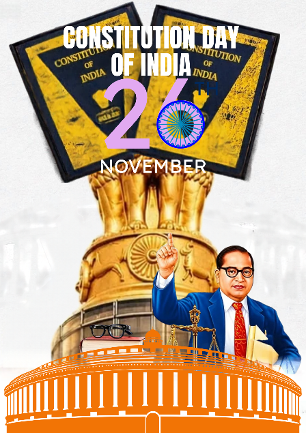
This new future became the reality of India with the adoption of the Constitution of India on 26 November 1949. It introduced democracy in which every citizen, irrespective of his caste, religion, gender or economic status, would have a place.
That is why, every year, Constitution Day is celebrated on 26 November. It takes us back to the great day India opted for equality, justice and democracy as the basic tenets of national life.
But why is Dr. B.R. Ambedkar considered the chief architect of the Indian Constitution? What does this document imply for the average person? And over the past 70 years, are we really the kind of responsible citizens the Constitution envisioned us to be?
26 November 1949 changed India: Why 26 November 1949 Changed India?
On 15 August 1947, India became independent, but political independence would not bring about justice and equality. The nation required a new constitution that would regulate the functioning of its institutions, ensure individual rights, and rectify entrenched inequalities of society.
The Constituent Assembly took 2 years, 11 months, and 18 days to draft the Constitution. It had wide discussions, looked at various proposals, and reviewed other countries’ experiences before deciding on the final document.
The Constituent Assembly formally adopted the Constitution on 26 November 1949. It was adopted on 26 January 1950, in memory of the declaration of Purna Swaraj of 1930.
To spread awareness about the Constitution and its values among the citizens, especially the young generation, the Government of India in 2015 declared 26 November as Constitution Day.
Why is Dr. B.R. Ambedkar called the Chief Architect?
About 300 members were on the Constituent Assembly, and several committees were formed during the process of Constitution-making. Then, why is Dr. Ambedkar accorded such a high status in this historic achievement?
His outstanding legal knowledge, intellect, diligence, and awareness of Indian society are the key. The Drafting Committee was constituted to draft the decisions and recommendations of various committees into a well-drafted document. It was driven by Dr. Ambedkar, who was appointed its chairman on 29 August 1947.
On 5 November 1948, member T.T. Krishnamachari explained that due to resignation, death, illness, or other factors, several members of the Drafting Committee were not able to fully participate in the debate. Thus, a significant portion of the drafting was done by Dr. Ambedkar. He was one of the key players in crafting the draft and making sure its provisions were explained and answered in the debating process, despite his ailments.
But it wasn’t just his skill with the laws or his diligence that made his impact.
Dr. Ambedkar realized that the political independence of India was not enough if the people of the nation were divided in the name of caste, casteism, and social inequality. He felt that any democratic country would not be able to survive if everyday equality and dignity of its people were not ensured. He wanted the Constitution to ensure the rights of those who have traditionally been denied education, opportunities, and basic human rights.
This vision is reflected in the abolition of untouchability in Article 17, equality before law in Article 14, and prohibition of political discrimination in Article 15. Another revolutionary success was universal adult suffrage. Caste, religion, sex, or economic status were no barriers to voting for all adult citizens.
The social and economic status of a poor labourer and the Prime Minister of India are different, but each citizen’s vote has the same worth. This was an important shift in a society which had traditionally ranked people on the basis of birth.
Dr. Ambedkar’s contribution to the Constitution was thus a legal one and also a social one. He contributed to the creation of a constitution which could undermine the inequalities of history and consolidate democratic institutions.
What is the Constitution for a regular citizen?
Most people think that the Constitution is of central importance only for lawyers, judges, and politicians. But in fact, it is linked to their daily lives.
Constitutional protection of freedom of expression, the right to practise religion, to select occupation and to move freely throughout the country. These freedoms can be reasonably restricted as provided for by law, but they allow citizens to make decisions about their lives without undue interference.
Consider another situation.
What would you do if someone illegally tried to take possession of your land? What if you were arrested without the right and if your basic rights were violated?
There are remedies prescribed by the Constitution. The citizens have the right to approach the Supreme Court for enforcing their fundamental rights as per Article 32. Dr. Ambedkar felt that this was a very significant provision and called it the soul and the heart of the Constitution.
It guarantees the effectiveness of fundamental rights and gives citizens access to the courts to seek justice when their rights are breached. The Constitution also gives the basis for a number of protections which are relevant to women and children.
Article 39 of the Constitution of India, which calls for equal pay for equal work, and safeguards the health and strength of workers. The daughters’ rights have gained increased impetus from laws like the Hindu Succession (Amendment) Act, 2005, which modified their rights in ancestral property under Hindu Law.
The Sixth to Fourteenth Amendments state that children must receive free and compulsory education.
The provisions demonstrate that the Constitution is not merely a charter of government institutions. A code of conduct to protect citizens, opportunity to create a more just and equitable society.
Today, the Constitution is an interesting and significant document in our country. Why? India is a very diversified nation. It is a place of many languages, religions, cultures and traditions. However, equality, fraternity are at risk due to communal tension, caste discrimination, polarization and hate speech.
In such circumstances, the Constitution becomes even more important. It reminds us how much our identity as Indians is superior to our differences. It makes it clear that all the citizens are equal and that no one or any institution is above the Constitution.
The citizens, when they speak against injustice, quote the words of the Preamble: “We, the People of India.” These words are filled with a powerful message: The ultimate source of democratic power is the people.
The democratic system of Government of India is based on the fundamental principle of “Justice, Liberty, Equality and Fraternity“, which, although the government changes and political leaders come and go, continues to remain at the centre of the political system.
The Constitution also calls attention to the fact that rights are accompanied by duties. Citizens should respect the rights of others, reject discrimination, exercise their voting rights as responsible citizens, and contribute to the unity and integrity of the country.
As a responsible citizen, am I truly responsible?
Dr. Ambedkar gave his last speech on 25 November 1949 in the Constituent Assembly. His warning is still true today. A Constitution might be good, but if those in charge of running it are bad, then it could be bad as well, he said. In the same way, even a bad constitution might function well if the people who are to put it in force are good.
His message was simple: the character and conduct of the people of a nation are as important as the quality of its Constitution in determining the future of a nation. On the occasion of Constitution Day, we need to ask some very pertinent questions.
The Constitution has provided us with basic rights, equality before the law, and the right to choose our representatives. But are we responsible citizens who know and respect these rights?
Do we hold our elected officials to account when they do not do their duty, or do we sometimes become blindly loyal because of political or party affiliation?
Respect the rights of individuals with different opinions, different religions or from different communities?
Do we make democracy stronger by our actions or weaker by discrimination, intolerance and indifference?
Politicians are not the only ones who should answer these questions. They are of interest to all citizens. By the Constitution, we have become free and equal citizens. Now it is our duty to safeguard what makes this freedom worthwhile.
What is the meaning of being a responsible citizen to you?
Is the spirit of the Constitution understood, or are we still a long way off?
Comments are closed.