
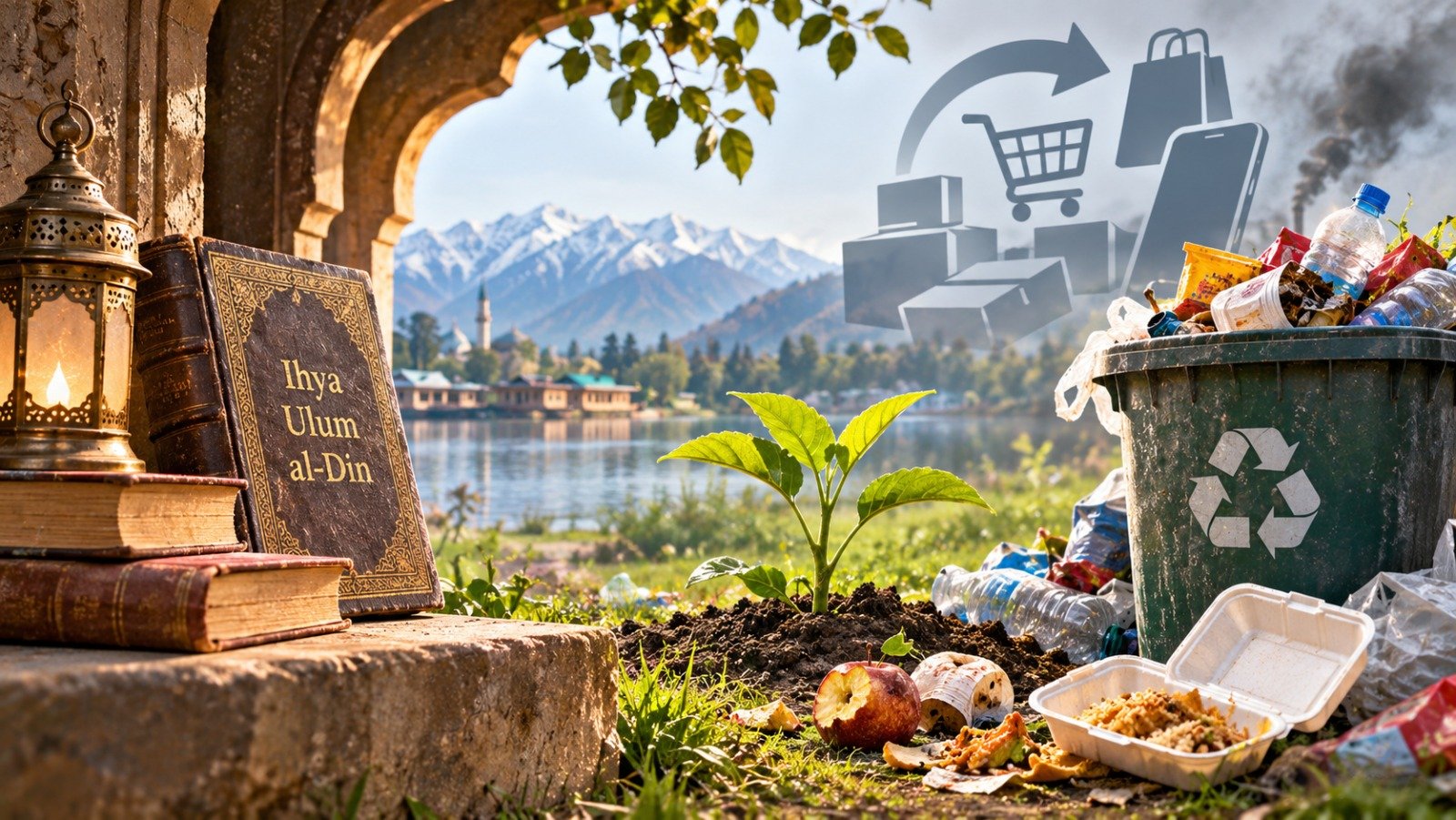
The Moral Cost of Waste: From Al-Ghazali to the Modern Throwaway Culture
From the Islamic principle of Isrāf to the environmental crisis of excessive consumption, the neglect of moderation reveals a deeper moral failure in humanity's relationship with the resources entrusted to it.


Mauzam Bakshi
“Isrāf questions an economic culture that measures success through rising consumption without accounting for environmental costs. Growth that depends on endless extraction and careless disposal cannot be called sustainable simply because it generates wealth.”
There is something deeply troubling about a world in which food is discarded while millions go hungry and usable products are replaced simply because something newer has appeared. These are not isolated contradictions. They are expressions of a culture that has learned to consume without considering the consequences. Modern society is remarkably efficient at producing goods but increasingly careless about the resources, labour and natural systems that make production possible.
The environmental crisis is often discussed in terms of rising temperatures, polluted rivers, disappearing forests and declining biodiversity. Yet beneath these problems lies a more fundamental question: what has happened to humanity’s sense of restraint?
Long before modern environmental debates, Islamic ethical thought identified excess as a moral problem. The Qur’anic principle of Isrāf, meaning extravagance or the crossing of proper limits, challenges the assumption that having the means to consume gives anyone the moral right to consume without restraint.
Among the Muslim scholars who offer a valuable perspective on this question is Abu Hamid al-Ghazali. He held that outward actions are closely connected to the condition of the inner self. Moral development demanded the discipline of desires and the ability to recognise when legitimate needs become excessive attachments. His examination of appetite and moderation provides a powerful framework for reconsidering the moral foundations of the present crisis.
In Ihya Ulum al-Din, he regards the uncontrolled pursuit of pleasure as a source of spiritual distraction. The problem is not that people should reject the comforts of life. Desire becomes excessive when it is no longer governed by reason, gratitude and awareness of responsibility. It then turns harmful when the pursuit of more becomes an end in itself.
Islam does not condemn the enjoyment of lawful provisions. The Qur’an makes this balance clear: “Eat and drink but do not be excessive. Indeed, He does not like those who commit excess.” (Al-A’raf 7:31). The verse does not demand deprivation. It draws a boundary between what is beneficial and what becomes excessive.
The principle returns in Surah Al-An’am, where believers are told to give their due on the day of harvest, followed by the warning: “And do not be excessive.” (6:141). Another passage describes the servants of the Most Merciful as those who, when they spend, are neither extravagant nor miserly (25:67). Moderation is thus a wider principle governing the relationship between human beings and their resources.
This ethical understanding is especially relevant to modern consumer culture. Advertising encourages people to replace rather than repair. Food is bought in excess and thrown away. Every discarded object requires raw materials, energy, water and human labour to produce. A small act of personal convenience can be part of a much larger chain of environmental damage.
Food waste is among the clearest examples. Wasted food also means wasted water used to grow crops, soil that supported them and the labour of everyone who brought them to the table. Food decomposing in landfills generates methane, a powerful greenhouse gas. Agricultural land and water are under growing pressure while edible food is wasted on a vast scale.
The same applies to plastics and electronics. Single-use plastics may be discarded after minutes yet remain in the environment for decades or longer. Electronic waste contains hazardous substances that can contaminate soil and water. Waste has become normalised because inexpensive objects hide their material origins. A discarded item disappears from the household but does not disappear from the world.
Al-Ghazali’s approach suggests that the problem begins long before an object is thrown away. It begins when the desire to possess becomes detached from genuine need. Isrāf therefore questions an economic culture that measures success through rising consumption without accounting for environmental costs. Growth that depends on endless extraction and careless disposal cannot be called sustainable simply because it generates wealth. The moral question is not whether societies should develop but whether development can take place without exhausting the natural foundations on which prosperity depends.
The Qur’anic concepts of Khalifah and Amanah remind human beings of their responsibility towards the earth and the resources entrusted to them. Environmental damage often falls most heavily on people with the fewest resources to protect themselves. This is why Isrāf is also a question of social justice. When some consume far beyond their needs while others struggle to secure basic necessities, the imbalance reflects a failure of collective responsibility.
For Kashmir, these questions are not abstract. The Valley’s rivers, lakes, wetlands and forests are increasingly exposed to pollution, urban expansion and changing patterns of consumption. Plastic waste accumulates along roadsides and waterways. Food is discarded at social gatherings. Water is also wasted through careless use. Kashmir’s orchards, paddy fields and water bodies sustain livelihoods and support the cultural life of the Valley. When they are treated carelessly, the communities that depend on them lose security.
The answer cannot rest on moral appeals alone. Municipal authorities need effective systems for waste segregation and recycling. Businesses must reduce unnecessary packaging. Schools and religious institutions can cultivate habits of moderation and repair. Yet institutional change will remain incomplete unless personal habits change alongside it. Individuals can buy what they genuinely need, repair usable objects and reduce single-use plastics. These actions may appear modest, but they restore the connection between consumption and responsibility.
Ultimately, the moral cost of waste is greater than the value of the objects thrown away. It lies in the weakening of gratitude and the loss of restraint. Al-Ghazali reminds us that the freedom to consume is not the same as the wisdom to consume responsibly. A society demonstrates its maturity not by how much it can produce and discard but by how wisely it uses what has been entrusted to it.
Moderation is not an outdated virtue. It is an essential condition of a responsible future. The first step may be a simple change within the human being: learning once again that not everything we can consume should be consumed and not everything we possess should be treated as disposable.
“A society demonstrates its maturity not by how much it can produce and discard, but by how wisely it uses what has been entrusted to it.”
Comments are closed.