
The Run that Reaches the District
Join your district’s next run. Bring a friend, run or walk, and experience how unity becomes more than a slogan.

Mohammad Muslim
Thousands of people in the Valley gave their time to run together, in public, in good spirits. That is not a small thing in a region that has known long stretches of fear. If the effort is handled with care and sincerity, it can grow into something that people look forward to each year.
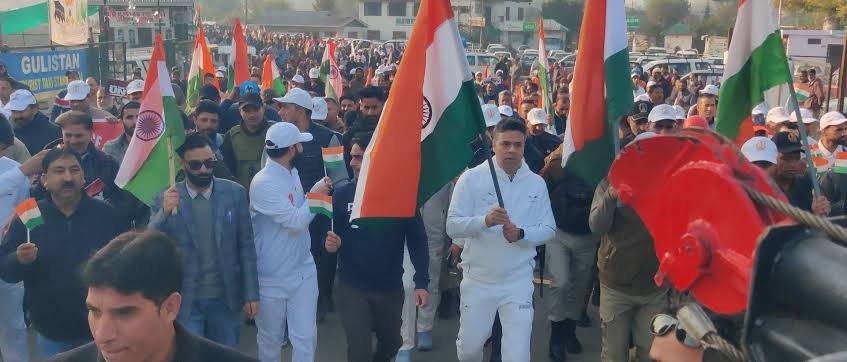
Most national events in India are decided in the capital and watched from afar. The Run for Unity is different, at least in Jammu and Kashmir. It is held in district towns, at police stations, in stadiums and on ordinary roads, and the people who run it are mostly local. That makes it worth a closer look than it usually gets.
This year, the Lieutenant Governor directed that unity runs and ceremonial parades be organised at district headquarters and police stations, along with national unity programmes in prisons. On 31 October, Anantnag answered that call. The district administration organised a Run for Unity in which students, youth, NCC cadets and members of the public took part. The Deputy Commissioner thanked the people of the district for coming out, which is a small courtesy that tends to matter more than officials realise.
The local pattern is not new. In 2017, events were held in several parts of Kashmir, with the Deputy Commissioner of Ganderbal chairing a pledge ceremony, a function at Showkat Ali Stadium in Baramulla, and rallies and seminars organised by police in Kupwara. In 2024, the Deputy Commissioner and SSP of Budgam flagged off a run from the railway station to Behishte Zehra Park. The same year, the Chief Minister flagged off the main run in Srinagar and said it reflects a spirit of unity that people of Kashmir hold dear.
So the tradition has had time to settle. Many young people in the Valley have now seen it several times. Some have run in it more than once. That repetition gives the event a chance to become a real habit rather than a one day show.
The biggest local development this year came a month earlier. On 1 October, the Jammu and Kashmir Police held the Kashmir Marathon as a Run for Unity, bringing together schoolchildren, women, girls, differently abled participants and sports enthusiasts. More than 6,000 runners took part in different categories. Police officials said the turnout was better than they had expected, even on a working day.
That number deserves some thought. Six thousand people is a large crowd by any standard. Many of them gave up a morning of work or study to be there. They did not do it because of a slogan. They did it because the event offered something they wanted, whether that was a challenge, a day with friends or the simple pleasure of running on an open road.
Young people in Kashmir are often discussed as a problem to be managed. Opinion pages, including this one, sometimes treat them as a statistic. A running event offers a different picture. A teenager at the start line is not a statistic. She is nervous, a little excited and thinking about her pace.
Sport gives young people something that speeches cannot. It gives them a goal that is clear and fair. The person who trains harder usually does better. There is no need to know anyone important. That sense of fairness is valuable in a place where many young people feel that chances are not always handed out evenly.
If even a few of those thousands discover a love for running and take it further, the event will have done more than any pledge could.
An honest column should say where things can improve, and there are three places to start.
The first is the gap between the event and the everyday. A runner who finishes a marathon and finds no track, no coach and no local club has nowhere to go. District sports councils and schools should treat Run for Unity as a recruiting moment. Collect names, form groups and organise a small race every month. Otherwise the energy of one morning is lost.
The second is the way people are brought to the event. Anyone who has attended an official function knows the difference between a crowd that chose to come and a crowd that was told to come. Students who join gladly will return with friends. Students who are simply marched to the venue will not. Organisers should invite warmly, keep the routes friendly and let people choose.
The third is the meaning of the word unity. The pledge speaks of unity, integrity and security. These are large ideas, and they will feel real to people only when daily life supports them. Fair treatment, jobs and a patient hearing from the authorities do more for unity than any ceremony. The run should be seen as one small part of that larger effort, not a substitute for it.
Some simple steps could make local runs stronger.
Involve local clubs early. Cricket clubs, youth groups and school sports teachers know their areas well. If they help plan the route and the day, the event feels like theirs.
Add a short walking category. Parents, grandparents and children can then take part together. This costs almost nothing and widens the crowd considerably. Pair the run with a useful activity. A blood donation camp, a tree plantation or a clean-up of a local park can share the same morning. Then people go home having done something for their town, not just something for the occasion.
Share the stories afterwards. Local newspapers and social media pages can feature the youngest runner, the oldest participant or a family that ran together. These small stories do more to build warmth than a list of officials who attended. It is easy to be cynical about government events, and some criticism is fair. A run cannot solve unemployment, and it cannot settle political questions. Anyone who claims otherwise is asking too much of a morning jog.
But it is also easy to be too dismissive. Thousands of people in the Valley gave their time to run together, in public, in good spirits. That is not a small thing in a region that has known long stretches of fear. If the effort is handled with care and sincerity, it can grow into something that people look forward to each year.
Comments are closed.