New Delhi, Nov 19: Union Home Minister Amit Shah on Thursday claimed that Kashmir is free of Indian-born terrorists following the killing of Lashkar-e-Toiba (LeT) terrorist Latif Bhat, describing it as a significant milestone in the country’s fight against terrorism after 35 years.
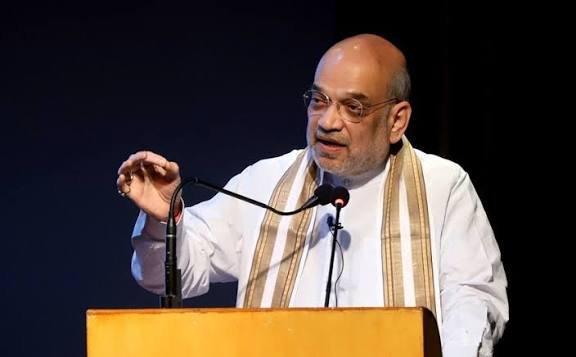
Addressing the inaugural session of the two-day Counter-Terrorism Conference in New Delhi, Union home minister as per Kashmir Convener said the government had adopted a policy of “zero tolerance” towards terrorism under Prime Minister Narendra Modi, which he claimed was yielding positive results.
“Yesterday, we achieved a significant milestone in the fight against terrorism. With the killing of Lashkar terrorist Latif Bhat, all of Kashmir has been freed from the presence of Indian-born terrorists,” Shah said.
He said the development marked a significant moment after three-and-a-half decades of terrorism in the region, while asserting that recent successful counter-terrorism operations had strengthened the country’s confidence.
Amit Shah said India is working towards establishing a uniform counter-terrorism framework from Kashmir to Kanyakumari and Dwarka to Kamakhya, with coordinated action extending to the police station level.
The Home Minister stressed that counter-terrorism efforts could no longer be confined to individual operations but required dismantling entire networks through intelligence-sharing, coordinated investigations and stronger institutional capabilities.
Highlighting action against the Shahzad Bhatti network, Amit Shah said it had been designated a terrorist organisation under the Unlawful Activities (Prevention) Act (UAPA).
More than 40 modules linked to the network had been dismantled across the country, over 100 cases registered and 271 people arrested, he said, urging state police forces to study and adopt the operational model.
“The job of a successful agency is to apprehend terrorists and put them behind bars before they can carry out a terrorist attack,” Shah said.
He also cited the dismantling of the Popular Front of India (PFI) network in September 2022, saying simultaneous operations across 11 states demonstrated the effectiveness of coordinated action by police forces.
Amit Shah said the government had also intensified efforts to bring fugitives back to India, with 303 people extradited or otherwise brought back from 36 countries since 2019.
He said the Central Bureau of Investigation, the Ministry of Home Affairs and intelligence agencies had worked to trace fugitives living abroad, adding that bringing back those involved in terrorism, organised crime and drug trafficking was necessary to ensure they faced prosecution in Indian courts.
Amit Shah said the government had undertaken a series of legislative and institutional measures since 2019 to strengthen the country’s counter-terrorism framework.
The National Investigation Agency (NIA) Act is amended on August 2, 2019, expanding the agency’s jurisdiction and adding new offences to its mandate, while the UAPA was amended on August 14, 2019, empowering the NIA to seize properties linked to terrorists and allowing individuals to be designated as terrorists, he said.
An integrated action plan to combat radicalisation was drawn up in September 2019 and finalised in December after consultations with various ministries, Shah said.
He said the functioning of the Multi-Agency Centre (MAC) had also been reorganised to bring cybersecurity, narcotics, organised crime networks and emerging radicalisation hotspots within its ambit.
The MAC’s system was restructured in 2023 using advanced technology, while a National Memory Bank was established to strengthen centralised databases and information-sharing among agencies, he said.
The NIA’s national presence was expanded with the approval of 16 new branch offices and two zonal offices, while 70 new special courts were established across the country, Shah said.
He added that a 25-point integrated plan to curb terrorist financing was being implemented and monitored, with greater coordination among agencies tasked with investigating financial crimes.
Emphasising the need for a coordinated approach, Shah said counter-terrorism efforts required stronger cooperation between the Centre and states, improved information-sharing and modernisation of investigative agencies.
He called for coordinated action against the entire chain of terror financing and better cooperation with financial investigation agencies.
“Unless we attack the entire network of terrorism together, we will not get success,” he said.
Amit Shah said the conference should be result-oriented, with common objectives and clearly defined accountability for agencies involved in counter-terrorism operations.
He called for strengthening the concept of “Prahar” in India’s counter-terrorism strategy, with greater emphasis on structural and operational capabilities.
The Home Minister said agencies should investigate entire terrorist networks instead of focusing only on individual operatives, adding that such an approach could help prevent attacks before they occur.
He also called for a mechanism to ensure that actionable intelligence gathered at police station level was transmitted through successive levels of the police hierarchy up to Directors General of Police (DGPs).
Amit Shah said state Anti-Terrorism Squads (ATS) needed to strengthen their cyber expertise, given the increasing use of technology in terrorist activities, and called for establishing a quadrilateral regional security grid in border states.
Earlier, Amit Shah released the NIA publication Fail-Safe Investigation, laid the foundation stone of the agency’s office complex in Chandigarh and inaugurated its residential complex at Maidangarhi in Delhi.
He also launched the NIA’s ‘Pushti’ portal and presented decorations to seven officers and personnel of the agency.
Union Minister of State for Home Affairs Bandi Sanjay Kumar, Union Home Secretary Govind Mohan, Intelligence Bureau Director Mahesh Dixit, Special Secretary (Internal Security) Anand Swarup and NIA Director General Rakesh Agarwal were among those present.
Senior police officers from states and Union Territories, counter-terrorism agency officials and experts in law, forensics and technology are participating in the two-day conference.


Comments are closed.