


Dr. Rizwan Rumi
“Tourism should improve people’s lives, generate employment and strengthen the local economy, but it should never come at the cost of destroying the landscape that sustains it.”
Kashmir is blessed with a beauty that millions of people travel thousands of miles to experience. Its green meadows, snow-covered mountains, flowing streams, dense forests, alpine lakes and peaceful landscapes are not merely tourist attractions; they are a priceless natural inheritance. Yet, as tourism continues to grow, an important question deserves our attention: Are we developing our tourist destinations to make them more attractive, or gradually changing the very character that makes them special?
There is no denying that tourism is an important pillar of Jammu and Kashmir’s economy. Thousands of families depend on it for their livelihood, and the sector deserves thoughtful investment, better infrastructure and institutional support. Roads, sanitation, drinking water, emergency services, parking facilities and other essential amenities are necessary to make tourist destinations accessible, safe and comfortable. However, development must have limits, and those limits should be determined by environmental considerations rather than commercial ambitions alone.
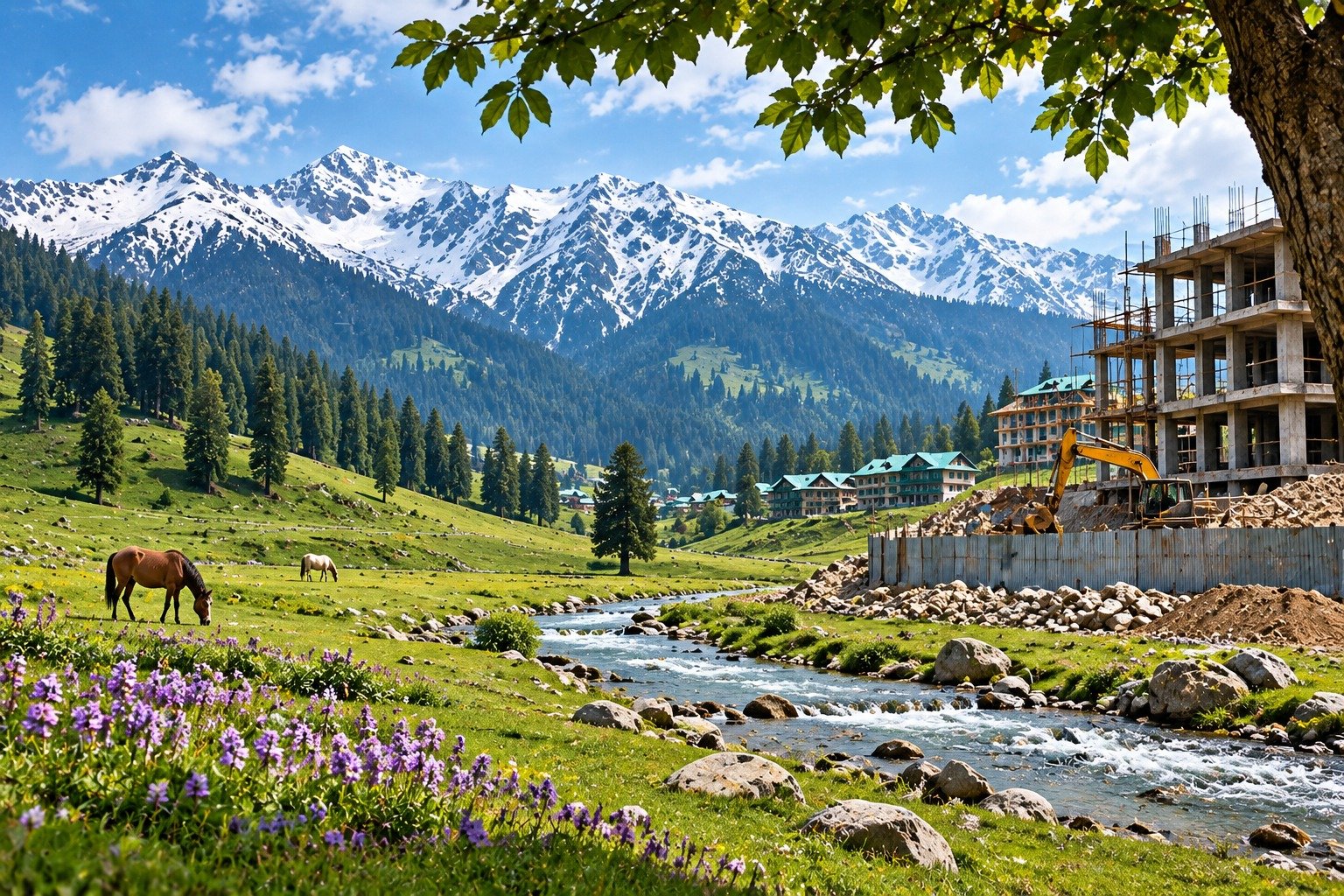
The real concern is not development itself but unnecessary construction in places whose greatest attraction is their untouched natural beauty. When every open meadow becomes a potential construction site, every roadside turns into a commercial establishment and every scenic location is surrounded by concrete structures, we risk losing something that cannot be recreated.
Destinations such as Gulmarg, Pahalgam, Sonamarg, Doodhpathri, Yousmarg and other emerging tourist locations should not be treated as ordinary urban spaces waiting to be filled with buildings. Their identity lies in their natural surroundings. Visitors come to these places to experience open landscapes, fresh mountain air, flowing water, silence and a sense of closeness to nature. They do not necessarily travel to Kashmir to find the same crowded commercial environment that exists in cities.
We must understand that more construction does not automatically translate into better tourism. In fact, uncontrolled infrastructure can eventually weaken the very attraction on which the tourism economy depends. Excessive hotels, restaurants, roadside structures and commercial establishments can increase pressure on water resources, generate additional waste, disturb natural drainage systems and put fragile ecosystems under stress. Once a natural landscape is damaged, restoring its original character may become extremely difficult.
What Kashmir needs is not a construction race but a carefully planned tourism model. Every destination should have a scientifically assessed carrying capacity, determining how many visitors and how much infrastructure its environment can sustainably support. Construction permissions should follow strict environmental assessments, land-use regulations and long-term planning. Sensitive meadows, forest areas, water bodies and ecologically fragile zones must remain protected from unnecessary commercial expansion.
There is also a need to distinguish between essential facilities and avoidable construction. Clean public toilets, proper waste disposal systems, drinking water points, designated parking spaces, emergency medical facilities, rescue services and well-maintained walking paths can significantly improve the tourist experience without changing the natural landscape. Existing infrastructure can be upgraded wherever possible instead of continuously opening new areas for construction.
Local communities must also remain at the centre of tourism planning. Homestays, local food outlets, traditional handicrafts, pony operators, guides and small businesses can benefit from tourism without requiring large concrete structures everywhere. A sustainable tourism economy should create opportunities for local people while protecting the environment on which their livelihoods depend.
The administration has an important responsibility in this regard. Tourism policies should focus not only on increasing visitor numbers but also on preserving the quality of the destinations they visit. Strict monitoring, transparent construction permissions, scientific waste management and effective enforcement of environmental regulations are essential. Tourism departments, development authorities, local bodies and environmental experts must work together rather than approach development in isolation.
We should also learn to appreciate that some places do not need to be developed beyond a certain point. Sometimes, the best intervention is to leave nature undisturbed. A meadow does not need a row of buildings to become attractive. A mountain does not need a commercial complex to welcome visitors. A stream does not need concrete structures along its banks to offer a memorable experience.
Kashmir has inherited a natural treasure that generations before us protected, often without even realising its economic value. We have a responsibility to pass it on to future generations in a condition that is as beautiful and meaningful as we received it. Tourism should improve people’s lives, generate employment and strengthen the local economy, but it should never come at the cost of destroying the landscape that sustains it.
Perhaps the time has come to redefine what we mean by tourism development. Success should not be measured merely by the number of hotels constructed, commercial establishments opened or visitors accommodated. It should also be measured by the number of forests preserved, meadows protected, water bodies kept clean and natural landscapes saved from unnecessary intervention.
Kashmir does not need to become a concrete version of the cities tourists leave behind. Its greatest strength is that it is different. Let us develop what is necessary, regulate what is excessive and preserve what is irreplaceable. The beauty of Kashmir should remain its identity, not become a casualty of its own popularity.
“Let us develop what is necessary, regulate what is excessive and preserve what is irreplaceable. The beauty of Kashmir should remain its identity, not become a casualty of its own popularity.”
Comments are closed.