Srinagar, November 10: As winter approaches in Jammu and Kashmir, the Fire and Emergency Services Department has issued a 15-point safety advisory, warning that unsafe use of Bukharis, Kangris, LPG heaters and electrical appliances can lead to residential fires, carbon monoxide poisoning, suffocation and electrocution.
The advisory, issued by the Directorate of Fire and Emergency Services under Director Alok Kumar and accessed by Kashmir Convener, urges residents to ensure adequate ventilation, regularly inspect heating equipment, handle LPG appliances safely and keep emergency exits unobstructed.
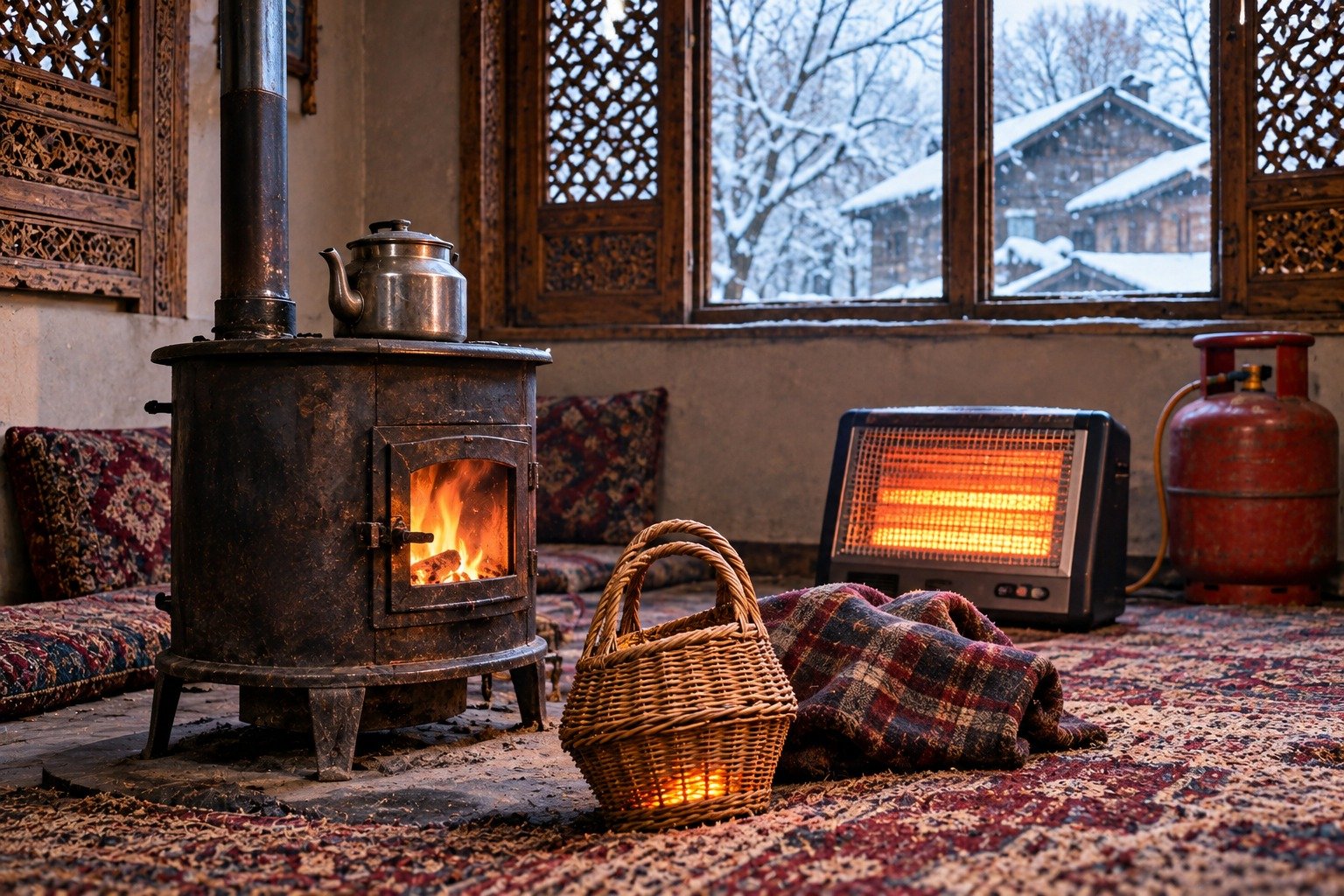
The warning assumes particular significance in Kashmir, where households rely on traditional heating arrangements as well as modern electrical appliances during the prolonged winter. Unattended heaters, faulty electrical connections and fuel-burning appliances operated in poorly ventilated rooms can pose serious risks.
The advisory also brings renewed attention to the dangers of indoor heating following a January 2025 tragedy in Gingle village of Uri, Baramulla district, where five members of a family, including three children, died at their rented accommodation. The family had reportedly been using a gas heater, with suffocation suspected to have caused the deaths.
A key concern highlighted by the department is the risk of suffocation from Bukharis, LPG heaters and other fuel-burning appliances used in inadequately ventilated rooms. Residents have been advised to maintain proper ventilation and specifically warned against leaving LPG heaters running while sleeping or in unattended rooms.
Such appliances can produce carbon monoxide when fuel does not burn completely. The colourless and odourless gas can cause headaches, dizziness, nausea and confusion, and may lead to unconsciousness or death in severe cases.
The department has also cautioned against burning or storing charcoal in enclosed spaces, attics and poorly ventilated rooms. Ashes and embers must be completely extinguished before disposal.
Kangris, widely used across Kashmir during winter, should be placed on stable surfaces and kept away from bedding, curtains and carpets. The advisory also warns against leaving burning Kangris unattended.
The department’s warning comes amid a series of fire incidents reported across Kashmir, particularly in densely populated residential localities where closely built houses can allow flames to spread rapidly.
On December 3, 2025, a fire in Srinagar’s Nowpora Khanyar area damaged at least five residential houses. In another instance, at least 25 fire incidents were reported across Kashmir within four days in December 2025, affecting residential houses, cowsheds, temporary sheds and other structures.
Departmental figures showed that Jammu and Kashmir recorded 6,039 fire calls during 2025, compared with 8,033 in 2024. In Kashmir, 468 fire incidents were reported between January and November 2025, against 720 during the corresponding period in 2024.
Although the figures indicated a decline, they also underlined the continuing burden on emergency services, particularly during winter when households increase their use of heating appliances and electrical equipment.
The advisory calls for regular inspection of LPG connections, pipes and regulators to identify leaks or damage. Residents have been asked to switch off cylinder valves and stove knobs whenever appliances are not in use.
For electrical heating arrangements, the department has recommended using good-quality appliances carrying standard certification and checking heaters, electric blankets and other equipment for damaged wiring, overheating and defects.
Households have been advised to switch off and unplug electrical heating appliances before going to bed or leaving home. Overloading sockets and extension boards has also been flagged as a potential fire hazard.
The department has recommended properly rated fuses, miniature circuit breakers (MCBs) and earth leakage circuit breakers (ELCBs) or residual current circuit breakers (RCCBs). Defective wiring should be repaired by qualified electricians, while electrical cables should be kept away from hot surfaces, water and damp areas.
Electric blankets should also be inspected regularly for damaged wires and overheating, with residents advised to follow manufacturers’ instructions.
Beyond heating equipment, the advisory cautions against storing dry grass, firewood, hay, waste wood, paper and other combustible materials inside residential buildings or near heating appliances. Such material should be stored at isolated locations away from houses.
Residents have also been advised to remain in kitchens while cooking and switch off stoves before leaving, even for short periods. Drying clothes, blankets and other combustible items over or near Bukharis and heaters has been discouraged. Carelessly discarded cigarette butts and matchsticks have also been identified as potential ignition sources.
Emphasising household preparedness, the department has recommended keeping suitable fire extinguishers and buckets filled with water or sand near cooking and heating areas. Staircases, corridors and other escape routes should remain clear to facilitate evacuation during emergencies.
Officials told Kashmir Convener that response time was critical in limiting damage during residential fires, particularly in densely populated neighbourhoods. They urged residents to keep approach roads and lanes clear for fire tenders, pointing out that narrow streets and improperly parked vehicles had obstructed firefighting operations during previous winters.
Residents have been advised to contact Fire and Emergency Services through the toll-free helpline 101 in case of an emergency.
The Srinagar Control Room can be contacted at 0194-2452155 and 0194-2452222, while the Jammu Control Room numbers are 0191-2457705 and 0191-2435283. People can also approach their nearest fire station for assistance.
As temperatures begin to fall, the department’s advisory underscores the importance of balancing the need to keep homes warm with precautions against fire and other winter-related hazards. Adequate ventilation, safe handling of fuel, sound electrical installations and unobstructed evacuation routes remain essential to preventing avoidable tragedies.


Comments are closed.