NEW DELHI, November 6: Climate change is increasingly threatening India’s agricultural output, rural livelihoods and food supply chains, with six states declaring drought this year and extreme weather events affecting more than 20 million hectares of farmland, according to a new report by Climate Trends.
The report, From Risk to Resilience: Climate Change, Ecology and the Future of Indian Agriculture, released on November 4, estimates that India loses food worth around USD 13 billion annually due to climate-related disruptions and inadequate storage infrastructure.
Nearly one-third of the country’s fruits and vegetables are lost before reaching consumers, highlighting the vulnerability of India’s food system beyond farms, particularly in transportation, storage and marketing.
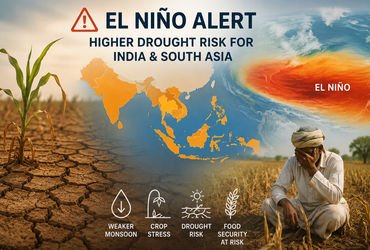
The findings come amid an emerging El Niño, erratic rainfall and intensifying heatwaves, adding to the pressures on farmers already grappling with declining soil health, falling groundwater levels and rising input costs.
The report warns that climate change is no longer merely an agricultural productivity concern, with its effects increasingly extending to food prices, household budgets and inflation, exposing gaps in the infrastructure and policies meant to protect farmers.
Dr G V Ramanjaneyulu, Executive Director of the Centre for Sustainable Agriculture, said six states had declared drought this year but cautioned against assuming that other states were free from similar conditions.
“Across the country, six states have declared drought till now. But that doesn’t mean the rest of the states are better,” he said.
Ramanjaneyulu said the intensity of drought and its consequences varied even within districts and blocks, adding that its effects were also being felt in urban areas.
He questioned whether the existing crop insurance system was adequately protecting farmers, particularly as rising climate risks were pushing up insurance premiums without necessarily ensuring sufficient compensation.
He argued that agricultural policies needed to prioritise preventing and reducing risks rather than relying predominantly on insurance to compensate farmers after losses.
The report estimates that extreme weather events have affected more than 20 million hectares of farmland, equivalent to over 14 per cent of India’s total sown area. It warns that the emerging El Niño could further aggravate the situation, particularly in rain-dependent agricultural regions.
The impact of rising temperatures is not confined to crop cultivation. India’s dairy sector is also suffering substantial losses due to heat stress.
According to the report, heat stress costs the country approximately Rs 2,661 crore annually in lost milk production, equivalent to around 1.8 million tonnes of milk or nearly two per cent of total output.
Around 40 per cent of India’s livestock population is vulnerable to extreme weather events, while 45 per cent of crop-producing land lies in areas exposed to significant flood risks.
These figures underline the growing vulnerability of both crop cultivation and livestock-based livelihoods, with weather fluctuations increasingly threatening rural incomes.
Post-harvest losses deepen food security concerns
The report identifies inadequate storage and transportation infrastructure as a major weakness in India’s agricultural supply chain.
Only four per cent of fresh produce is covered by cold-chain facilities. Consequently, losses of fruits and vegetables can reach 40 per cent, while five to six per cent of food grains are lost before reaching consumers.
The estimated annual loss of USD 13 billion reflects the economic cost of disruptions across the food system, including inadequate storage and climate-related damage.
The report also flags the environmental cost of prevailing agricultural practices. Per-hectare consumption of chemical fertilisers has more than doubled over three decades, rising from 73.5 kg in 1990 to 199 kg in 2023.
It further estimates that crops damaged by air pollution could otherwise have provided food to nearly 94 million people.
Aarti Khosla, Director of Climate Trends, said Indian agriculture was facing multiple pressures simultaneously, including the emerging El Niño, deteriorating soil health, declining groundwater levels and decades of input-intensive farming.
“These shocks are evidently going beyond the farm to markets, food prices, household budgets and inflationary pressures across the country,” she said.
Khosla said climate resilience needed to become an integral part of agricultural planning, financing and farming practices rather than being addressed only after a crisis.
The concern is particularly significant for agriculture-dependent households, as weather-related disruptions affect both farmers’ earnings and consumers’ ability to afford food.
Experts call for early action, better weather advisories
The report also highlights gaps in weather advisories and irrigation facilities, arguing that access to forecasts alone does not guarantee protection against crop losses.
Dr Anand Sharma, former Additional Director General of the India Meteorological Department, said farmers needed extended weather forecasts to make informed decisions about sowing, irrigation and other agricultural activities.
He suggested that farmers consider drought-resistant crops during El Niño years instead of relying on water-intensive varieties.
“Early warning without early action will not solve the problem,” Sharma said.
He stressed the need to restore traditional water bodies and ensure life-saving irrigation facilities, particularly during critical stages of crop growth.
The emphasis on local-level preparedness is significant as rainfall deficits can vary substantially between districts and even smaller administrative units.
Tenant farmers’ exclusion a major concern
The report also highlights gaps in agricultural welfare policies, particularly the exclusion of tenant farmers from several government support and compensation schemes.
Siraj Hussain, former Union Agriculture Secretary and former Chairman of the Food Corporation of India, said tenancy remained a major challenge as many tenant farmers were unable to access government benefits.
For those cultivating leased land, the absence of formal recognition can become a major obstacle in securing compensation and assistance following crop losses.
The issue assumes greater significance as climate-related disruptions increase the financial risks associated with cultivation.
The white paper recommends expanding crop and weather-indexed insurance, including coverage for tenant farmers, strengthening block-level weather advisories and improving seasonal drought monitoring.
It also calls for greater investment in organic farming, bio-fertilisers and sustainable agricultural practices to improve soil health and reduce dependence on chemical inputs.
On the infrastructure front, it recommends strengthening climate-resilient supply chains, expanding storage facilities and improving farmers’ access to market infrastructure.
The report argues that India’s response to climate change cannot remain centred on relief and compensation after disasters. Reducing vulnerability through better water management, climate-resilient crops, sustainable farming, reliable weather information and stronger supply chains will be crucial to protecting farmers’ livelihoods and ensuring long-term food security.


Comments are closed.