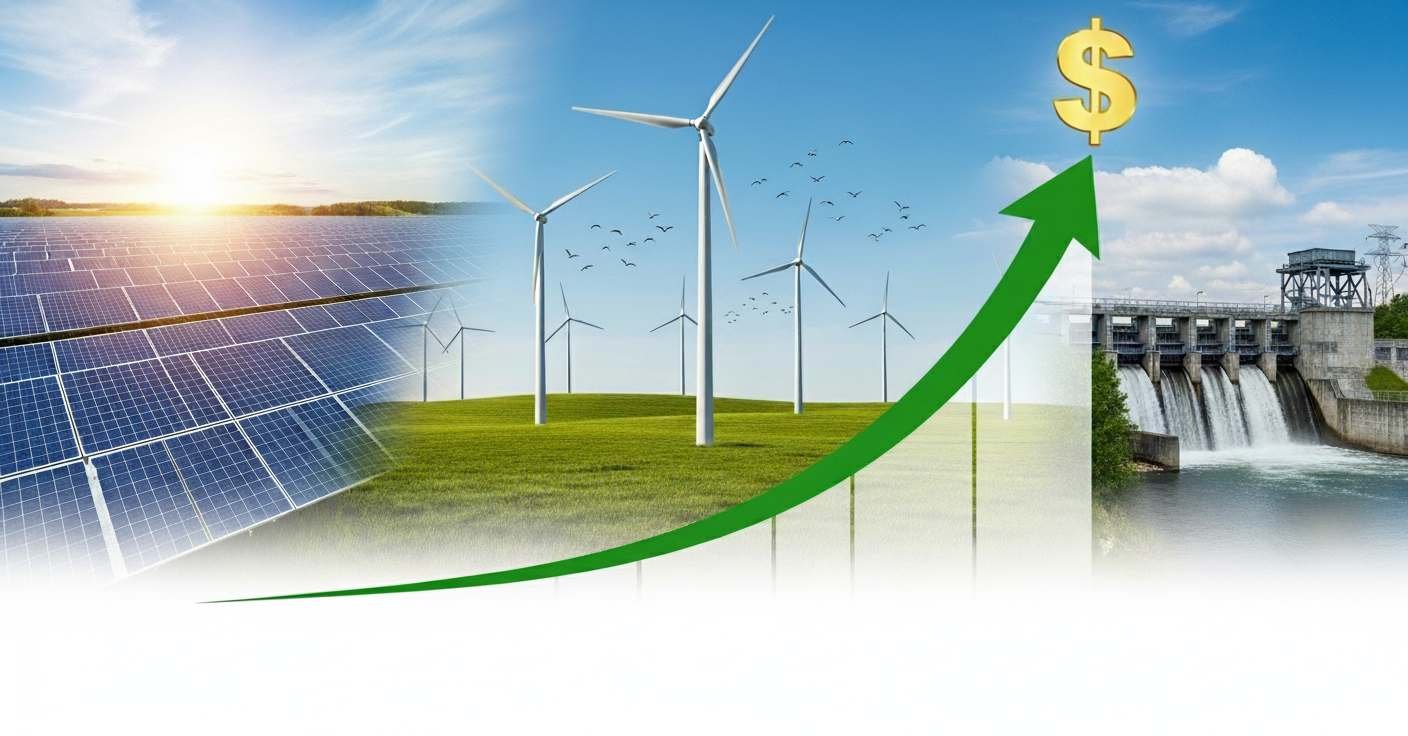
Srinagar, Oct 31: Investments in solar and onshore wind energy projects across emerging and developing economies could reach USD 356 billion by 2040, driven by rising electricity demand and expanding renewable energy capacity, according to a report released in October 2026.
The report, Emerging Market Financing for Renewables, authored by Amy Kong and Bridget Woodman accessed Kashmir Convener argues that concerns over high financing costs and investment risks in developing economies may be overstated, potentially limiting the flow of private capital into renewable energy projects.
Citing projections by the International Energy Agency (IEA), the study said renewable energy could account for 42 per cent of electricity generation in emerging and developing economies by 2030. Achieving this would require an additional 3,251 gigawatts (GW) of renewable capacity under the base-case scenario, while an accelerated transition could push net capacity additions beyond 4,000 GW.
The expansion would also require substantial investment in supporting infrastructure, with emerging and developing economies needing around USD 300 billion annually for grid development to accommodate rising demand and increased renewable power generation.
However, the cost of capital remains a major constraint. According to IEA estimates cited in the report, the average weighted cost of capital for large solar photovoltaic projects in major emerging economies was up to twice that in advanced economies during 2015-2024.
The study questioned whether such financing premiums accurately reflect the underlying risks, pointing to data from the Global Emerging Markets Risk Database (GEMs).
Loans extended by multilateral development banks (MDBs) and development finance institutions (DFIs) to private companies in emerging markets between 2006 and 2025 carried an average spread of 3.77 per cent, while the average realised loss rate was 0.90 per cent.
The resulting gap of 2.87 percentage points suggests that risk premiums charged by lenders have historically been considerably higher than the actual credit losses recorded, the report said.
It further noted that renewable energy projects financed by MDBs and DFIs across 159 countries recorded an average default rate of 2.61 per cent between 1994 and 2025, alongside a recovery rate of 71.8 per cent.
These figures challenge the perception that investments in emerging economies necessarily involve significantly higher credit risks, the authors said.
The report identified political uncertainty, limited market transparency and the financial reliability of electricity purchasers as key factors affecting investor confidence.
To address these concerns, it called for stable government policies, transparent procurement systems, reliable power purchase agreements, improved grid connectivity and greater regulatory certainty.
India’s experience was highlighted as an example of how a comprehensive policy and regulatory framework can help attract investment and accelerate renewable energy expansion.
Ranked third globally in installed renewable energy capacity, India has introduced a range of measures, including long-term capacity targets, renewable energy parks, incentives for foreign investment, subsidies, transmission charge waivers and assured renewable power procurement.
According to data from Rystad cited in the report, India’s solar and wind capacity has expanded at an average annual rate of more than 20 per cent since 2020, largely driven by solar power. Its solar capacity increased from 0.09 GW in 2010 to more than 190 GW in 2025.
The study also examined developments in Egypt, Nigeria and Senegal, where rising electricity demand and policy reforms are opening up opportunities for private investment.
Egypt aims to generate 45 per cent of its electricity from renewable sources by 2028, while Nigeria is pursuing reforms to expand renewable energy generation and improve electricity access through mini-grids.
Senegal, meanwhile, has set a target of achieving 40 per cent renewable energy capacity by 2030 under its Just Energy Transition Partnership.
On financing, the report said blended finance, credit guarantees and concessional funding from multilateral institutions could help reduce investment risks and mobilise private capital.
It cited initiatives such as India’s Green Growth Fund and Nigeria’s renewable energy financing programmes as examples of efforts to combine public and private funding.
“Climate finance is not a one-size-fits-all solution,” the report observed, stressing that financing models must be tailored to the economic and institutional conditions of individual countries.
The authors said coordinated efforts by governments, multilateral development banks and development finance institutions would be crucial to lowering financing costs, strengthening investor confidence and accelerating the global transition to renewable energy.


Comments are closed.