New Delhi, Oct 28: India’s green cover declined by 5.6 percentage points between 2001 and 2025, with areas experiencing vegetation loss recording an increase in mean summer temperature, according to a new study by research initiative Climate Trends.
The study, titled Assessment of Green Cover Dynamics and Their Influence on Summer Temperature across India Using MODIS Land Cover and ERA5 Reanalysis Data, found that green cover accounted for 36.95 per cent of the country’s land area in 2001, declining to 31.35 per cent in 2025. The share of non-green land, meanwhile, rose from 63.05 per cent to 68.65 per cent.
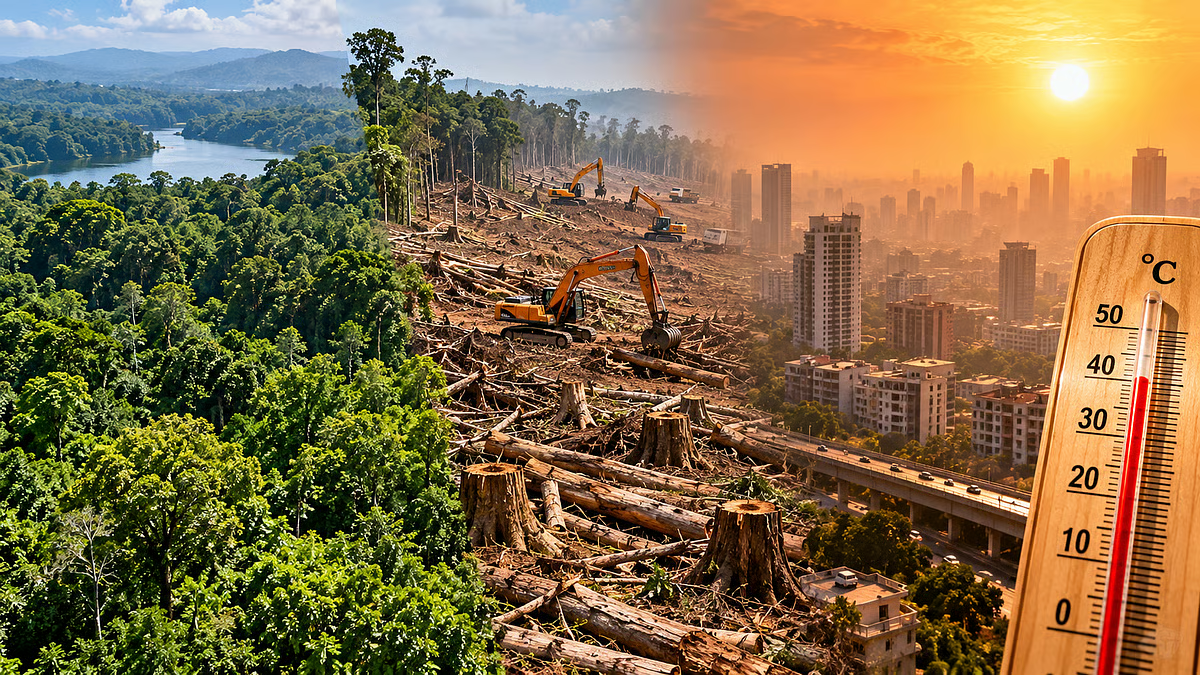
The findings highlight the role of vegetation in regulating local temperatures, with green-covered areas remaining between 1 and 2.5 degrees Celsius cooler than non-green landscapes during summer, the study said, according to Kashmir Convener.
“The persistent 1–2.5 degrees Celsius summer temperature difference between green and non-green landscapes highlights the role of vegetation in regulating local thermal conditions,” Dr Palak Balyan, Research Lead at Climate Trends, told Kashmir Convener.
Balyan said vegetation should be viewed not merely as an ecological asset but also as an important part of India’s climate-adaptation infrastructure. Protecting existing natural vegetation, she added, should be treated as an adaptation priority.
The study found that areas experiencing green-cover loss recorded a mean summer temperature increase of 0.26 degrees Celsius, indicating an association between the conversion of vegetated land into non-green surfaces and rising temperatures.
Green-cover loss was concentrated largely in western India, the Indo-Gangetic Plain, parts of central India and several regions of peninsular India. Localised gains were observed in parts of the northeastern states, the Himalayan foothills and scattered areas of southern and eastern India.
The study also identified pronounced warming across northwestern and northern India, while some parts of central and southern India experienced localised cooling.
However, the researchers cautioned against attributing temperature changes solely to shifts in land cover, noting that regional climate warming and local land-use dynamics act together to influence temperatures.
Dr S K Dhaka, Professor of Atmospheric Physics at Delhi University, told Kashmir Convener that vegetation restoration could help reduce local thermal stress but could not replace broader climate action.
India needs a two-pronged approach, he said, focusing on preventing further loss of established vegetation while undertaking scientifically targeted restoration in regions vulnerable to heat. This must be accompanied by improved water management, better urban planning and stronger action to curb greenhouse-gas emissions, he added.
Aarti Khosla, Founder-Director of Climate Trends, said the study provided evidence of vegetation’s role in climate adaptation, arguing that it should be treated as essential infrastructure rather than viewed only through the lens of biodiversity conservation.
Khosla also referred to the United Nations Environment Programme’s Emissions Gap Report 2026, which she said underscored the growing challenge of limiting global warming to 1.5 degrees Celsius and identified deforestation as an area where global action remained significantly inadequate.
The findings come amid concerns over the possibility of another severe summer, with a strong El Niño developing in the Pacific, according to the material accompanying the study.
The accompanying release also cited drought declarations in five states, August being recorded as the warmest since 1901, and monsoon rainfall running 12.6 per cent below average.
The International Labour Organization and the Council on Energy, Environment and Water have projected that continued warming could reduce India’s GDP by 4.5 per cent by 2030, an impact equivalent to the loss of the working capacity of 35 million full-time workers, the release said.
The study recommended protecting existing vegetation, preventing unnecessary green-cover loss and promoting ecological restoration as integral components of climate adaptation and sustainable land management.


Comments are closed.