
Balhama farmer nearly doubles saffron production with timely irrigation

Growers seek functional irrigation facilities by Govt

Bilal Habib


Pampore, October 27: A saffron farmer from Balhama in Srinagar district has reported nearly double the production this year, attributing the encouraging results to timely irrigation, hard work and years of practical experience.


Fayaz Ahmad Bhat, who irrigated his saffron fields using his own water pumps, has demonstrated how access to water at the right time can contribute to better flowering and improved saffron production.


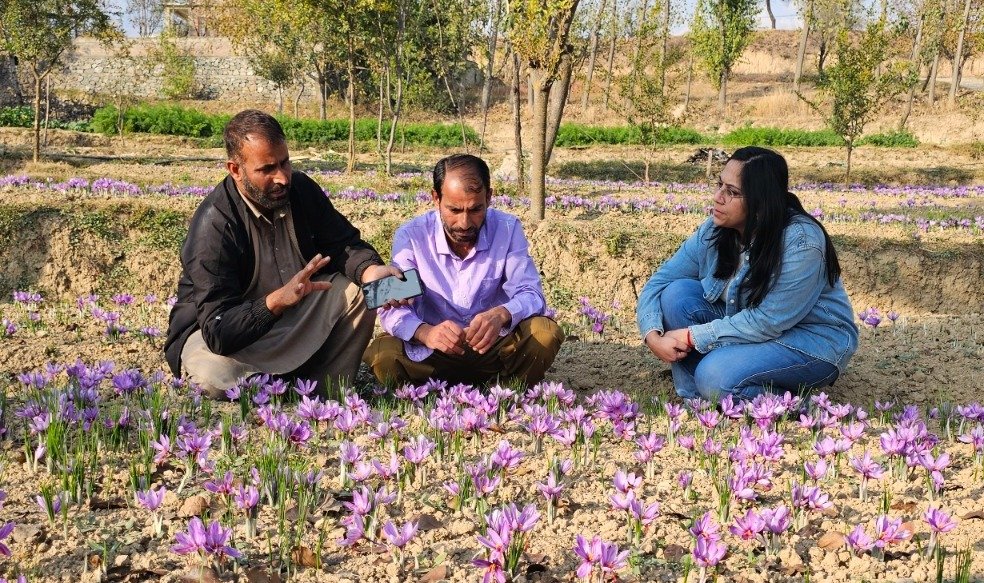
Dr Sheetal Ambardar, Assistant Professor at the School of Biotechnology, University of Jammu, and progressive saffron farmer and Kissan Advisory Board member Irshad Ahmad Dar of Pampore recently visited Bhat’s fields to assess the crop. They expressed satisfaction with the healthy flowering and well-developed stigmas observed there.


Speaking to Kashmir Convener, Bhat said successful saffron cultivation required dedication, practical experience and timely irrigation. He observed that many young people were reluctant to undertake hard work despite the livelihood opportunities available through agriculture.


“Except during the winter months, I remain engaged in my saffron fields throughout the year. The good production we are witnessing today is the result of my hard work,” he said.


Emphasising the importance of irrigation, Bhat said farmers needed practical experience to determine when their fields required water. He added that having his own water pumps had enabled him to irrigate the crop at the right time, contributing significantly to this year’s improved production.

“I have my own motor pumps, which I use to irrigate my saffron fields. Had I not had these pumps, I would not have achieved such good production. Irrigation has played a crucial role in improving this year’s crop,” he said.

Bhat said saffron growers in Balhama and Pampore had been demanding adequate irrigation facilities for years. Although borewells had been installed in several areas under government initiatives, he said many facilities remained non-functional.

He urged young people to explore opportunities in agriculture, work hard and become self-reliant.

“There are many opportunities in Kashmir through which young people can earn their livelihoods. My message to the youth is to work hard, become self-reliant and make the best use of the opportunities available to them,” he said.

Dr Ambardar, who has been researching saffron for the past 16 years, said she regularly visited Kashmir during the flowering season to study the growth and development of saffron flowers.

Speaking to Kashmir Convener, she expressed concern over the decline in saffron flowering observed in recent years, particularly in Pampore, where she found comparatively few flowers during her visit this season.

“This year, we came to Kashmir to collect samples during the saffron flowering season. However, we were surprised to see very few flowers in the Pampore saffron fields. Progressive saffron farmer Irshad Ahmad told us about Fayaz Ahmad of Balhama, and we visited his field to see the results for ourselves,” she said.

Dr Ambardar said she was impressed by the healthy flowering and promising crop condition in Bhat’s fields. On enquiring about the reasons for the better results, she learned that the farmer had ensured timely and proper irrigation.

She said the field had a good number of flowers with well-developed stigmas, highlighting the potential role of irrigation in improving saffron productivity.

“I would urge all saffron growers to ensure proper and timely irrigation. The government should also provide adequate irrigation facilities to farmers so that saffron production can improve. The methods adopted by Fayaz Ahmad should be studied and replicated in other saffron-growing areas,” she said.

Dr Ambardar, who specialises in microbiology research, said she was also collecting samples from the field to examine its microbiological characteristics and investigate whether factors associated with irrigation could be contributing to the crop’s healthy growth.

She said the findings could help researchers better understand the factors behind the field’s promising performance and identify practices that could be adopted by other saffron growers.

Praising Bhat’s efforts, she said his achievement in Balhama offered an encouraging example for saffron cultivation in Kashmir. She also called for government support to help him expand his cultivation and further improve production.

Speaking to Kashmir Convener, Irshad Ahmad Dar, a progressive saffron farmer from Pampore who has been associated with saffron cultivation since childhood, said he visited Bhat’s fields along with Dr Ambardar after learning about the encouraging results.

Describing his experience, Dar said the fields reminded him of saffron-growing regions in Iran, underscoring the importance of proper irrigation and scientific farming practices in achieving healthy flowering and better production.

He said Bhat’s use of his own water pumps demonstrated how timely irrigation could make a significant difference to saffron cultivation and serve as a model for other growers.

“The government must learn from the Balhama model and introduce similar technology and irrigation facilities in Pampore’s saffron fields. Although borewells were installed under government initiatives, many remain non-functional, depriving farmers of the irrigation facilities they urgently need,” he said.

Dar added that reliable irrigation facilities could encourage thousands of farming families to return to saffron cultivation, restore traditional livelihoods and motivate younger people to take up agriculture.

He said he had recently participated in a world conference where discussions also focused on providing modern irrigation facilities to farmers across India.

Appealing to the Central Government, the Lieutenant Governor and the Omar Abdullah-led Jammu and Kashmir government, Dar urged them to prioritise irrigation infrastructure in saffron-growing areas.

“Saffron is a heritage crop of Kashmir and an important part of India’s agricultural heritage. The government must take concrete steps to protect and promote this valuable crop by ensuring that farmers have access to modern irrigation technology,” he said.

Dar also expressed gratitude to the Central Government for launching the National Saffron Mission, describing it as an important initiative for saffron growers. However, he said the lack of functional irrigation facilities remained a major concern requiring urgent attention.

He stressed that the Balhama model should be studied and replicated in Pampore and other saffron-growing areas to strengthen the sector, improve productivity and revive the traditional livelihoods of farming families.

The results reported from Bhat’s fields have highlighted the potential importance of timely irrigation and practical farming experience in saffron cultivation, while the visiting researcher and progressive farmer called for better irrigation infrastructure to support growers across Kashmir.

Comments are closed.