

Suhail Khan
Srinagar, Oct 27: Jammu and Kashmir Chief Minister Omar Abdullah’s long-awaited Cabinet expansion on Tuesday ended months of uncertainty over ministerial appointments but opened a fresh challenge for the ruling National Conference, with the exclusion of several senior legislators triggering public expressions of disappointment, protests by supporters and efforts by the party leadership to contain the fallout.
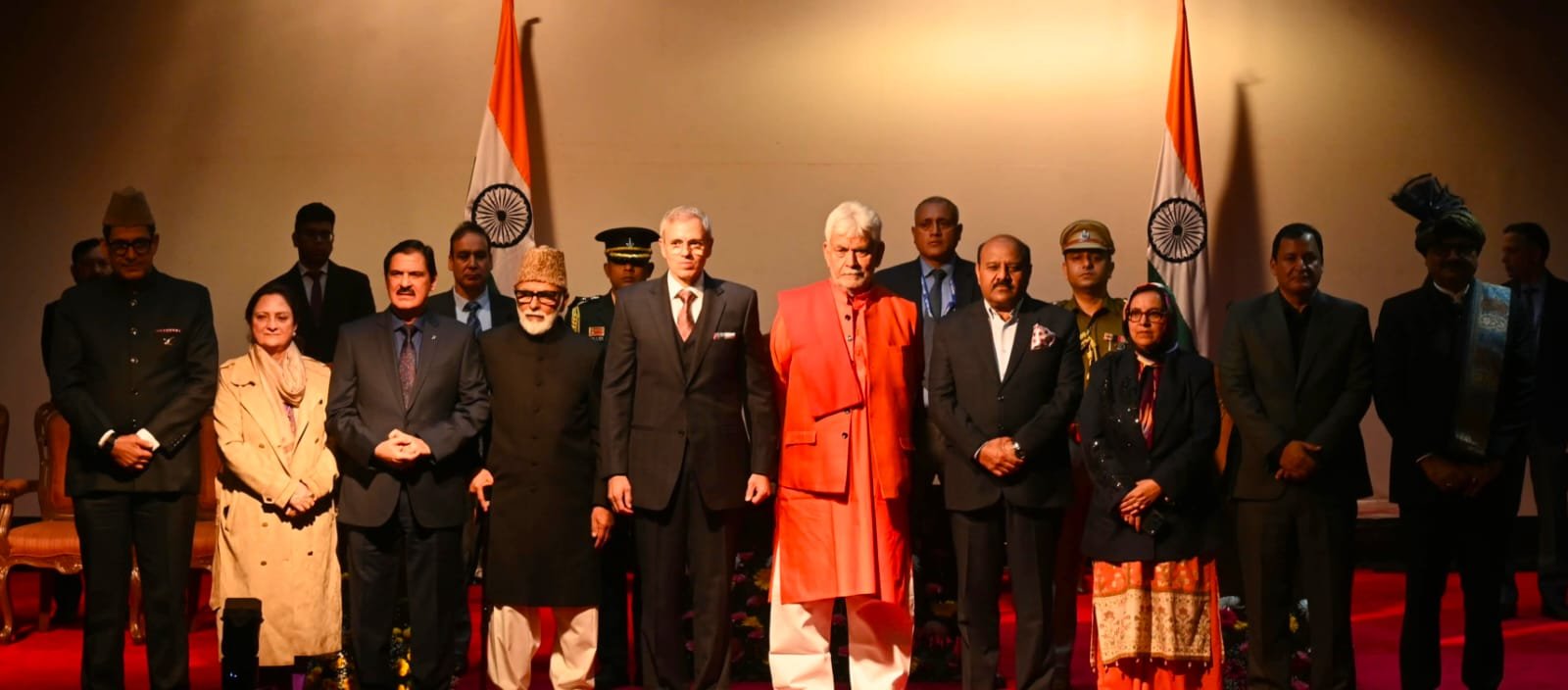
Four National Conference legislators — Ali Mohammad Sagar, Mir Saifullah, Shamima Firdous and Altaf Ahmad Wani, popularly known as Altaf Kaloo — were sworn in as ministers by Lieutenant Governor Manoj Sinha at Lok Bhavan in Srinagar. Independent MLA Satish Sharma, who was part of the earlier Council of Ministers, was dropped.
The expansion, the first major restructuring of the Omar Abdullah-led government since the National Conference returned to power after the 2024 Assembly elections, took the strength of the Council of Ministers to its maximum permissible limit of nine, including the Chief Minister.
But the political consequences of the exercise became apparent within hours of the ceremony. Gurez MLA Nazir Ahmad Gurezi stayed away from the oath-taking event, supporters of veteran leader Mubarak Gul protested at the National Conference headquarters, and Anantnag West MLA Abdul Majeed Larmi publicly expressed his hurt at being left out.
The developments placed the party leadership in the position of having to defend its choices while managing the expectations of legislators who had anticipated a place in the government.
At the National Conference headquarters at Nawa-i-Subah in Srinagar, supporters of Gul raised slogans against his exclusion, arguing that his seniority and decades of service to the party made him deserving of a ministerial berth.
Gul, the six-time legislator from Eidgah and a former Speaker of the Legislative Assembly, had expressed disappointment even before the swearing-in ceremony, saying he had repeatedly witnessed ministerial oath-taking events without himself being inducted.
“I have attended at least 20 oath-taking ceremonies, but I have always been dropped, and I have been dropped this time as well. I will talk at an appropriate time,” he said.
In subsequent remarks, Gul referred to having attended nearly 30 such ceremonies during his political career, underscoring his frustration at once again being overlooked.
His exclusion prompted National Conference president Farooq Abdullah to reach out to him and appoint him the party’s general secretary, a senior organisational position that could help the leadership address the resentment surrounding the Cabinet selection.
The appointment was announced on Tuesday, shortly after the induction of the four ministers. However, reports later in the day suggested that Gul had not accepted the assignment, and the position remained unclear.
The episode highlighted the limits of the Cabinet expansion as a means of accommodating seniority within the party. With the ministry having reached its maximum permissible strength, the leadership has fewer immediate options to address the expectations of legislators left out of the exercise.
Gul has represented Eidgah in multiple Assembly terms, beginning in 1983, and served as Speaker from 2013 to 2015. He was also appointed pro-tem Speaker following the 2024 Assembly elections.
Another significant development was the absence of Gurezi, the National Conference MLA from Gurez in north Kashmir’s Bandipora district, from the swearing-in ceremony.
Gurezi had been among the leaders discussed as a potential contender for a ministerial position. His exclusion prompted newly inducted ministers Mir Saifullah and Altaf Kaloo to visit his residence at Tulsi Bagh in Srinagar.
The two ministers were accompanied by other legislators, including Javid Ahmad Baig and MLAs from Lolab and Sumbal-Sonawari, as efforts were made to persuade Gurezi to accept the leadership’s decision.
Sources said the discussions were aimed at addressing his concerns over being left out of the Cabinet. There was no immediate public statement from Gurezi confirming whether the outreach had succeeded.
The visit suggested that the leadership was keen to prevent the disappointment of a senior legislator from developing into a larger organisational problem.
Gurezi’s absence also added to the political significance of the day, as the expansion was expected not only to strengthen the government administratively but also to settle competing claims within the ruling party.
Abdul Majeed Larmi, the National Conference MLA from Anantnag West, also spoke openly about his disappointment over being left out of the ministry.
Larmi said his seniority, honesty, loyalty and dedication to the party had led him to believe he would be considered for a ministerial position.
“My heart hurts because I was a senior. Secondly, I was honest. Thirdly, I was loyal. Fourthly, I was dedicated,” he said.
He acknowledged that he had expected to be inducted but maintained that he respected the leadership’s decision and would continue working for the party.
“I am a soldier of the party. God willing, we will work for the party. Such situations keep coming up,” he said.
His remarks reflected the dilemma facing several legislators who have remained associated with the party over successive political cycles but were unable to secure a place in a ministry with limited positions.
Larmi also referred to Satish Sharma, who was dropped from the Cabinet despite being an Independent legislator, saying Sharma had made a commitment to join the National Conference.
The immediate reactions from Gul, Gurezi and Larmi showed that the expansion had not resolved all the party’s internal expectations. Instead, the leadership now faces the task of ensuring that the discontent does not affect organisational cohesion.
The expansion brought the Council of Ministers to its statutory limit under the Jammu and Kashmir Reorganisation Act, 2019.
The law limits the strength of the Council of Ministers to 10 per cent of the total membership of the Legislative Assembly. With the Assembly having 90 seats, the maximum permissible strength is nine ministers, including the Chief Minister.
The government had been functioning with six members before Tuesday’s exercise. Four legislators were inducted and Satish Sharma was dropped, taking the strength to nine.
The latest restructuring followed weeks of speculation about the timing and composition of the expansion. Omar Abdullah had indicated that the names had been finalised after consultations with the party leadership and had urged colleagues to refrain from lobbying for ministerial positions.
The final selection appears to have involved balancing legislative experience, political seniority and regional representation, although the exclusion of several senior leaders has shown that not all competing claims could be accommodated.
The expanded Cabinet also leaves no vacant ministerial position for an immediate additional induction unless another reshuffle is undertaken.
The four inductees bring different kinds of political experience to the government.
Ali Mohammad Sagar, a seven-time MLA from Khanyar in Srinagar, is among the National Conference’s most experienced legislators. He has held ministerial positions in previous governments and has been a prominent figure in the party’s organisational structure.
Sagar took his oath in Urdu, while the other three inductees took their oaths in English.
Mir Saifullah, a four-time legislator, previously represented Kupwara for three terms before winning from Trehgam in the 2024 Assembly elections. He has also served as a minister in an earlier government.
Shamima Firdous, a three-time MLA from Habbakadal, is a prominent woman leader of the National Conference and heads its women’s wing. Her induction gives the ministry a second woman member alongside Sakina Itoo.
Altaf Ahmad Kaloo, who represents Pahalgam, won his second Assembly election in 2024 after previously representing the constituency in 2014. He has entered the Council of Ministers for the first time.
The appointments bring additional experience to the government while increasing representation from Srinagar and strengthening the party’s ministerial presence in north and south Kashmir.
The reshuffle has also triggered a debate over the regional composition of the Cabinet.
Seven of the nine ministers are now from Kashmir, while Jammu is represented by Deputy Chief Minister Surinder Choudhary and Javed Ahmad Rana.
Sharma’s exit reduced Jammu’s representation from three ministers to two. All four new inductees hail from Kashmir.
The induction of Sagar and Firdous gives Srinagar two additional representatives in the government, while Saifullah strengthens the representation of north Kashmir and Kaloo adds to that of south Kashmir.
The altered composition became a central point of criticism for the Bharatiya Janata Party, which accused the government of creating a regional and cultural imbalance.
Leader of Opposition Sunil Sharma congratulated the newly inducted ministers but urged them to focus on public welfare rather than political disputes.
He also referred to the legislators who had been left out, saying it was the Chief Minister’s responsibility to address their disappointment.
“I will wipe their tears, but it is Omar Sahab’s responsibility to wipe those tears. We will also wipe them,” Sharma said.
He urged patience when asked about his earlier assertions that the government could fall, saying it was too early to draw conclusions immediately after the swearing-in.
BJP leader and Udhampur East MLA Ranbir Singh Pathania also questioned the government over its election commitments, allegations of corruption and reported differences within the ruling establishment.
Pathania argued that a Cabinet reshuffle could not substitute for delivery on public promises, transparency and accountability. The allegations were part of the BJP’s political criticism and were not independently established by the remarks cited.
The regional composition of the ministry is likely to remain a point of political debate, particularly because the expansion has reduced Jammu’s representation even as the government seeks to project the new Cabinet as a team equipped to address the Union Territory’s administrative priorities.
The party leadership and its ministers sought to play down the significance of the expressions of disappointment, maintaining that members had the right to voice their concerns.
Minister Sakina Itoo dismissed suggestions that the party was facing protests on the streets, arguing that members expressing their views at the party headquarters should not automatically be described as demonstrations.
She said legislators could express disagreement within the party and that ministerial positions were not permanent entitlements.
Itoo also rejected the argument that Jammu had been ignored, pointing to the Chief Minister’s position and the presence of the two ministers from the region.
National Conference MLA Salman Ali Sagar acknowledged that some legislators were disappointed but said the leadership had to consider multiple factors while deciding the composition of the Cabinet.
“Everyone has desires and aspirations, and that is legitimate. However, the leadership has its own compulsions and limitations,” he said.
He maintained that the party had attempted to ensure representation from different parts of Jammu and Kashmir, including north, south and central Kashmir.
National Conference president Farooq Abdullah also defended the expansion, expressing confidence that the new ministers would work to address public difficulties and problems.
The leadership’s response indicates that it is seeking to distinguish disappointment over individual appointments from a wider organisational revolt. However, the protests by Gul’s supporters and Gurezi’s absence have made the management of internal expectations an immediate political priority.
The Congress, an alliance partner of the National Conference, remained outside the government, reiterating that it would not accept ministerial office until statehood was restored to Jammu and Kashmir.
Omar Abdullah had reached out to Jammu and Kashmir Pradesh Congress Committee president Tariq Hameed Karra on Monday evening. Karra declined the offer and conveyed that the Chief Minister could proceed with filling the available positions.
Karra said the Congress had consistently maintained its position on the issue and did not see a need to repeatedly explain its decision to stay out of the Cabinet.
The party will continue to extend support from outside while pressing for the restoration of statehood.
The Congress decision removed the remaining uncertainty over whether the alliance partner would be accommodated in the expanded ministry, allowing the National Conference to complete the exercise with its own legislators.
Congress MLA Irfan Hafiz Lone, meanwhile, said the government should concentrate on delivering on its commitments rather than on who had secured ministerial positions.
He cited issues including daily-wage workers, employment, ration supplies, free electricity, paper leaks, freedom of speech and restoration of statehood as areas requiring attention.
The Congress’s position means that the Cabinet expansion has settled the question of ministerial representation within the ruling party for now, but has not resolved the broader political differences over the Union Territory’s status.
While the political fallout unfolded in Srinagar, the induction of Saifullah was welcomed by supporters in Kupwara district, where celebrations were held with firecrackers and drums.
Supporters credited the Chief Minister with strengthening the district’s representation in the government.
Saifullah said he would work for people across Jammu and Kashmir and attempt to resolve public grievances.
“I am a minister for the whole of Jammu and Kashmir. I will do my best and work for every district. I will try to resolve the problems of the people,” he said, thanking the party leadership for its confidence in him.
The new ministers are expected to receive their portfolios as the government moves towards the administrative phase of the expansion.
For Omar Abdullah, however, the immediate challenge is not limited to assigning departments. The Cabinet has reached its permissible strength, the Congress has declined to join the government, and several senior National Conference legislators have publicly conveyed their disappointment.
The expansion has therefore ended months of suspense over who would enter the Cabinet, but it has also begun a new phase of political management for the ruling party: balancing the authority of its leadership with the expectations of legislators whose seniority and loyalty did not translate into ministerial office.
Comments are closed.