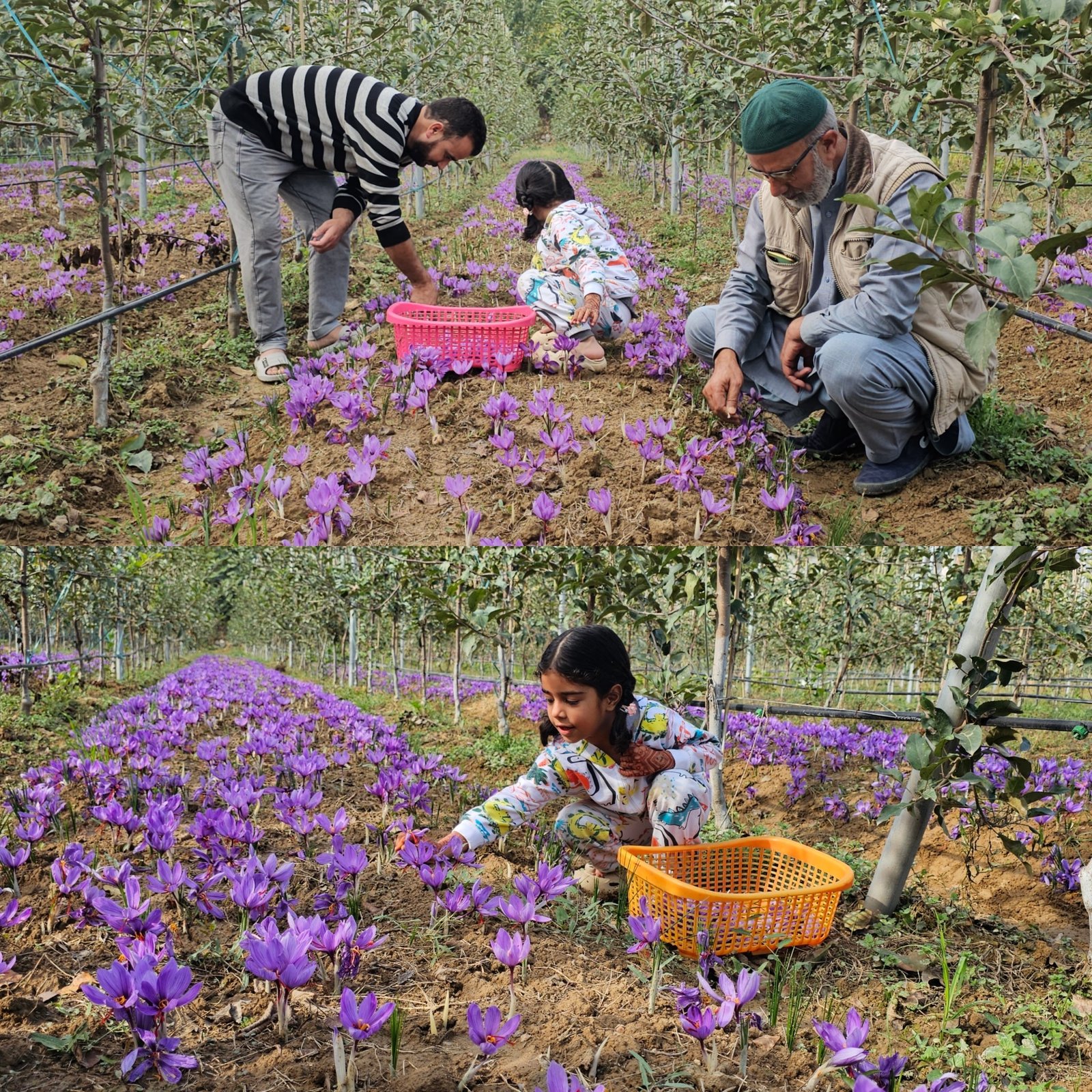
Pampore, October 17: In an innovative farming experiment, a Pampore farmer, Mohammad Sultan Rather, is growing saffron in a high-density apple orchard, exploring the potential of cultivating the region’s prized spice alongside apple trees to make better use of agricultural land.
Rather, who began the experiment in 2025, has reported encouraging results in the second year of the trial. Although the flowering is yet to reach its full stage, he said the crop’s progress had strengthened his confidence in the possibility of integrating saffron cultivation with high-density apple farming.
Speaking to Kashmir Convener, Rather attributed the encouraging growth primarily to timely irrigation during August and September, along with moisture retention in the soil beneath the apple plants.
“The main reason behind this encouraging crop is that I irrigated the field two to three times during August and September. The high-density apple plants have also helped retain moisture in the soil, which has contributed to better saffron growth and production,” he said.
Recalling the quality of saffron produced in Pampore nearly two decades ago, Rather said the results of his experiment reminded him of the region’s earlier harvests and strengthened his belief that suitable cultivation practices could help improve production.
“Saffron is not merely a cash crop; it is an integral part of Pampore’s heritage and identity. If we want to preserve this legacy for future generations, we must ensure timely irrigation and adopt suitable cultivation practices to improve production,” he said.
Highlighting the challenges confronting saffron growers, Rather said production across the Pampore saffron belt had declined over the years, with changing climatic conditions and inadequate rainfall emerging as major concerns.
“Earlier, we used to receive adequate rainfall, and saffron production was quite good. However, over the past three decades, we have observed a gradual decline in rainfall due to changing climatic conditions. Since saffron cultivation largely depends on natural rainfall, the shortage of rain has significantly affected production and reduced crop yields,” he said.
Concerned about the declining productivity of the traditional crop, Rather decided to explore whether the vacant spaces between high-density apple plants could be used for saffron cultivation.
“I started this experiment in 2025 because saffron production was declining, and I wanted to explore whether the available space between high-density apple plants could be utilised for saffron cultivation. Although some of my family members were initially hesitant, I decided to undertake the trial to see whether this approach could prove successful,” he told Kashmir Convener.
According to Rather, the results in 2026 have been promising, with two rounds of flower picking completed so far.
“The crop appears similar to the kind of saffron we used to grow 20 to 25 years ago. The results have strengthened my confidence that saffron cultivation in high-density apple orchards could prove to be a successful initiative,” he said.
Rather said timely irrigation during August and September was crucial for supporting saffron flowering and improving production. He believes that growing saffron between apple plants could enable farmers to utilise available land more efficiently while potentially reducing irrigation requirements.
“Being from an agricultural family, I understand the importance of irrigation in saffron cultivation. Providing adequate moisture during August and September can help improve flowering and production. If this model is adopted successfully in Pampore, it could open new opportunities for farmers,” he said.
He added that moisture retained in the soil beneath apple plants could create favourable conditions for saffron growth and reduce the need for additional irrigation.
“I believe this integrated farming model could reduce irrigation requirements by nearly 50 per cent. The moisture retained in the soil may provide additional benefits for saffron growth and production,” Rather said, adding that further trials would be needed to establish the model’s potential.
He expressed hope that his experiment would encourage other farmers in Pampore to explore saffron cultivation in high-density apple orchards, particularly as growers seek practical ways to improve productivity and sustain their traditional livelihoods.
Meanwhile, Rather urged the Agriculture Department Kashmir to address persistent irrigation-related problems in the Pampore saffron belt.
He said crores of rupees had been spent on developing irrigation infrastructure under the National Saffron Mission, but inadequate planning and implementation had affected its effectiveness on the ground.
According to Rather, around 120 borewells were installed in the area, but most have since become non-functional, depriving saffron growers of an important source of irrigation.
“Had these borewells remained functional, saffron production in Pampore would have been much better. We have witnessed poor production over the past few years, and the lack of adequate irrigation facilities is one of the major concerns faced by farmers,” he said.
He appealed to the concerned authorities to restore the defunct borewells, strengthen irrigation facilities and ensure that the infrastructure developed under the National Saffron Mission serves its intended purpose.
Rather said a combination of timely irrigation, improved cultivation practices, functional irrigation infrastructure and innovative farming methods could help address the challenges confronting saffron growers.
His experiment highlights the potential of integrated farming to improve land utilisation by growing saffron alongside high-density apple plants. While further trials are needed to establish the model’s viability and its impact on yields and irrigation requirements, the initiative offers an alternative approach for farmers seeking to sustain saffron cultivation in Pampore.
For the region’s saffron growers, the experiment represents an effort to combine traditional cultivation with innovative farming practices while preserving Pampore’s longstanding saffron heritage.


Comments are closed.