
Women’s Work Must Translate into Economic Independence
India’s rising female workforce participation and expanding support for women entrepreneurs mark progress, but the real test lies in better incomes, secure employment and opportunities for sustained growth.

S Ahmad
India’s women employment story is moving from participation to better-quality work. PLFS shows female Labour Force Participation Rate (LFPR) rising from 23.3% in 2017-18 to 40% in 2025, while Worker Population Rate (WPR) increased from 22% to 38.8%. Building on this improvement, policy support is strengthening women’s work through formal enterprise recognition, credit, market access, safer workplaces, skilling and new livelihood avenues. Now, the focus is on turning higher participation into stronger income, security and economic development.
India’s women’s employment story is entering an important phase. The challenge is no longer limited to bringing more women into the workforce; it is also about ensuring that their participation translates into reliable incomes, financial independence and greater economic security. Rising workforce participation, growing women-led enterprises and expanding opportunities in technology and manufacturing indicate progress. The next task is to make these gains more inclusive, durable and meaningful.
According to the Periodic Labour Force Survey figures cited by the government, the female Labour Force Participation Rate (LFPR) for women aged 15 years and above increased from 23.3 per cent in 2017–18 to 40 per cent in 2025. The Worker Population Ratio (WPR) rose from 22 per cent to 38.8 per cent over the same period. An estimated 20 crore women aged 15 years and above were employed in 2025.
These figures point to a significant expansion in women’s engagement with the labour market. However, participation rates alone cannot tell the full story. The quality of employment, earnings, job security, working conditions and opportunities for advancement are equally important. A meaningful employment strategy must ensure that women can enter work, remain in it and progress without facing avoidable barriers.
From participation to enterprise
Entrepreneurship offers one route towards greater economic independence. Women-owned businesses can generate income, create jobs and help build assets, particularly when entrepreneurs have access to finance, skills and dependable markets.
Government figures show that approximately 3.69 crore registered micro, small and medium enterprises were women-owned as of October 2026, accounting for around 38 per cent of registrations. By March 2026, more than 1.07 lakh recognised startups had at least one woman director or partner, representing approximately 48 per cent of recognised startups.
These numbers demonstrate the growing presence of women in the formal enterprise ecosystem. But registration is only the beginning. Small businesses need working capital, market information, reliable infrastructure, digital capabilities and support to manage costs. Without these, formal recognition may not translate into business stability or expansion.
Initiatives such as the Swavalambini Scheme and the Yashasvini Campaign seek to support women through entrepreneurship training, handholding and formalisation. The government reports that the Yashasvini Campaign facilitated more than 22 lakh women-owned MSME registrations by July 2026. Such initiatives can widen access to the formal economy, provided that registration is followed by practical support for business development.
Credit must lead to growth
Access to finance remains central to women’s enterprise development. The Pradhan Mantri MUDRA Yojana has sanctioned more than 57.79 crore loans since its inception, with women accounting for around two-thirds of the loans, according to figures available in April 2026.
The Credit Guarantee Scheme for Micro and Small Enterprises provides enhanced guarantee coverage for women-led enterprises, while the Prime Minister’s Employment Generation Programme offers eligible women higher subsidy rates for establishing micro-enterprises. Support for women-led startups also includes seed funding and credit guarantees.
These mechanisms can help entrepreneurs overcome barriers to finance, particularly where collateral and limited credit histories restrict access to conventional lending. Yet the effectiveness of credit programmes must be assessed by more than the number or value of loans sanctioned. The relevant questions are whether enterprises survive, whether incomes improve, whether businesses expand and whether women gain greater control over their earnings.
Credit must be accompanied by financial literacy, transparent lending practices, business mentoring and market access. Otherwise, access to a loan may increase financial obligations without guaranteeing sustainable returns.
Connecting producers to markets
For women entrepreneurs, producing goods is only one part of the business process. Finding buyers, meeting quality standards, pricing products competitively and receiving timely payments are equally important.
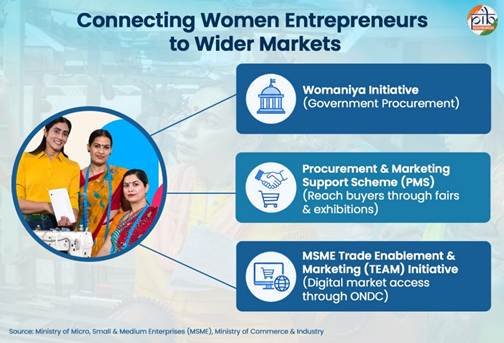
The Government e-Marketplace’s Womaniya initiative seeks to connect women-owned micro and small enterprises and self-help groups with government buyers. By July 2026, more than 2.17 lakh women-owned MSEs were registered on GeM. The government reported that contracts worth more than ₹28,000 crore were awarded to women-owned MSEs during 2025–26, with the total contract value growing by 27.6 per cent over the previous year.
The Procurement and Marketing Support Scheme and the MSME Trade Enablement and Marketing initiative also seek to help smaller businesses reach new markets, including through exhibitions and digital commerce.
These efforts address a critical gap between production and income. However, women-led businesses need more than a digital listing. They require support with packaging, product quality, branding, logistics, digital payments and compliance. Public procurement can create valuable opportunities, but transparent procedures and timely payments are necessary to make those opportunities commercially sustainable.
Women are entering emerging sectors
The changing profile of women’s employment is also visible in manufacturing, aviation, semiconductor development and scientific research.
According to the government’s October 2026 note, women accounted for nearly 70 per cent of the direct workforce in mobile phone manufacturing as of July 2026. Women represented around 25 per cent of the semiconductor workforce as of March 2025. Their participation in STEM research careers increased from 13 per cent in 2000–01 to 29 per cent in 2023–24, according to the Research and Development Statistics 2025–26 report cited in the note.
These developments suggest that women are contributing to sectors that can offer specialised skills and new career pathways. But representation must be matched by opportunities for training, retention, promotion and leadership. Access to technical jobs is important; so are fair wages, safe working environments, career progression and the ability to return to work after career interruptions.
Skilling programmes, including PMKVY 4.0, apprenticeship initiatives, NAVYA and AI Careers for Women, aim to prepare women for emerging occupations. Research programmes such as WISE-KIRAN support women pursuing scientific careers and research opportunities.
The impact of these initiatives will depend on how effectively training connects with actual employment. Courses must respond to industry demand, provide practical experience and help participants move into jobs or viable self-employment. Training figures are useful indicators of reach, but employment outcomes and sustained career progression should remain the ultimate measures of success.
Safe workplaces are essential
Women cannot participate fully in economic life if workplaces are unsafe, discriminatory or incompatible with family responsibilities. Employment policies must therefore address not only access to jobs but also the conditions under which women work.
The labour-law framework described in the government note includes provisions relating to maternity benefits, crèche facilities, representation in grievance redressal mechanisms and women’s employment in establishments, including night shifts subject to consent and prescribed safeguards. These measures are intended to support workplace safety, equality and wider access to employment.
Their effectiveness depends on implementation. Workers must know their rights, employers must comply with applicable requirements, and grievance mechanisms must be accessible and credible. Safety cannot be reduced to formal rules; it also requires prevention of harassment, fair treatment and accountability when complaints arise.
Care responsibilities remain another major consideration. Maternity protection, childcare facilities and workable employment arrangements can help women remain in the workforce instead of leaving jobs because household responsibilities become difficult to manage. Employers and public institutions both have a role in creating conditions that allow women to pursue careers without being forced to choose between paid work and family care.
The next challenge is quality
India’s progress in women’s employment should be measured through a broader set of outcomes. Rising participation matters, but it must be accompanied by better earnings, secure work, social protection and opportunities for advancement. For entrepreneurs, the relevant measures include business survival, access to markets, profitability and the capacity to employ others.
Policy implementation should also account for differences in geography, education, income and access to infrastructure. Women in smaller towns and rural areas may need transport, digital connectivity, affordable childcare, local training and easier access to institutional finance. A programme designed around formal enterprises may not adequately address the needs of women whose economic activities remain small or informal.
For Jammu and Kashmir, these priorities are particularly relevant to women involved in handicrafts, handloom, food processing, tourism, agriculture and other local enterprises. Better market linkages, product development, digital marketing, skills and access to affordable finance can help women-led businesses reach customers beyond their immediate communities. Such efforts must be tailored to local conditions and supported by reliable market demand.
Ultimately, women’s economic empowerment is not achieved merely by increasing the number of registrations, loans or training certificates. These are important instruments, but their value lies in the opportunities they create.
India has expanded the policy architecture supporting women’s work, enterprise and skill development. The next phase must focus on implementation and measurable outcomes. More women should be able to secure decent employment, build sustainable businesses, acquire valuable skills and progress into leadership roles.
The objective is not simply to bring women into the economy. It is to ensure that economic participation strengthens their independence, dignity and choices. That is how higher workforce participation can become a foundation for more inclusive and sustained development.
Comments are closed.