


Sakeena Masood Itoo’s Leadership in the Kashmir Context

Dr. Arif Ahmad Dar


Kashmir leadership cannot be measured using standard criteria only. In areas where political life is exercised under the conditions of a long history of the conflict development, uncertainty and instability of institutions, leadership is evaluated not only by the policy productions or indicators of development, but by more liquid features. Being available on a crisis occasion, capacity to receive grief, anger of the people and show a clear edge to continuance of the institution become primary indicators of serving the people.

In this context-specific paradigm, the political principal bearing of Sakeena Masood Itoo is quite an instance of leadership that is not molded so much on ideological affirmation but rather on endurance, restraint, and interpersonal responsibility.

The Kashmir situation presents unique requirements of leadership. Political power exists in the environment of periodic violence, administrative ruptures and profound social trauma. The institutions operate under difficulty and trust of the people is easily shaken more often than not, the occurrence of events outside the mandate of the governance of civil citizens.

Under these conditions, leadership takes on an ethical level beyond managerial competence. It is not only the presence of leaders as decision-makers that is expected, but also as witnesses, who recognize suffering, are available in the presence of disruption, and perpetuate the conception of governance when its systems are compromised.


Being there during a crisis is the first and, perhaps, the most obvious standard of leadership evaluation. Crises in Kashmir are not a special phenomenon of the life of the mass media, but a common phenomenon. Closing of operations, demonstrations, patrol, natural interruptions, and abrupt changes of administration break stream after stream. At this point, the lack of political figures tends to further suggest feelings of being dumped, and the presence, albeit with minimal practical value, has all the symbolic value of that.


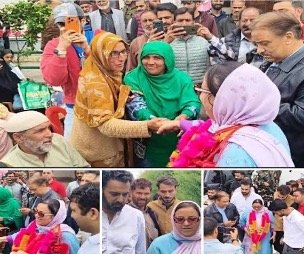
The career path of Sakeena Masood Itoo shows that she is keenly aware of this dynamic. Her style of politics continuously focused on visibility in time of insecurities. Such presence was hardly dramatic or challenging. Rather, it was in the form of visits to the impacted families, communication with the local communities and follow up communication with the administrative lines.

These moves did not work out crises, but they opposed the obliteration that violence and disruption are inclined to create. Leadership forged the relevance of civilian representation by staying visible during the time of withdrawal when being invisible could have been considered safer and more convenient.

Notably, vision in this matter had to be person-centrically calibrated. Too much publicity might incite a backlash or jeopardize personal security but less publicity might diminish credibility. It required guile to maneuver through this tension and not braveness. Presence itself was thus selective and based on the building of small kind of interactions as opposed to mass mobilization. This strategy was manifested in an awareness that crisis leadership is not about exerting control but an awareness of maintaining contact.


The second criterion is an aptitude to absorb the grief and anger of people further sets the leadership of Kashmir apart in more stable political setups. The passion of the people in the societies that are conflict-ridden is strained, mixed and unresolved. Sorrow of loss, rage of perceived injustice and hopelessness about uncertainties coexist, which are often manifested through our communications to political leaders. Leaders become mediums of emotion that is not always being poured on them but on the greater organization of power and history.

This emotional burden has to be absorbed through specific type of political labor. It requires patience, the ability to control ones emotions, and being empathetic and the ability to listen without being dismissive or defensive.

The capacity was evident in the leadership approach exhibited by Sakeena Masood Itoo. The ability to block the expression of emotions and control the tone of her speech enabled her to approach volatile situations without exaggerating them. She did not reflect the outburst of the masses, but did not also endeavor to repress it by authority. Rather, she recognized feeling as she shifted the interaction to conversation and procedure.

One must not be passive by receiving the grief and anger without turning it into confrontation but rather this is an active skill of leadership. It moderates contact and minimizes the chances of an escalation and space to participate in an institutional manner is maintained. Where rhetoric becomes easy to be incendiary, prudence is a political virtue and not a virtue. Such self-restraint over time leads to credibility, which is one of the signs that leadership may endure the pressure and it does not fall into pieces.

The third requirement, a dedication to running an institution, establishes the leadership on Kashmir as having an extended time frame. Organizations in war-torn states are often disorganized, restructured or put on hold.

Both breaks threaten to make the governance a case of episodic governance instead of a sustainable one. Normative meaning is gained in keeping institutional routines in this environment. The continuity in itself is a political success.

This is the principle that Sakeena Masood Itoo has upheld in her career. In electoral periods and government transitions and structures, her politics stressed maintenance of presence after institutional order instead of dramatic break. Either in terms of the welfare delivery, redressal of grievances, or coordination of the administration, the point was always to keep systems functioning however in an imperfect manner.

This orientation thwarted the temptation to make governance start with the self or to understand leadership in terms of individual action only. Rather, it strengthened the notion that the concept of public service is practiced by institutions that have to be stronger than individuals.

An example of authority in her reaction to criticism and press attention is also related to institutional continuity. Instead of the public rebuttal or the process of rhetoric upheaval, she responded in an administrative tone and procedure.

This policy was a sign of trust in institutional avenues as opposed to performative defense. Such moderation promoted stability, even at the price of direct narrative control, in a world in which popular discourse is usually polarised.

The three mentioned criteria, being present during crisis, internalizing societal feeling, and commitment to continuity, are what constitute a context-sensitive understanding of leadership that is significantly different when compared with prevailing political typologies.

Here, charisma does not mean speaking, it is more to bear with. Power is not obtained by claiming but through trustworthiness. The judged leadership is not measured by the measure of transformation that has been accomplished, but how the involved has been able to withstand collapse and maintain engagement.

In this regard, her career also affects the gendered aspects of leadership. Being a woman, and working in one of the traditionally male-dominated political spheres, the expectations were compounded with criticism. Assertiveness was dangerous to be perceived as aggression whereas restraint was risky to be perceived as weak.

This state of both binds had to be carefully balanced. Taking composure and consistency as the foundation of leadership, Sakeena Masood Itoo defied such limited views of what leadership entailed and proved that stability and empathy might achieve respect even in the most unstable settings.

Besides, her leadership highlights the relational aspect of serving the people in Kashmir. Leaders are often tested by constituents in their daily lives and not according to their ideological connection. Accessibility, listening and follow up tend to prove to be rather important than policy articulation. This assessment system embodies the experience: the quality of interplay is used as a province of institutional legitimacy in instances where the institutions are weak. This is because, in this sense, the role of leadership is played via repetitive rather than individual actions of engagement.

On a more general note, her career can be viewed as an example of the fact that leadership in Kashmir cannot exist outside of collective memory. Political actors are placed in the context of a history of loss, resistance, and survival. The decisions made by the leaders are perceived not only in the current context but also through the experience. This landscape is one that needs sensitivity to memory and vision in order to remain in continuity. It requires an understanding that governance is as much about keeping dignity and a bond as well as it is about services.

More importantly, such context-oriented leadership does not mean that there is no ambition or policy-focus. Instead, it redefines ambition as being incremental and embedded. The restructuring is limited to the factors that cannot be worked out by an individual, though, stabilization and access are possible destinations. With these as priorities, leadership turns out to be in line with realities of the environment instead of confronting them in rhetoric.

To sum up, the situation in Kashmir needs to be perceived as a leader that needs a different evaluative approach. It is not only judged by results, but by behaviour under pressure, not only by reform, but by persistence, not only by power, but by sympathetic or empathetic feeling. Sakeena Masood Itoo is a perfect example of this perception of the serving population.

Her constant availability in times of crisis, ability to internalize the suffering and anger of the people, and her dedication to being an institution instead of being an ideal is an indication of a leadership style that is context-specific instead of abstract idealism. In an area where political overkill can be socially redressive, this type of leadership proves that they do not make quietism or self-restraint or even the art of relationships the by-products of a leadership style, but rather the main pillars of an effective leadership.


Author is a Contractual Assistant Professor Govt. Degree College Kulgam. He can be mailed at  hsnarif37@gmail.com

Comments are closed.