
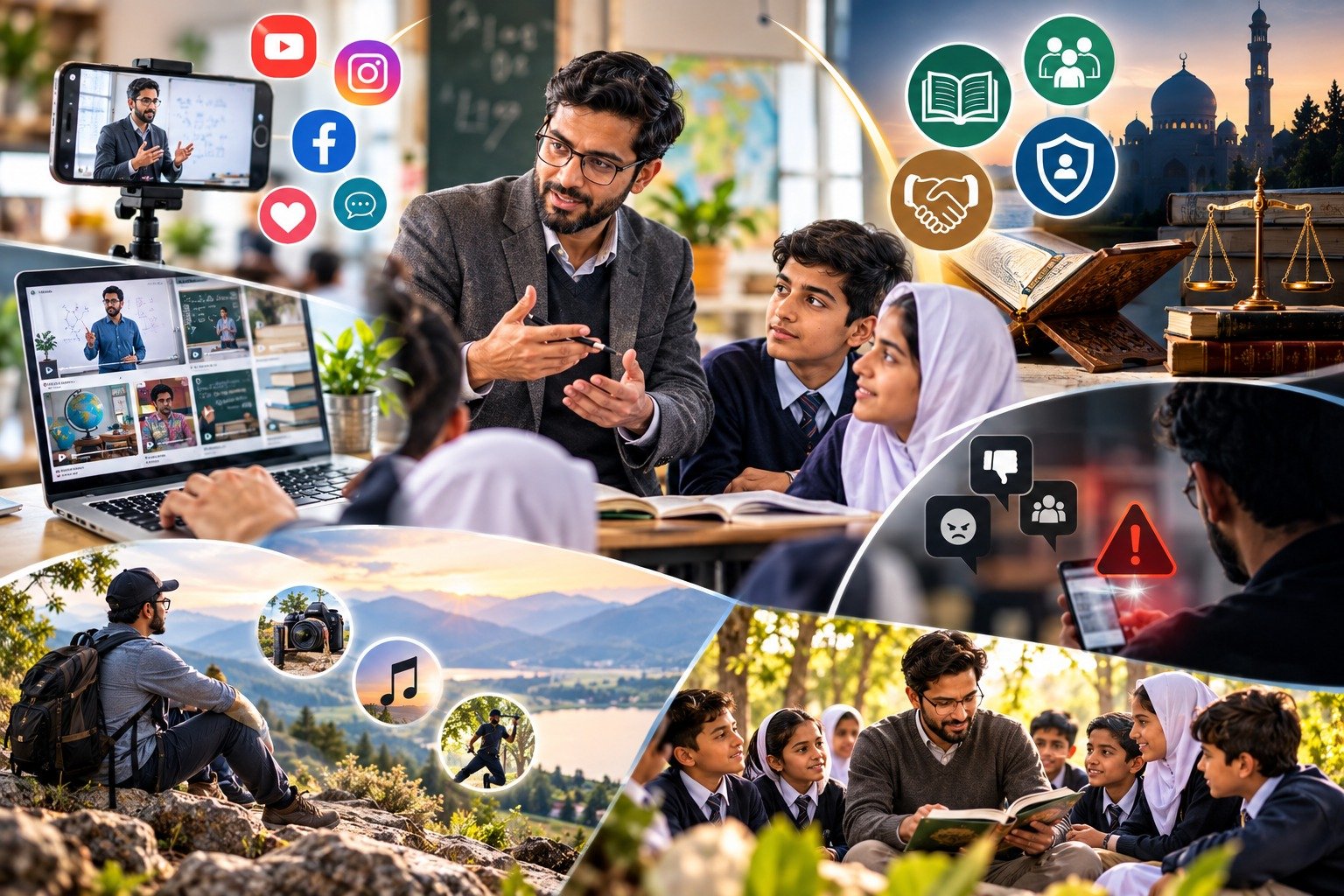
Teachers in the Age of Social Media: Dignity, Responsibility and Public Trust

Teachers must use digital platforms thoughtfully, protect students’ privacy and credibility, and balance professional ethics with personal freedom.


Malik Mushtaq


A reel may disappear from public attention within days, but the influence of a good teacher can endure for generations. Let our legacy be knowledge rather than noise, service rather than self-promotion, and character rather than showmanship.

Teachers do far more than complete syllabi, conduct examinations and prepare students for the next stage of their education. They help shape character, nurture curiosity and influence how young people understand the world. Their contribution extends beyond classrooms because students learn not only from what teachers say but also from how they behave.

In an age when a short video can reach thousands of people within minutes, this responsibility has acquired a new dimension. Social media has opened valuable opportunities for teachers to share knowledge, demonstrate innovative teaching methods and engage with the wider community. At the same time, it has made public communication more immediate and exposed personal conduct to wider scrutiny.

As a member of the teaching fraternity, I believe this calls for reflection rather than condemnation. Teachers deserve personal freedom, privacy and the opportunity to enjoy life beyond their professional responsibilities. However, they must also recognise that their public conduct can influence students’ perceptions and shape society’s confidence in the teaching profession.

The challenge is not to keep teachers away from social media. It is to encourage its responsible use.

Teaching Is a Responsibility Beyond the Classroom

Every doctor, engineer, scientist, administrator and professional begins as a student. Behind their development stands a teacher who helped build their knowledge and confidence. A teacher’s influence can therefore extend across generations.

A few words of encouragement can change a child’s outlook, while humiliation, discrimination or unfair treatment can leave lasting effects. Similarly, when students see teachers demonstrating honesty, respect, patience and discipline, these values become more meaningful than abstract lessons.

The same principle applies to the digital world. Teachers who share unverified information, use abusive language or ridicule others online risk contradicting the values they promote in classrooms. Conversely, those who communicate thoughtfully and use technology constructively reinforce the importance of responsible citizenship.

Professional credibility is built through subject knowledge, preparation, fairness and consistent conduct. Social-media popularity cannot replace these qualities.

The Islamic Emphasis on Knowledge and Character

In the Islamic tradition, knowledge carries great importance. The first revealed verses of the Holy Qur’an begin with the command to read:

“Read in the name of your Lord who created.” (Qur’an 96:1)

The Qur’an also teaches believers to pray: “My Lord, increase me in knowledge.” (Qur’an 20:114)

These verses remind educators that learning is a continuous process. A teacher’s responsibility does not end with obtaining a degree or securing an appointment. It requires a willingness to update knowledge, improve teaching methods and develop personal character.

The Qur’an further commands:

“Indeed, Allah commands you to render trusts to whom they are due.” (Qur’an 4:58)

Students, classroom time and professional responsibilities may be understood as trusts placed in the hands of educators. Public service must therefore be approached with sincerity and accountability.

The Prophet Muhammad (peace be upon him) also emphasised the importance of character and responsible speech. A well-known hadith recorded in Sahih al-Bukhari and Sahih Muslim advises believers to speak good or remain silent.

This principle has particular relevance in the digital age. Not every disagreement requires a public response, not every provocation deserves an argument, and not every thought needs to become a post.

The Qur’an also cautions believers against pursuing matters about which they have no knowledge (17:36) and instructs them to verify information before acting upon it (49:6). These teachings offer a sound ethical foundation for online communication, where misleading captions, edited videos and unverified claims can quickly damage reputations.

For teachers, responsible communication should be a matter of professional integrity as well as personal conviction.

Social Media: An Opportunity, Not Merely a Risk

Facebook, Instagram, YouTube and other platforms can become extensions of the classroom. Teachers can explain difficult concepts, share educational resources, promote reading, demonstrate science experiments and help parents support learning at home.

They can also use these platforms to raise awareness about bullying, cyber safety, substance abuse, environmental protection and other issues affecting young people.

A simple video explaining a mathematical concept may help a student who cannot afford private tuition. A demonstration using inexpensive teaching materials may inspire educators in schools with limited resources. A thoughtful discussion can encourage young people to approach difficult questions with curiosity and responsibility.

These are meaningful uses of technology.

The concern arises when the pursuit of likes, views and followers begins to take precedence over the purpose of communication. Content that humiliates others, spreads misinformation, promotes discrimination or exposes students to risk deserves careful reconsideration.

Yet it would be unfair to label every reel, photograph or entertaining video as unprofessional. Teachers are human beings with interests, talents, families and lives outside school. They can enjoy music, sports, travel, cultural activities, humour and creative expression without compromising their professional responsibilities.

The appropriate standard is not constant seriousness but sound judgement. Professionalism does not require the absence of personality; it requires an awareness of how our actions affect others.

Before sharing content publicly, teachers can ask themselves a few simple questions: Is it accurate? Is it respectful? Does it serve a useful purpose? Could it violate someone’s privacy or cause avoidable harm? Am I comfortable with the possibility that students, parents and colleagues may see it?

Such reflection should encourage thoughtful participation, not fear of public scrutiny.

Students’ Safety and Dignity Must Come First

Teachers increasingly interact with students in a world where school boundaries and digital spaces overlap. This makes privacy and professional boundaries especially important.

Photographs and videos of students should be shared only when there is an appropriate purpose and the necessary permission. Confidential information about a child must never be disclosed for publicity or online engagement. Teachers should also ensure that digital communication with students remains appropriate and safeguards their welfare.

A teacher’s authority carries responsibilities that should never be used to pressure students into following personal accounts, participating in online content or sharing private information.

At the same time, public criticism of teachers must be fair and proportionate. A single photograph or video cannot always reveal a person’s character, intentions or circumstances. Context matters, facts must be established, and everyone deserves an opportunity to explain a mistake.

Accountability should not become harassment, and professional ethics should not be used as an excuse for moral policing.

Teachers deserve respect and understanding for the challenges they face, including heavy workloads, administrative duties, limited resources and family responsibilities. Society must recognise their humanity even while expecting them to exercise responsible judgement.

Protecting Credibility Through Responsible Conduct

Credibility develops gradually through punctuality, preparation, fairness, subject knowledge and sincerity. Students trust teachers who treat them with dignity, acknowledge mistakes and explain difficult concepts patiently. Parents gain confidence when they see their children learning and developing.

Careless public communication can weaken that trust, particularly when it involves false allegations, abusive language, misleading information or the misuse of professional authority. This does not mean that teachers should avoid raising concerns or criticising decisions. Legitimate criticism is an essential part of a healthy educational system.

Teachers should be able to speak about staff shortages, inadequate infrastructure, learning gaps, working conditions and other educational challenges. Such advocacy should be factual, respectful and directed towards solutions rather than personal attacks.

Professional responsibility must never be confused with unquestioning silence. A teacher can defend legitimate rights, challenge an unfair decision and express a personal opinion while maintaining dignity and respect for others.

The distinction lies in the manner of communication and the evidence supporting it.

Let Social Media Become a Classroom Without Walls

Rather than focusing only on what teachers should avoid online, the education system should encourage them to create useful content and share good practices.

Mathematics and science teachers can explain difficult topics through simple demonstrations. Language teachers can promote reading and writing. Sports instructors can encourage fitness and teamwork. Experienced educators can guide younger colleagues and share practical classroom innovations.

Teachers can also use digital platforms to promote inclusion, foundational literacy, environmental awareness and respect for diversity. Such contributions can extend educational opportunities beyond the school building and connect teachers across geographical boundaries.

Education authorities and professional associations should support this constructive use of technology through digital-literacy programmes, professional development and clear guidance on privacy, online conduct and communication with students.

The objective should not be to turn every teacher into a content creator or public personality. It should be to ensure that those who choose to use social media have the skills and judgement to do so responsibly.

A useful educational post can benefit more people than a popular but empty performance. The value of digital communication should ultimately be measured by its contribution to learning, understanding and public welfare.

A Balanced Approach to Professional Ethics

The teaching profession deserves high standards, but those standards must be reasonable and applied fairly. Not every personal expression is misconduct, just as not every act of criticism is indiscipline. Teachers should not be expected to surrender their individuality or private lives simply because they work in education.

At the same time, professional freedom must be accompanied by responsibility, particularly when online conduct affects students, reveals confidential information or causes demonstrable harm.

A few practical principles can help: verify information before sharing it; avoid abusive and discriminatory language; protect students’ privacy; maintain appropriate professional boundaries; distinguish personal opinions from official institutional statements; respond calmly to criticism; and correct misleading or harmful posts when necessary.

These habits do not require complicated rules. They require reflection, integrity and a willingness to learn.

Teachers should also extend the same fairness to colleagues that they expect from society. Instead of rushing to judge someone over an online controversy, they can encourage constructive discussion, mentorship and self-correction. Educational institutions, in turn, should address genuine misconduct through fair procedures rather than public humiliation.

The aim must be improvement, not intimidation.

An Appeal to the Teaching Fraternity

As teachers, we have an opportunity to influence lives in ways that may remain meaningful long after our students leave school. A child may forget the details of a lesson but remember the encouragement received from a teacher during a difficult period. A simple act of fairness can strengthen a student’s confidence, while a good example can shape how that student treats others.

This influence should encourage us to examine our own habits before criticising those of others.

If we want students to become responsible digital citizens, we must demonstrate responsible digital behaviour. If we expect them to verify information, we should do the same. If we teach respect for diversity, our public communication should reflect that value. If we want lifelong learners, we must remain willing to learn ourselves.

We should neither become prisoners of public opinion nor disregard the consequences of our actions. The right approach lies in balancing personal freedom with professional responsibility, and accountability with compassion.

The Holy Qur’an states:

“Indeed, Allah will not change the condition of a people until they change what is in themselves.” (Qur’an 13:11)

The principle of self-improvement is relevant to our schools and to the teaching fraternity as a whole. Progress begins with the willingness to reflect, recognise shortcomings and improve.

Our legacy will not be measured by followers, views or likes. It will be measured by the minds we help develop, the confidence we build, the opportunities we create and the values we demonstrate.

Let us use our phones as instruments of knowledge, our words to promote understanding and our public presence to encourage constructive change. Let us defend the dignity of the teaching profession without denying the humanity of those who serve it.

Comments are closed.