
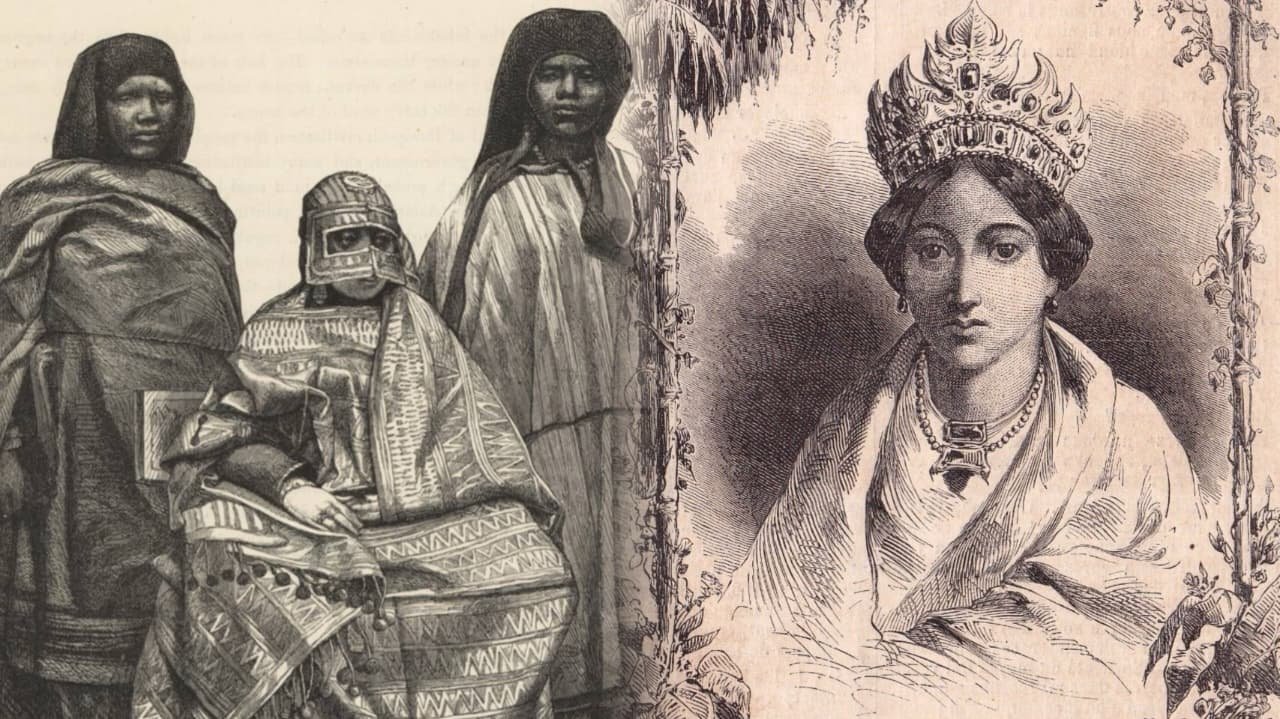

Tamanna Hazarika
“Despite facing foreign pressure, political uncertainty and repeated challenges to her authority, Djoumbé Fatima demonstrated remarkable determination in defending her position as ruler and reclaiming her throne.”
Djoumbé Fatima (c. 1837–1878), who was also called Djoumbé Soudi or Queen Jumbe-Souli, was a powerful female ruler of the island of Mohéli in the Comoros. She became the Sultana at a very young age in 1842 and ruled until 1865. Later, she returned to power again in 1874 and continued ruling until she died in 1878.
Early life and reign:
Djoumbé Fatima became the ruler of the island of Mohéli (also called Mwali) after her father, Ramanetaka (also known as Sultan Abderahmane), died in 1842. Her father was originally a prince from Madagascar. He had fled his homeland after the death of Radama I. Djoumbé Fatima was also related to the royal family of Madagascar and was a cousin of Radama II. She had a sister named Jumbe-Salama, but she died at a young age.
Her mother, Ravao, came from the Merina royal group of Madagascar and was the daughter of Andriantsiahofa from the region of Imamo West. After the death of her husband, Ravao acted as regent, meaning she ruled on behalf of her young daughter for some time.
In 1843, Ravao married her late husband’s former adviser, General Ratsivandini. After this marriage, he became an important figure in the kingdom and took charge of guiding young Jumbe-Souli.
Sadly, Ravao died in 1847, reportedly by poisoning. After her mother’s death, General Ratsivandini became Djoumbé Fatima’s tutor and guardian. He began planning her future, including arranging her marriage to the Sultan of Zanzibar.
When the missionary David Griffiths came to Mohéli in 1841, he expected to meet the island’s ruler, Djoumbé Fatima’s father. Instead, he was surprised to find that the young girl, Djoumbé Fatima, was on the throne. Like most people on the island, she followed Islam and chose not to convert to Christianity.
Relations with the French:
Around 1846, the nearby island of Mayotte came under the control of France. The French wanted to increase their influence over Mohéli, so they sent a woman named Madame Droit to act as a governess and guide for the young queen.
With French support, Djoumbé Fatima was officially crowned at the age of just 12 in 1849. However, she did not want too much foreign control. Only two years later, she sent the governess away. She then married Saïd Mohammed Nasser M’Kadar, who was a cousin of the Sultan of Zanzibar.
He became her husband and ruled alongside her as prince consort. Their rule continued until 1860, when the French removed him from power. Even after this, Djoumbé Fatima remained the ruler. Over time, she married two more sultans and eventually gave up the throne in favour of her son.
In 1863, the French government sent an official group to meet Queen Djoumbé Fatima. A photographer named Désiré Charnay recorded the visit. He described the queen as looking somewhat sad and weak, surrounded by attendants.
She was dressed in very rich and beautiful clothes made of silk and gold in a Turkish style. Most of her face was covered, and only her hand could be seen. The French delegation wanted to convince her to allow Mohéli to become a French colony, but she refused. At that time, she lived in a palace overlooking the sea, near a small military post where about 28 soldiers were stationed.
Later, in 1871, the French returned again and helped restore her to the throne. Djoumbé Fatima ruled once more until her death in 1878, showing strength and determination throughout her life despite constant foreign pressure and political challenges.
Despite facing challenges and interruptions in her rule, she managed to regain her throne and lead her people more than once. Her life shows strength, determination, and the ability to overcome difficulties in a male-dominated society.
Bibliography:
-
Charnay, Désiré. “Madagascar à vol d’oiseau” Le Tour du monde vol. 10, 1864.
-
Sheldon, Kathleen. (2005). Historical Dictionary of Women in Sub-Saharan Africa. Bloomsbury Academic.
-
Campbell, Gwyn. (2012). David Griffiths and the Missionary “History of Madagascar”. BRILL.
-
Ottenheimer, Martin. Ottenheimer, Harriet. (1994). Historical Dictionary of the Comoro Islands. Bloomsbury Academic.
Comments are closed.