For decades, manufacturing was largely defined by the principle of cutting, shaping, moulding and assembling. A block of metal was cut to make a component; a sheet was shaped into a part; a mould was created before a product could be mass-produced. The manufacturing process was therefore closely tied to machines, factories, tooling and physical supply chains.
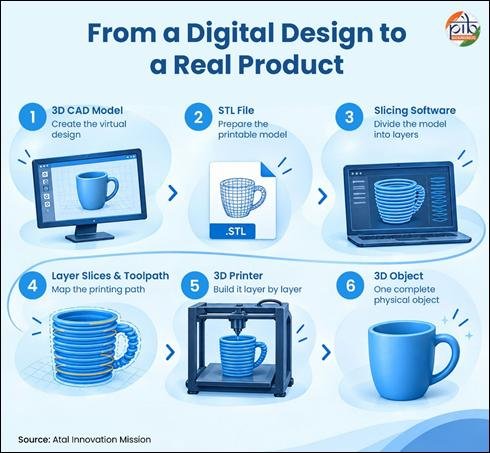
Additive Manufacturing, or AM, is changing that logic. Better known to the public as 3D printing, it allows a digital design to be converted directly into a physical object by depositing material layer by layer. The significance of this technology, however, goes far beyond the ability to print a three-dimensional object. It represents a convergence of digital design, computing, artificial intelligence, materials science, electronics and advanced engineering.
For India, that convergence comes at an important moment. The country is seeking to strengthen domestic manufacturing, reduce strategic import dependence, create high-skilled employment and move from being primarily a large market for technology to becoming a producer of technology. Additive manufacturing can contribute to all four objectives.
India’s National Strategy for Additive Manufacturing, introduced in 2022, was an acknowledgement that 3D printing should not remain confined to laboratories, hobbyists or isolated industrial experiments. It should become part of the country’s manufacturing ecosystem. More than four years into the strategy, over 1.54 lakh people have reportedly been trained, 56 AM start-ups have been supported and 65 India-specific technologies have been developed across materials, machines, design and printed products.
These numbers are encouraging. But they should be viewed as the beginning of an industrial transition rather than its conclusion.
The central question is no longer whether India can use additive manufacturing. It can. The more important question is whether India can build a globally competitive AM ecosystem—one that develops its own machines, materials, software, standards, intellectual property and industrial applications, while creating enough demand to make the technology commercially viable.
That is where the proposed second phase of the National Strategy for Additive Manufacturing becomes important.
From digital design to industrial capability
The most important feature of additive manufacturing is that the starting point is not a physical mould or tool but a digital file. A component can be designed using computer-aided design software, converted into a suitable format, sliced into layers and then manufactured by a machine according to those digital instructions.
This changes the economics of manufacturing in several ways.
Traditional manufacturing can become expensive when a product requires complex tooling, specialised moulds or large inventories. AM can reduce some of those barriers, particularly for low-volume production, customised components, rapid prototyping and geometrically complex parts. A manufacturer can modify a digital design and produce a different version without necessarily rebuilding an entire production system.
The technology can also support distributed manufacturing. Instead of transporting every specialised component from a distant factory, some products could potentially be manufactured closer to where they are required. For a country as geographically large as India, that possibility has considerable significance.
But digital manufacturing does not eliminate the need for industrial infrastructure. It creates a different set of requirements. Advanced printers need specialised materials, precision equipment, software, quality control, skilled operators and reliable testing systems. The real challenge is therefore to build an ecosystem rather than simply increase the number of printers.
This distinction is crucial. Buying sophisticated machines from abroad may create AM capacity, but it does not necessarily create technological sovereignty. India’s long-term objective should be to master the entire value chain—from materials and machine components to process control, software, design and certification.
A window of opportunity
The global opportunity is substantial. The AM machines market is projected to reach $149 billion by 2035, while the AM-electronics supply chain is expected to expand sharply during the same period.
India cannot assume that a large domestic market will automatically translate into a large share of this global opportunity. Manufacturing leadership will depend on cost, reliability, intellectual property, quality, standards and the ability to scale.
The country nevertheless has several advantages. India has a large engineering workforce, a growing start-up ecosystem, strong scientific institutions and an expanding digital economy. Its experience with software and digital infrastructure provides another foundation for digital manufacturing. The next step is to connect these strengths more closely with industrial production.
The government’s strategy of establishing specialised Development and Deployment Centres is useful in this context. Such centres can help bridge a gap that often exists between laboratory research and commercial manufacturing. Universities may develop promising technologies, while companies need products that can operate reliably at industrial scale. A functioning ecosystem must connect these two worlds.
The same principle applies to start-ups. Supporting a start-up to develop a prototype is only the first step. It must eventually find customers, secure investment, meet industrial standards, protect its intellectual property and manufacture at competitive cost. NSAM 2.0 should therefore place greater emphasis on commercialisation and market creation rather than measuring progress primarily through the number of projects supported.
Space and defence show what is possible
Some of the strongest arguments for additive manufacturing come from strategic sectors.
India’s space programme has already demonstrated the potential of the technology. The May 2024 launch of Agnikul Cosmos’s Agnibaan SOrTeD, featuring a single-piece, AM-printed semi-cryogenic rocket engine, showed how 3D printing can be used for highly complex aerospace hardware.
Space applications are particularly suited to AM because the technology can produce intricate geometries and potentially reduce the number of components required in an assembly. It can also help shorten development cycles.
The defence sector presents another compelling case. Armed forces frequently operate in difficult and remote environments where conventional supply chains can be slow, expensive or vulnerable. An ability to manufacture selected components closer to the point of use could strengthen maintenance, repair and overhaul capabilities.
The Indian Army’s use of 3D-printed construction and its work on precast defences in difficult terrains point towards a broader application of the technology. Support for workshop-level AM facilities for maintenance and repair across the three services could eventually become strategically important.
But defence AM requires exceptionally high standards. A component used in an aircraft, missile system or critical military platform cannot be treated in the same way as a consumer product. Material consistency, process repeatability, certification and quality assurance must be uncompromising.
The objective should be not merely to print defence components but to establish confidence that those components can perform under demanding conditions.
Healthcare could be another major beneficiary
Perhaps the most socially significant application of additive manufacturing is in healthcare. The human body is not standardised. Patients differ in anatomy, bone structure and medical requirements. This makes customised implants and medical devices a natural area for AM.
India is already developing indigenous technologies for 3D-printed bone grafts and implants. The possibility of producing components tailored to a particular patient could improve treatment while reducing dependence on imported medical products.
The development of indigenous biomaterials could be even more significant. Research into materials that support bone growth and other biological applications points towards a future in which AM is not simply printing plastic or metal objects but participating in advanced biomedical engineering.
Yet healthcare requires caution. Every medical device must satisfy stringent safety, performance and regulatory requirements. Innovation cannot come at the expense of clinical validation. India’s challenge will be to create pathways that allow promising technologies to move from research institutions to hospitals without weakening regulatory safeguards.
Construction offers a different kind of promise
3D printing in construction has attracted attention because of its potential to change the way buildings are produced.
The reported demonstration of a 2,500-square-foot house in less than 30 days using low-carbon geopolymer material suggests that construction AM may eventually reduce dependence on conventional processes. Early applications indicate potential reductions in material and logistics costs and substantially lower emissions compared with cement-intensive construction.
These claims require wider validation before they can be treated as a new industry standard. Construction is a complex activity, and the cost of printing a structure is only one part of the equation. Foundations, reinforcement, electrical systems, plumbing, finishing, approvals, site preparation and long-term durability must also be considered.
Still, the potential is significant. India faces enormous demand for housing and infrastructure. If digital construction can eventually combine speed, affordability, structural safety and lower environmental impact, it could become an important part of the construction sector.
The real foundation is skills
Technology strategies often focus heavily on machines and investment. But additive manufacturing ultimately depends on people who understand both digital systems and physical production.
The training of more than 1.54 lakh individuals under NSAM is therefore one of the most important achievements reported so far.
India should now focus on the quality and depth of this training. A workforce capable of operating a printer is different from one capable of designing components for AM, developing new materials, optimising manufacturing parameters, maintaining machines or certifying industrial products.
The concept of Design for Additive Manufacturing needs particular attention. Components designed for conventional manufacturing cannot always take advantage of the full potential of AM. Engineers need to learn how to redesign products around the technology’s strengths.
Introducing 3D printing through Atal Tinkering Labs is also valuable. Early exposure can encourage experimentation among school students. But the education pipeline must continue beyond school laboratories. Polytechnics, engineering colleges, ITIs and universities should have pathways that connect classroom exposure with industrial skills.
The objective should be to create not just printer operators but AM engineers, material scientists, software specialists, process experts and entrepreneurs.
From prototypes to products
This is where India’s AM journey will face its hardest test.
The country has demonstrated prototypes. It has established centres. It has trained people. It has supported start-ups. The next challenge is to produce commercially successful products at scale.
The proposed NSAM 2.0 appropriately identifies intellectual property, digital integration, competitive technologies, affordability and stronger industry linkages as priorities. These areas deserve sustained attention.
Cost remains a major barrier. Advanced AM machines and materials can be expensive. If Indian companies have to import most of their critical equipment and feedstock, the economic benefits of domestic production will remain limited.
Developing domestic materials is therefore as important as developing printers. Polymers, metal powders, ceramics, composites and electronics-grade materials each require specialised research and quality control.
Standards are equally important. A component manufactured in Bengaluru should be able to meet the same performance specifications as one manufactured elsewhere. Common standards build confidence among industry and consumers and make exports easier.
India should also invest more aggressively in testing and certification infrastructure. Without trusted certification, many industries will remain reluctant to adopt AM for critical applications.
A technology for more sustainable manufacturing?
Additive manufacturing is often presented as inherently green because it can use material more efficiently than some subtractive processes. That potential is real, but it should not be exaggerated.
The environmental footprint of AM depends on the material used, the energy consumed by the machine, the manufacturing process and the lifecycle of the final product.
The strongest sustainability case will therefore emerge when AM is combined with low-carbon materials, renewable energy, efficient processes and localised production.
This is also where the technology can complement India’s broader manufacturing transition. Producing only what is required, reducing unnecessary tooling, manufacturing replacement parts closer to the point of use and extending the life of products through on-demand components can all reduce waste in appropriate applications.
But sustainability claims must be supported by lifecycle assessments rather than assumptions.
India must move beyond a government-led ecosystem
Government support has been necessary to establish the AM ecosystem. It will remain important for research, strategic applications, standards and early-stage technology development.
But a mature ecosystem cannot depend indefinitely on government programmes.
Industry must become a stronger driver of demand. Large manufacturers should work with Indian start-ups and research institutions to identify components that can be redesigned and produced through AM. Universities should be encouraged to commercialise intellectual property. Financial institutions should understand the capital requirements of advanced manufacturing. States should develop industrial clusters around areas where AM has a natural advantage.
The National Additive Manufacturing Symposium and other platforms can help bring these stakeholders together. The ultimate measure of such collaboration, however, should be what happens after the conference ends: how many technologies reach the market, how many companies scale, how many products are exported and how many critical imports are replaced competitively.
The promise of Atmanirbhar Bharat
The phrase “Atmanirbhar Bharat” should not be interpreted as technological isolation. India will continue to participate in global supply chains and import technologies where necessary.
Self-reliance is better understood as the ability to design, adapt, manufacture and improve critical technologies domestically.
Additive manufacturing fits that definition particularly well.
A digital design can be transmitted almost instantly, but the ability to convert that design into a reliable physical product depends on local technological capability. For defence, aerospace, healthcare and strategic electronics, that capability can have implications far beyond economics.
There is also an opportunity for Indian companies to serve global niche markets. India need not manufacture every category of AM machine or material. It can seek leadership in selected areas where its scientific and engineering strengths give it an advantage.
That requires strategic prioritisation.
The next phase must be about scale
NSAM 1.0 established the foundation. NSAM 2.0 should be judged by what it does with that foundation.
The target of capturing 5 per cent of the global AM market and adding nearly $1 billion to India’s GDP is ambitious. The earlier goals of developing 50 India-specific technologies, 100 start-ups, 500 products and a skilled workforce are similarly significant. With more than 1.54 lakh people trained and 65 India-specific technologies already reported, some targets have moved beyond their original scale.
That makes the next phase an opportunity to raise the level of ambition.
The focus should increasingly shift towards patents, globally competitive products, exports, industrial adoption, affordable machines, domestic materials and measurable commercial outcomes.
There should also be a stronger focus on small and medium enterprises. Large corporations may have the resources to experiment with advanced manufacturing, but MSMEs form the backbone of Indian manufacturing. If AM remains accessible only to major companies and specialised laboratories, its economic impact will be narrower than its technological promise.
Affordable shared facilities, manufacturing clusters and technology access centres could help smaller firms experiment without having to make large upfront investments.
A new definition of manufacturing
The most important change brought by additive manufacturing may ultimately be conceptual.
Manufacturing is becoming less about the physical location of a factory alone and more about the integration of design, data, materials and machines.
A product can begin as a digital model, be optimised through software and artificial intelligence, manufactured locally and modified rapidly according to demand. That is a different manufacturing paradigm from the one India inherited during the industrial age.
For a country aspiring to become a developed economy by 2047, mastering that paradigm matters.
India’s advantage will not come simply from having more 3D printers. It will come from building the intellectual, industrial and institutional capacity around them.
The journey from PARAM to supercomputing showed how India could gradually move from importing advanced computing capabilities to building its own ecosystem. Additive manufacturing offers another such opportunity—this time at the intersection of the digital and physical economies.
The technology is still evolving. Some applications will succeed; others will prove commercially unviable. Not every product needs to be 3D-printed, and AM will not replace conventional manufacturing. Its greatest value will come where it offers a clear advantage in complexity, customisation, speed, material efficiency or decentralised production.
The task for policymakers and industry is therefore not to promote AM for its own sake. It is to identify where the technology can genuinely make India more competitive.
The foundations are being laid through national strategy, research institutions, start-ups, training programmes and strategic applications. The next stage must turn these foundations into durable industrial capability.
India’s manufacturing future will be shaped not only by how much it produces, but by how intelligently it designs and produces. Additive manufacturing offers a chance to make that transition faster.
The opportunity is substantial. The challenge is to ensure that India does not remain merely a consumer of 3D printing technology, but becomes one of the countries that defines its next generation.
The article is based on the inputs and background information provided by the Press Information Bureau (PIB). Author is Writer, Policy Commentator. He can be mailed at kcprmijk@gmail.com


Comments are closed.