
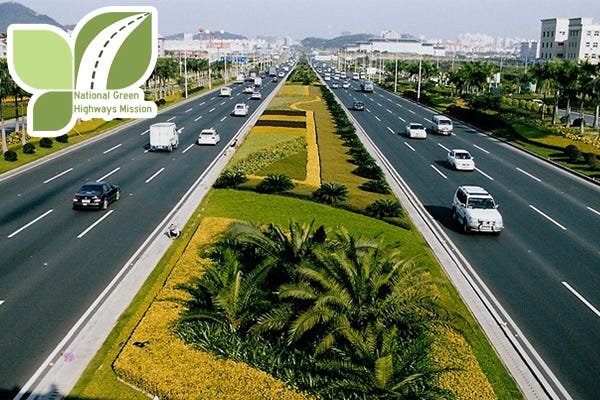
When Roads Grow Green: Rethinking India’s Highway Infrastructure
India’s expanding highway network is increasingly being designed not merely to move people and goods, but also to conserve resources, strengthen ecological resilience and reduce the environmental cost of infrastructure.

S Ahmad
A road is usually understood as a line on a map—a strip of asphalt connecting one destination to another, carrying people, goods and economic activity. For much of modern infrastructure planning, that has been its primary purpose.
But as India builds roads at an unprecedented scale, that definition is beginning to change.
The highway of the future cannot be judged only by how quickly vehicles travel on it or how efficiently it connects two cities. It must also be assessed by what happens around it: whether trees survive along its edges, whether construction materials are used efficiently, whether agricultural waste can find productive uses, whether slopes remain stable, whether local biodiversity is protected and whether the infrastructure can withstand a changing climate.
This is the larger significance of India’s emerging Green Highways approach.
Over the past five years, more than 3.61 crore saplings have been planted along nearly 1.32 lakh kilometres of National Highways. At the same time, the country is experimenting with Miyawaki plantations, recycled construction materials, bio-bitumen derived from agricultural residues, satellite-based monitoring and pollinator corridors.
Taken together, these initiatives suggest that India’s highway network is slowly becoming more than a transportation system. It is becoming part of the country’s environmental infrastructure.
That transition matters because the scale of India’s road expansion is enormous.
The National Highway network has increased by around 61 per cent, from 91,287 kilometres in 2014 to 1,46,572 kilometres by March 2026. Such expansion has obvious economic benefits. Better roads reduce travel time, connect producers to markets, improve access to services and facilitate the movement of goods across regions.
But every large infrastructure programme also carries an environmental footprint.
Road construction requires land, aggregates, bitumen, cement, water and energy. It can alter drainage patterns, disturb vegetation, fragment habitats and increase dust and pollution during construction. Once operational, highways can influence the ecology of the landscapes through which they pass.
The answer cannot be to stop building roads. For a growing economy with a large population and significant regional disparities, connectivity remains essential. The more practical question is whether infrastructure can be designed in a manner that reduces its environmental cost and, where possible, creates additional ecological value.
That is where the Green Highways (Plantation, Transplantation, Beautification and Maintenance) Policy, 2015 becomes significant.
The policy was conceived to provide a framework for plantation along National Highways, reduce the impact of air pollution and dust, prevent soil erosion, moderate the effects of wind and incoming radiation, and create employment opportunities for local communities.
The important shift is from seeing plantation as decorative landscaping to treating it as an integral component of highway development.
Trees along roads can provide shade, help bind soil, absorb pollutants and contribute to the visual and ecological quality of a corridor. But the success of such an initiative cannot be measured simply by counting how many saplings were planted.
A sapling planted today is not necessarily a tree tomorrow. This is why the recent emphasis on survival rates is important.
Under new guidelines, plantation works are to be considered compliant for provisional completion certification only when at least 80 per cent of the available Right of Way earmarked for plantation has been covered. More importantly, the survival rate of planted saplings must be at least 90 per cent at inspection, with the same criterion applying during the operation and maintenance period and provisions for replacing plants that do not survive.
This is a welcome movement from plantation as an event to plantation as a long-term responsibility.
India has often struggled with the gap between targets and outcomes in environmental programmes. Millions of saplings can be planted in a single season, but if watering, protection, species selection and maintenance are neglected, the numbers quickly lose meaning.
A living tree is the outcome that matters.
The introduction of the Green Highways Excellence Awards also indicates an attempt to reward better practices. The emphasis is increasingly being placed on survival, species diversity, the use of native species, site-specific planning and conservation measures rather than merely the number of plants put into the ground.
This is important because highway landscapes are not uniform.
A plantation suitable for a dry region may not be appropriate for a Himalayan ecosystem. A species that grows rapidly in one climate may become invasive or fail to survive in another. Local soil, rainfall, temperature, wildlife and water availability all matter.
The future of green highways should therefore be less about planting the largest possible number of trees and more about planting the right trees in the right places and keeping them alive.
Technology can help make that transition more scientific.
The National Highways Green Cover Index, prepared in collaboration with the National Remote Sensing Centre of ISRO, represents an important development in this regard. Its first annual report for 2025–26 provides a quantitative assessment of green cover within the Right of Way along approximately 30,000 kilometres of National Highways across 24 states.
The use of satellite-based assessment changes the nature of monitoring.
Earlier, plantation could largely be assessed through field inspections and reports. Satellite and drone technologies allow authorities to observe much larger stretches, establish baselines, compare changes and identify areas requiring intervention.
This is precisely the kind of application for which technology should be used in public infrastructure—not merely to create sophisticated dashboards, but to improve decisions on the ground.
If a highway stretch shows declining green cover, the data should trigger investigation. If a plantation consistently records poor survival, the choice of species or maintenance arrangements should be reconsidered. If one corridor performs significantly better than another, the underlying practices should be studied and replicated.
Data becomes useful only when it changes action.
There is another encouraging development in India’s green highway strategy: the recognition that the environmental contribution of a road need not stop with trees.
The highway construction sector consumes enormous quantities of raw material. Therefore, making construction itself more resource-efficient could have an impact comparable to plantation.
This is where India’s work on bio-bitumen becomes particularly interesting.
India currently meets around half of its bitumen requirement through imports. At the same time, agricultural states face the persistent problem of managing crop residues, including rice straw.
The development of technology to produce bio-bitumen from agricultural residues brings these two challenges together.
The technology developed jointly by CSIR-Central Road Research Institute and CSIR-Indian Institute of Petroleum uses post-harvest rice straw as feedstock. Through pyrolysis, the biomass is converted into bio-oil, which can then be blended with conventional bitumen to produce a bio-bitumen mixture.
The first 100-metre test stretch on the Jorabat–Shillong Expressway in Meghalaya provides an important demonstration of the technology.
The significance extends beyond one road. If agricultural residues can become a useful industrial input, farmers and rural economies could gain another avenue for waste utilisation. At the same time, India could reduce some dependence on imported petroleum-derived road materials.
This is precisely the kind of circular approach that infrastructure development needs.
For decades, economic development has often followed a linear model: extract resources, manufacture products, consume them and dispose of the waste. A sustainable infrastructure system must increasingly look for ways to bring waste back into the production cycle.
Highways provide a particularly large opportunity because the sector consumes vast quantities of materials.
Fly ash and pond ash from thermal power plants are being used in embankments and structural works. Reclaimed Asphalt Pavement, construction and demolition waste and recycled aggregates are being incorporated into suitable highway projects. Plastic waste, slag, crumb rubber and other industrial by-products also have applications where technical specifications permit.
The objective should not be to use recycled material merely because it is environmentally fashionable. The material must meet safety, durability and engineering requirements.
But where scientifically validated alternatives can replace virgin resources without compromising performance, their wider adoption makes both environmental and economic sense.
This is where the Green Highways approach can become more ambitious. Instead of treating sustainability as an additional feature of road construction, it can become a design principle. Imagine a highway planned from the beginning around its entire environmental life cycle.
The alignment could consider ecological sensitivity. Plantation could use native species selected for local conditions. Drainage could be designed to reduce erosion and support natural water movement. Construction waste could be reused. Agricultural residues could become inputs for road materials. Satellite imagery could monitor vegetation. Pollinator habitats could be incorporated. Maintenance contracts could include measurable ecological performance.
Such a highway would not simply be less harmful. It could actively provide environmental benefits.
The idea of pollinator corridors along selected stretches of the Delhi–Amritsar–Katra Expressway points in this direction.
Under the “Trees for Beej” campaign, flowering species suited to local conditions are being used to provide nectar and pollen across seasons, creating habitats for bees and other pollinators. At first glance, a pollinator corridor may seem peripheral to highway construction. It is not.
Pollinators are essential to agricultural ecosystems and biodiversity. Creating connected habitats in landscapes increasingly fragmented by urbanisation and infrastructure can provide ecological value beyond the immediate road corridor. This also demonstrates why the word “green” in Green Highways should not be reduced to green-coloured landscaping.
The objective should be biodiversity. A line of ornamental plants that requires excessive water and offers little ecological value is not necessarily a green corridor. A diverse mix of native vegetation that supports insects, birds and soil health may be far more valuable even if it appears less manicured.
The same principle should guide the development of Miyawaki plantations. The technique, which involves densely planting a variety of trees and shrubs in relatively small areas, can rapidly establish forest-like vegetation. Its application near highway infrastructure can be useful where land is limited.
But Miyawaki should be treated as one tool rather than a universal solution.
Different landscapes require different ecological approaches. A dense plantation in a small urban space serves a different purpose from a native woodland restoration project along a rural highway. Ecological planning must therefore remain site-specific. The broader objective should be resilience rather than a particular plantation method.
Climate change makes this even more urgent. Roads are themselves vulnerable to climate extremes. Heavy rainfall can damage embankments. Flooding can disrupt traffic. Heat can affect road surfaces. Landslides can threaten hill roads. Water scarcity can make plantation maintenance difficult.
A climate-resilient highway must therefore be designed to withstand environmental stresses rather than simply coexist with them.
Greening can contribute to this resilience, but it cannot substitute for sound engineering.
Trees cannot compensate for inadequate drainage. Plantation cannot prevent every landslide. Recycled material cannot replace rigorous construction standards. Environmental sustainability and engineering quality must work together. There is also a social dimension to Green Highways that deserves greater attention.
The 2015 policy envisaged participation by Self-Help Groups, private agencies, State Forest Departments, Forest Corporations and contractors. This creates opportunities to connect environmental maintenance with local livelihoods.
A highway plantation should not become a one-time government programme in which contractors plant saplings and leave.
Local communities can have a continuing role in watering, protection, maintenance, nursery development and monitoring, provided that appropriate institutional arrangements and payments are in place.
This can turn highway greening into a source of rural employment as well as environmental improvement.
There are already examples of sustained plantation efforts. In Andhra Pradesh, around 18 lakh saplings were planted along the National Highway network between 2010 and 2025 through avenue and median plantations, with another 3.86 lakh targeted for 2026–27.
Such initiatives demonstrate that greening must be understood as a maintenance commitment, not simply a plantation target. The same logic should apply nationally. India’s expanding highway network provides an enormous canvas for environmental restoration, but it also creates enormous responsibility.
More than 1.46 lakh kilometres of National Highways is a vast infrastructure footprint. Even relatively small improvements in material efficiency, water management, vegetation survival or waste utilisation can produce substantial cumulative benefits.
But the opposite is also true. Poorly designed plantation, excessive water consumption, inappropriate species, neglected maintenance or weak ecological safeguards can turn a well-intentioned programme into a numbers exercise.
The next stage of Green Highways should therefore be about measurement.
How much carbon is being stored?
Which species have the highest survival rates in different climatic zones?
How much agricultural residue can realistically be converted into road materials?
How much construction waste is being diverted from disposal?
Which highway corridors have improved biodiversity?
How much water is being consumed for plantation maintenance?
What is the cost per surviving tree rather than the cost per planted sapling?
These questions can transform sustainability from a slogan into a performance framework. The National Highways Green Cover Index provides a foundation for this approach. Over time, such monitoring could become more granular, allowing highway authorities to compare corridors and identify best practices.
There is also a case for making environmental performance more visible to the public.
Highway users rarely know whether the green belt beside the road is being maintained properly or whether a plantation programme has met its targets. Public dashboards, geotagged plantation records and periodic survival assessments could make the process more transparent.
The objective should not be to burden highway agencies with paperwork. It should be to ensure that environmental commitments are measurable and accountable.
India’s Green Highways approach is ultimately part of a larger transformation in how infrastructure is conceived.
For much of the twentieth century, development was frequently understood through physical expansion: more roads, more bridges, more buildings, more industrial capacity.
The twenty-first century requires a more sophisticated equation. Development must also ask how efficiently resources are used, how resilient infrastructure is to climate change, how ecosystems are affected and how much value can be recovered from waste. This does not mean slowing infrastructure development. It means making development smarter.
A highway can be an economic corridor and an ecological corridor at the same time. A road can move freight while supporting trees. Agricultural residue can become a road input rather than a waste problem. Satellite technology can monitor vegetation. Local communities can participate in maintenance. Engineering can incorporate climate resilience from the beginning.
The challenge is to make these practices mainstream rather than exceptional.
India’s vision of a Viksit Bharat by 2047 will require massive infrastructure expansion. Roads will remain among its most important physical foundations. But the infrastructure built over the next two decades will shape the country’s environmental conditions for decades beyond that.
This is why the Green Highways approach deserves attention. It represents an attempt to reconcile two objectives that were too often treated as contradictory: infrastructure development and environmental responsibility.
The road ahead, quite literally, can be greener. But that will depend on whether India moves beyond counting kilometres and saplings and begins measuring outcomes—surviving trees, healthier landscapes, efficient materials, lower waste, stronger biodiversity and greater resilience.
The most successful green highway will not necessarily be the one with the largest number of plants beside it. It will be the one where the road, the surrounding landscape, the materials used to build it and the communities living around it form a more sustainable relationship.
That is the real promise of Green Highways. India is building roads for movement today. The opportunity is to ensure that, in doing so, it also builds ecological resilience for tomorrow.
Comments are closed.