

Tamanna Hazarika
The female rulers of Zazzau show that women were not absent from African political history; in fact, they sometimes stood at the center of it. Bakwa Turunku helped shape the early growth of the state, Amina expanded its territory through military power, and Zaria preserved the memory of royal female authority.
The history of Zazzau, in present-day Nigeria, includes three remarkable women rulers who played a major role in the growth of the state. Bakwa Turunku was the first queen of Zazzau. She is said to have established the city of Zaria and ruled during a peaceful time. Her daughter, Amina, became the most famous of all Zazzau’s rulers. Amina is celebrated as a warrior queen who led military campaigns, conquered new lands, and strengthened the state. She was succeeded by her sister — Zaria. Together, these women represent an important chapter in the history of Hausaland and West Africa.
Bakwa Turunku:
Bakwa Turunku was the first Sarauniya (Queen) and the 22nd ruler of the Zazzau state. Very little is known about her but it is certain that she lived during the 16th century. Some accounts identify Bakwa as the daughter of Sarkin Zazzau Nohir (r. 1532—1535), while others describe her as an outsider who rose to power in Turunku.
According to a local tradition, the name “Bakwa Turunku” may mean “the stranger belonging to the Toronke people.” She is said to have been a ruler who enjoyed entertainment and pleasure, and her reign was remembered as a peaceful period.
Because Turunku had a limited water supply, Bakwa established a new capital called Zaria, naming it after her second daughter. During the sixteenth century, especially under Bakwa’s rule, Zazzau expanded its authority beyond the Kaduna River to the upper Gurara Valley.
Except for an unsuccessful invasion by Kwararafa from the south, Bakwa’s reign was generally peaceful. According to tradition, weapons were left unused for so long that spider webs covered the quivers, while swords and arrows became rusty. Bakwa was also said to have built a large room in the palace called Kigo. Women gathered there every day to perform the gada dance, accompanied by musicians playing the kalangu, a talking drum.
The exact length of Bakwa’s reign is uncertain. One chronicle states that she ruled for thirty years, while another source records a much shorter reign of only three years, from 1536 to 1539. Historian Sa’ad Abubakar suggests that she ruled for thirty years and died around 1566.
Amina of Zazzau:
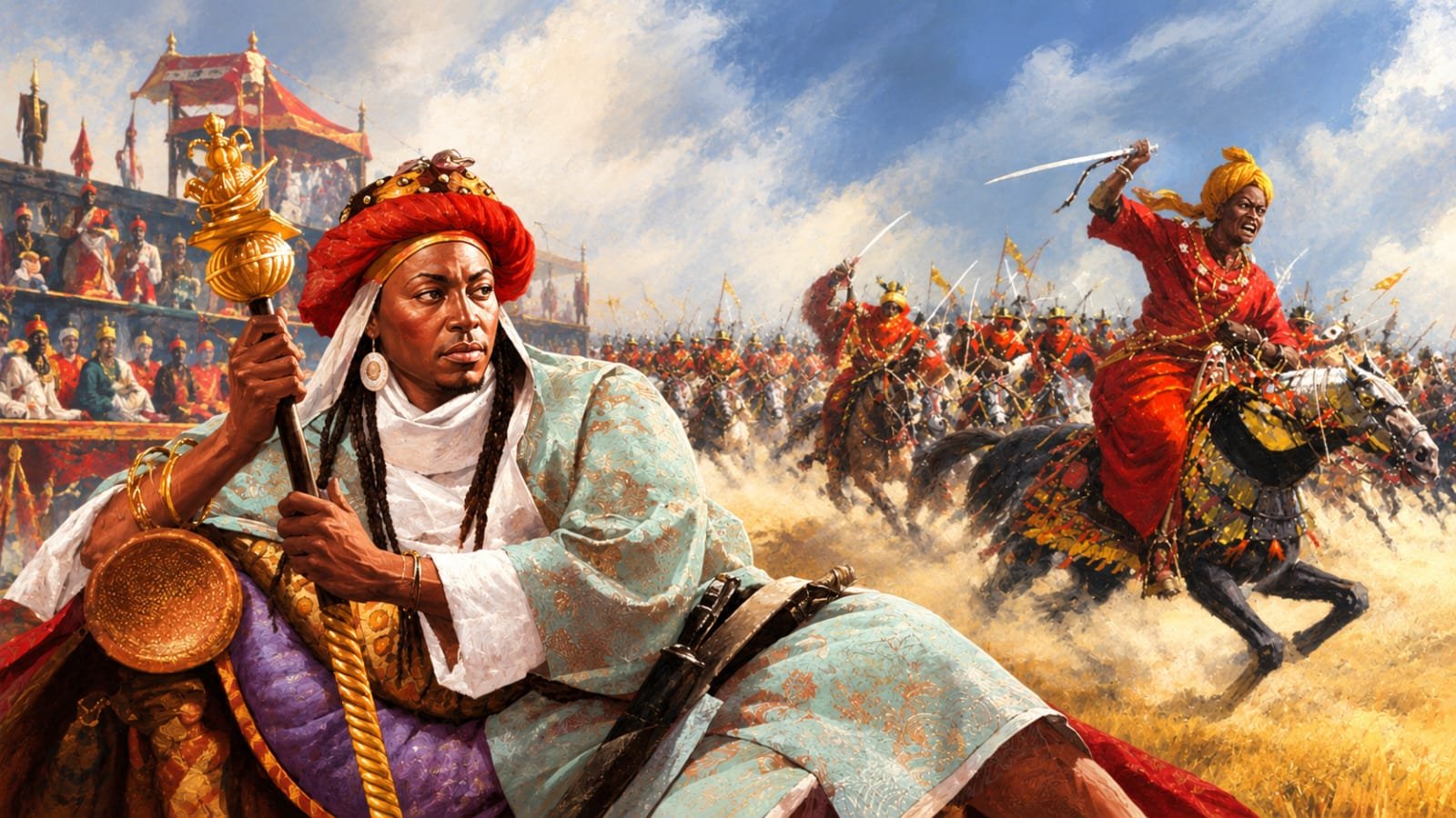
Queen Amina of Zazzau (born around 1533) was a famous Hausa warrior queen of Zazzau. She is generally believed to have lived during the sixteenth and early seventeenth centuries. Amina is remembered for her courage, military leadership, and conquests. During her long rule, traditionally dated from 1576 to 1610, she expanded the territory of Zazzau and strengthened its trade and politics.
Her mother was Queen Bakwa Turunku, who ruled from about 1536 to 1566. According to oral traditions, Amina spent much of her childhood in her grandfather’s court. Her grandfather loved her and personally taught her about government, politics, and military affairs. When Amina was sixteen years old, she was given the title Magajiya, meaning the heir or successor to the throne. She was also given forty female slaves, known as kuyanga.
Many powerful men wanted to marry her and offered large numbers of slaves, cloth, and other gifts to gain her hand. After Amina’s parents died around 1566, her brother became king of Zazzau. Amina then became an important soldier in her brother’s cavalry. She was a capable leader, hence became famous for her courage and military ability.
After the death of her brother Karama in 1576, Amina is believed to have become the queen of Zazzau. Zazzau was one of the seven original Hausa states, known as the Hausa Bakwai. The other six states were Daura, Kano, Gobir, Katsina, Rano, and Garun Gabas. Before Amina became queen, Zazzau was already one of the largest Hausa states. Only three months after becoming queen, Amina began a long military campaign that lasted about thirty-four years. Her aim was to expand the territory of Zazzau. Since Kano and Katsina blocked expansion to the north and the Jos Plateau blocked expansion to the east, she led her armies towards the south-east and south-west.
Amina’s army reportedly included 20,000 infantry soldiers and 1,000 cavalrymen. Amina conquered large areas, including parts of Kwararafa, Nupe, Bauchi, and Yauri. Some later accounts claim that she reached the meeting point of the Niger and Benue Rivers and forced Kano and Katsina to pay tribute. However, modern historians question some of these claims.
According to the Chronicle of Abuja, the ruler of Nupe gave her forty eunuchs and 10,000 kola nuts, which helped introduce kola nuts to Hausaland. Under Amina’s rule, Zazzau became larger than ever before. To defend the conquered territories, she ordered the construction of earthen walls around cities. These walls later became common throughout the region and are known as ganuwar Amina, or Amina’s walls. Many of them still exist today. The exact details of Amina’s death are unknown. According to the nineteenth-century Muslim scholar Dan Tafa, Amina died in a place called Attaagar (around 1610).
A local chronicle of Zaria was mainly written during the nineteenth century and continued until 1902. It was published in 1910 and contains the names of Zazzau’s rulers along with the length of their reigns. However, the chronicle does not mention Amina. Early twentieth-century oral traditions identified her as the daughter of Bakwa Turunku. Since the chronicle dates Bakwa’s reign from 1492 to 1522, some historians have placed Amina’s reign in the early sixteenth century rather than 1576.
Zaria of Zazzau:
According to one tradition, Amina was succeeded by her younger sister Zaria. However, historical information about Zaria is limited, and different accounts present different versions of her life. Queen Zaria is mainly remembered because the city of Zaria was traditionally named after her.
The female rulers of Zazzau show that women were not absent from African political history; in fact, they sometimes stood at the center of it. Bakwa Turunku helped shape the early growth of the state, Amina expanded its territory through military power, and Zaria preserved the memory of royal female authority. The names of Bakwa Turunku and Amina continue to live on in history, especially in the city of Zaria and in the identity of the Hausa people.
Bibliography:
-
Awe, Bolanle. (1992). Nigerian Women In Historical Perspective. Sankore Publishers Ltd.
-
Hogben, S. J.; Kirk-Greene, A. H. M. (1966). The Emirates Of Northern Nigeria: A Preliminary Survey Of Their Historical Traditions. Oxford University Press.
-
Ajayi, J.F. Ade.; Espie, Ian. (1965). A Thousand Years of West African History. Ibadan University Press.
-
Gates, Henry Louis; Akyeampong, Emmanuel; Niven, Steven J. (2012). Dictionary of African biography: Vol. 1 Abach-Brand. Oxford University Press.
-
Falola, Toyin; Genova, Ann. (2009). Historical Dictionary of Nigeria. Scarecrow Press.
-
Smith, Bonnie G. (2008). The Oxford Encyclopedia of Women in World History, Volume 1. Oxford University Press.
-
Hogben, S.J. (1966). Emirates of Northern Nigeria. Oxford University Press.
-
Denzer, Laray. (2011). Dictionary of African Biography. Oxford University Press.
-
Crowder, Michael. (1978). The story of Nigeria. Faber and Faber.
-
Commire, Anne., Klezmer, Deborah. (1999). Women in World History: A Biographical Encyclopedia, Volume 1. Yorkin Publications.
Comments are closed.