

Tamanna Hazarika
Each of them showed leadership, courage, and strong commitment to resisting British control. Their courage and sacrifice expand our view of the uprising beyond military accounts and remind us that resistance to colonial rule included diverse voices and new forms of leadership. Honouring their stories helps keep alive a fairer memory of 1857 and the many people who risked everything for the sake of the country.
The Revolt of 1857 was a major uprising in India against the rule of the British East India Company. It began on 10 May 1857 as a mutiny of Indian sepoys in Meerut, but quickly spread to Delhi and other parts of northern and central India. The Revolt involved many different people across northern India, and Muslim women played an important part in the resistance.
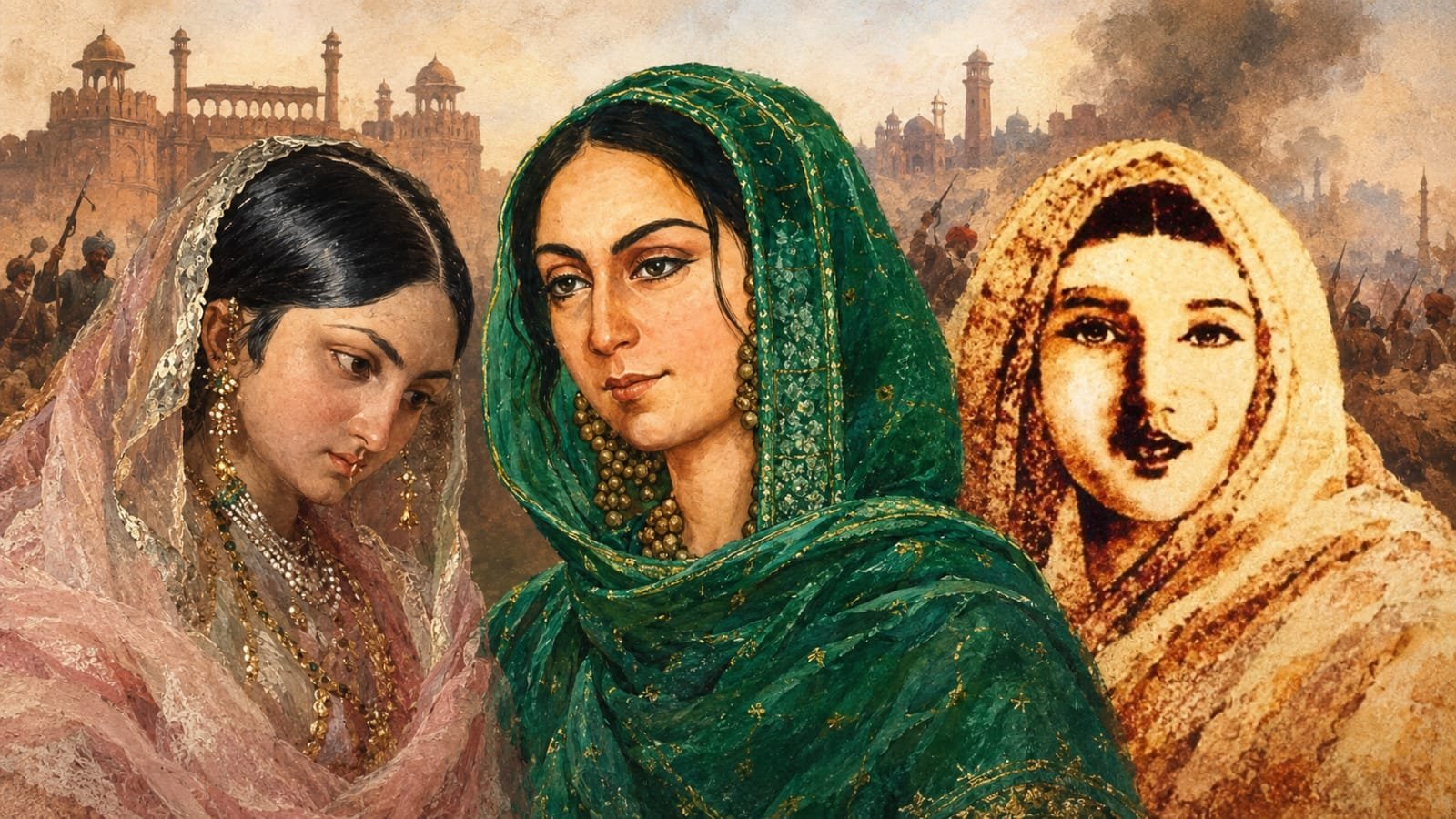
Begum Hazrat Mahal, Azizun Bai, Asghari Begum, and Habeeba Begum were four most prominent muslim women who took active part against British rule. Their stories show how women joined battles, led troops, organised resistance, and made sacrifices during the uprising.
Begum Hazrat Mahal:
Begum Hazrat Mahal (1820–1879) — also known as the Begum of Awadh — was the second wife of Nawab Wajid Ali Shah (r. 1847—56). After the British East India Company exiled her husband, she acted as regent of Awadh till 1858 and played a leading part in the uprising against the British East India Company in the 1857 rebellion.
Begum Hazrat Mahal was born was Mohammadi Khanum in 1820 in Faizabad, the old capital of Oudh. Her parents sold her when she was young, and she worked as a singer-dancer. Later she was sold to royal agents and she entered the Nawab’s harem as an attendant. She became a Begum after joining the royal household as a concubine of Wajid Ali Shah.
After their son Birjis Qadr was born, she was given the title “Hazrat Mahal.” In 1856 the British annexed Awadh and sent Wajid Ali Shah into exile in Calcutta. Begum Hazrat Mahal stayed in Lucknow with her son and soon took control of the government of Awadh.
During the 1857 rebellion, Begum Hazrat Mahal fought against the British. Rebel forces led by Raja Jailal Singh took control of Lucknow, and the Begum ruled as guardian for her young son, Prince Birjis Qadr, whom she made the ruler of Awadh. As regent, she became one of the main leaders of the uprising. The rebellion began in Lucknow in May of 1857 where the rebel forces captured much of the city.
One of her major complaints was that the East India Company had torn down temples and mosques to build roads. In a proclamation near the end of the revolt she ridiculed British claims about religious freedom, pointing out actions like forcing people to use greased cartridges, allowing missionaries to preach, building churches, opening English schools, and ignoring Hindu and Muslim places of worship.
The rebel forces under Begum Hazrat Mahal attacked the British residency. Although the British defenders resisted strongly, they suffered from shortages of food, water, and medical supplies. However, British forces later arrived with reinforcements and gradually strengthened their position.
After the British re-established a military position at Alambagh, near Lucknow, Begum Hazrat Mahal continued the struggle. Alambagh became an important British military camp and rebel forces repeatedly attacked this position in an effort to prevent the British from advancing into the city. Begum Hazrat Mahal worked alongside leaders such as Nana Saheb Peshwa and later joined the Maulavi of Faizabad in attacking Shahjahanpur.
The Battle of Musabagh was another important conflict during the defence of Lucknow. Musabagh was a fortified palace on the outskirts of the city. Rebel soldiers used the building to resist the advancing British army. British forces attacked Musabagh with better weapons, artillery, and trained soldiers. The rebel defenders fought bravely but were eventually forced to withdraw when the British captured the position.
The fall of Musabagh weakened the rebel defence of Lucknow. British forces recaptured Lucknow and most of Oudh, which forced Begum Hazrat Mahal to withdraw. She finally fled to Nepal. Prime minister Jung Bahadur granted her political asylum. She died in Nepal in 1879 and was buried in an unmarked grave in the grounds of Kathmandu’s Jama Masjid.
Azizun Bai:
Azizun Bai (or Azizun Nissa) was a professional dancer from the 19th century, who is said to have been born in the year 1832. She was an important figure in the rebellion of 1857. Azizun Bai secretly worked against British rule and helped the revolutionaries. She gave up her anklets as a symbol of breaking the chains of slavery.
Although she had earlier organised gatherings for music and entertainment, she soon began meeting revolutionaries and helping them make plans. On 1 June 1857, Nana Saheb, Tatya Tope, Shamsuddin Khan, Azimullah Khan, and Azizun Bai met in Kanpur. Azizun Bai formed and led an armed group of women against the British.
In June, the revolutionaries defeated the British in a major battle and declared Nana Saheb the independent ruler of Bithoor. However, their success did not last long. On 16 August, the British fought the revolutionaries again at Bithoor and defeated them.
Azizun Bai played an important role in both battles. She organised a group of young women who dressed as men and rode horses. Azizun Bai was a kind and supportive person towards brave soldiers, but she strongly criticised those who avoided the battlefield.
After the Battle of Bithoor, Nana Sahib and Tatya Tope escaped, but Azizun Bai was captured. General Havelock offered to forgive her if she admitted her mistake and apologised to the British.
Azizun Bai refused to apologise, instead, she boldly said that the British should apologise for the cruelty they had inflicted on the Indian people. Her fearless reply angered the British officers. They ordered her execution, and British soldiers shot her to death.
Ashgari Begum:
Asghari Begum (1811–1857) was an Indian freedom fighter who fearlessly participated in the Revolt of 1857 against Company rule. Asghari Begum was born in 1811 to Alim Shah Abdul Rahim in Thana Bhawan, a town now associated with Muzaffarnagar in Uttar Pradesh.
When the Revolt of 1857 began, Asghari Begum joined the struggle against British rule. She openly supported the revolutionaries and organised a group of women who were trained to fight. From 1857 to 1858, she fought the British on several fronts in western Uttar Pradesh.
According to some accounts, she shot the British officer Sir Henry Lawrence and helped the revolutionaries defeat company forces at the Battle of Chinhat in 1857. She later entered into an alliance with the Shamli state that was liberated by the Deobandi rebels under the leadership of Imdadullah Muhajir Makki.
In October 1857, British forces under Major Sawyer attacked Thana Bhawan, an important centre of the rebel movement in the Shamli state. Asghari Begum was captured by the British forces while trying to organise women fighters to resist the British.
To frighten the locals and demotivate the rebels, the British officials publicly burned her alive. Asghari Begum’s death was horrifying and cruel, however it revealed her extraordinary courage and selfless sacrifice for the freedom of her country.
Habeeba Begum:
Habeeba Begum was reportedly a young woman from a Muslim Gujjar family in the Muzaffarnagar region. She fought in several battles against the British during the Revolt of 1857 under Haji Imdadullah Muhajir Makki and helped in organising local women’s resistance as she was one of the associates of Ashgari Begum.
She used to disguise herself as a man and carried a shining sword. Local traditions preserve this detail that Habeeba used to lead night attacks on British supply trains. After the British under Major Sawyer regained control over Thana Bhawan, she was captured and hanged along with eleven other women rebels.
Among the eleven were Asha Devi, Bibi, Bhagwani, Bhagwati, Inder Kaur, and Jamila Khan. It is said that Habeeba was only about 24-25 years old at the time of her death. This indicates that she was born around 1833.
These four women — Begum Hazrat Mahal, Azizun Bai, Asghari Begum, and Habeeba Begum, remind us that the Revolt of 1857 was not only fought by soldiers and men in command.
Comments are closed.