

S Ahmad
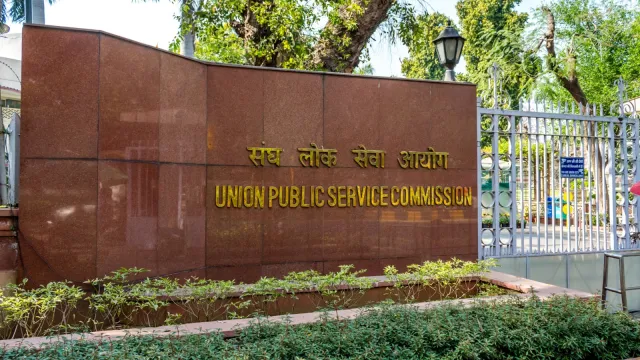
On 1 October 2026, the Union Public Service Commission (UPSC) completes one hundred years. Its institutional journey began on 1 October 1926, when India’s first Public Service Commission was constituted – an advisory body whose Chairman and Members were appointed by the Secretary of State in London. Over the century that followed, the Commission evolved in structure, status and responsibilities, becoming what it is today – an independent constitutional body.
On October 1, 2026, the Union Public Service Commission completes a hundred years. Few public institutions can claim such a long and consequential journey without having repeatedly reinvented themselves. Born in colonial India as a limited advisory body, the Public Service Commission has evolved into a constitutional institution entrusted with one of the Republic’s most sensitive responsibilities: selecting people for some of the most important positions in government through a process intended to be impartial, competitive and transparent.
The centenary, therefore, is more than an occasion to recall examination dates, institutional milestones or famous civil servants. It is an opportunity to ask a more fundamental question: what does merit mean in a democracy, and how does an institution ensure that merit is not simply another name for inherited advantage?
The answer is contained, at least partly, in the history of the UPSC itself.
The story begins well before 1926. In 1855, the British introduced competitive examination for the Indian Civil Service, replacing the East India Company’s system of nomination. On paper, this was an important shift from patronage to competition. In practice, however, competition remained heavily tilted towards those who possessed the education, resources and geographical access required to participate.
The examination was conducted in London and in English. Its syllabus included subjects such as Greek and Latin. For an Indian aspirant, appearing for the examination could mean travelling thousands of kilometres, financing an education within the British system and competing in an environment structured around assumptions that were hardly neutral.
Satyendranath Tagore’s story captures the difficulty. In 1862, at the age of 21, he travelled from Calcutta to England to sit for an examination that was not available in his own country. He succeeded and became the first Indian to enter the ICS. Others followed, but access remained extremely restricted. By 1919, only 78 of 1,255 ICS officers were Indian, according to the UPSC’s centenary account.
That history offers an important lesson. A competitive examination can be formally open and still be socially inaccessible.
Merit cannot be separated entirely from the conditions under which people are permitted to demonstrate it.
The creation of the Public Service Commission in 1926 was therefore significant, even though its powers were limited and its institutional framework remained rooted in colonial governance. The Government of India Act of 1919 had provided for such a commission, while the Lee Commission in 1924 recommended its establishment. The first Public Service Commission was constituted on October 1, 1926, with Sir Ross Barker as its first chairman and Metcalfe House in Delhi as its headquarters.
The institution changed substantially after Independence.
The Federal Public Service Commission became the Union Public Service Commission with the adoption of the Constitution on January 26, 1950. More importantly, the Constitution placed Public Service Commissions within a framework designed to protect their independence. Articles 315 to 323 of Part XIV established the constitutional architecture governing their composition, functions, tenure, finances and reporting obligations.
This was not a minor administrative arrangement. It reflected the understanding that recruitment to public office cannot safely be left entirely to the preferences of the government of the day.
The Constitution’s framers understood the danger. In his concluding address to the Constituent Assembly, Dr Rajendra Prasad emphasised the importance of independent Public Service Commissions in preventing jobbery, nepotism and favouritism. The underlying principle remains relevant: the state must have the authority to recruit, but the recruitment process must have safeguards against arbitrary preference.
That distinction is central to the legitimacy of the UPSC.
The Commission today conducts examinations for the Civil Services, Indian Forest Service, Engineering Services, Combined Medical Services, National Defence Academy and Naval Academy, Combined Defence Services and Central Armed Police Forces, among others. It also conducts recruitment by selection and advises the government on recruitment rules, promotions, induction into the All India Services and disciplinary matters.
The scale has changed dramatically.
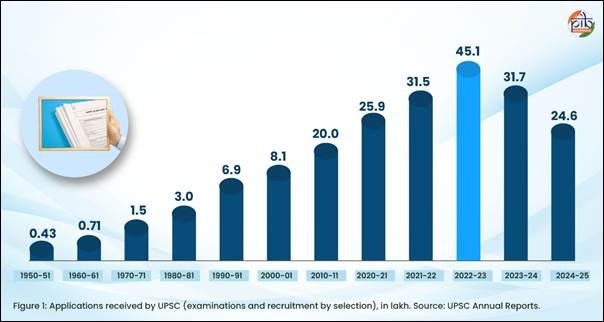
Applications across examinations and recruitment by selection rose from 42,727 in 1950-51 to more than 45 lakh in 2022-23. Examination centres have expanded from eight in 1950 to dozens across the country. The Civil Services Examination alone now attracts hundreds of thousands of serious aspirants at different stages of the process.
Behind these figures is a profound transformation in the meaning of public competition.
India is no longer a country where access to higher government service is primarily a privilege of a small, geographically concentrated educated class. Women, Scheduled Castes, Scheduled Tribes, Persons with Benchmark Disabilities and candidates from diverse linguistic and social backgrounds participate in a system that has progressively introduced measures intended to widen access.
The numbers tell part of this story.
In 1952, only three of the 83 candidates recommended through the Civil Services Examination were women. In 2025, 299 of the 958 recommended candidates were women. Similarly, the number of Scheduled Caste candidates recommended rose from nine in 1955 to 158 in 2025, while Scheduled Tribe recommendations increased from two in 1956-57 to 73 in 2025.
These figures should not be interpreted as proof that every barrier to opportunity has disappeared. They demonstrate
something narrower but important: the composition of public recruitment has changed considerably as the architecture of access has changed.
That distinction matters.
Inclusion is not achieved merely by opening the door. It also requires examining whether people have the means to reach the door, enter the examination hall, understand the rules and compete without unnecessary barriers.
This is why the evolution of the UPSC’s examination system is as important as the examination itself.
Consider language.
For years, the language of the examination was itself a significant barrier. The Commission’s position in the early 1970s was that the Personality Test could be conducted only in English. That changed in the 1980s, when candidates were permitted to answer in an Indian language, with an interpreter provided where required. Hundreds of candidates have subsequently exercised that option.
The significance extends beyond language preference. In a multilingual country, the ability to demonstrate knowledge should not automatically depend on one’s familiarity with a particular linguistic environment.
The same principle can be seen in the Commission’s efforts concerning Persons with Benchmark Disabilities. Scribes and additional time have become important components of the examination process, while eligible candidates receive other forms of assistance. Such provisions do not diminish merit. They attempt to remove barriers unrelated to the actual capability being assessed.
This is a crucial distinction in any discussion about merit.
Equality of opportunity does not necessarily mean treating every candidate identically. Sometimes fairness requires removing a barrier that has nothing to do with the quality being tested.
The Commission’s institutional history contains several examples of this approach. When communication and postal infrastructure were limited, application forms were printed in newspapers. During severe snowfall that cut off Kangra in 1984, the application deadline was extended for affected aspirants. During the Covid-19 pandemic, when travel became exceptionally difficult, measures were introduced to facilitate candidates appearing for interviews.
These may appear like administrative details. They are not.
An examination system becomes credible when candidates believe that the institution understands the difference between a genuine test of ability and an accidental test of privilege.
Technology has now added another dimension to this challenge.
The UPSC’s examination system operates at a scale where logistics and security are themselves tests of institutional capacity. The right paper must reach the right candidate at the right place and time. Question papers have to remain confidential. Candidates must be authenticated. Answer scripts must be processed and evaluated securely.
In 2026, the Commission introduced facial authentication on a large scale for the Civil Services Preliminary Examination, using mobile devices operated by invigilators. It also used historical candidate data to identify applicants who had allegedly provided false information to claim additional attempts.
The technology is important, but the principle behind it is older: protect the integrity of the competition.
Digital systems, however, should never become ends in themselves. Every technological reform creates new questions about privacy, accessibility, cybersecurity, data protection and the possibility of technical exclusion. The credibility of technology-driven recruitment will ultimately depend not merely on whether it makes examinations more secure, but whether candidates understand and trust the systems being used.
That is why transparency has become increasingly important.
The Commission’s recent reforms include a Universal Registration Number, randomised interview boards, a candidate helpdesk, new examination centres, online representation mechanisms and the development of a paperless system for Departmental Promotion Committee proposals. A 30-channel candidate helpdesk introduced in 2026 has reportedly handled more than 50,000 calls.
Such reforms may not generate the same public attention as examination results, but they shape the everyday experience of thousands of aspirants.
Perhaps one of the more interesting developments is Pratibha Setu, the revamped initiative through which details of willing candidates who clear the required stages but narrowly miss the final selection can be made available to verified employers. The idea recognises that an examination’s outcome need not divide candidates into a simplistic binary of “successful” and “unsuccessful”.
A person who narrowly misses a final list may still possess skills, knowledge and professional qualities valuable to another public institution or organisation.
This raises a broader point about merit: a merit list is necessarily finite, but human capability is not.
The UPSC’s history also demonstrates that recruitment institutions must respond to changing national requirements.
During periods of exceptional need, special recruitment mechanisms were used. Scientists, technologists, defence personnel and other specialists were recruited through arrangements suited to particular circumstances. During the Covid period, the Commission modified logistical arrangements without abandoning the basic requirements of its recruitment process.
The lesson is that institutional stability should not be confused with institutional rigidity.
An institution that has survived for a century has necessarily changed.
The examination itself has changed repeatedly. The three-stage Civil Services Examination structure was introduced in 1979. Essay papers, aptitude testing, ethics and integrity components, computer-based recruitment tests and online application systems were introduced at different stages. Examination centres expanded. Language options changed. Technology entered almost every stage of the recruitment process.
Yet beneath these changes, one principle has remained constant: public recruitment should be based on a process that can withstand scrutiny.
This is where institutional independence becomes particularly important.
The UPSC is not simply another recruitment agency. Its constitutional status creates a buffer between the political executive and the process through which many senior public officials enter government service. Its expenses are charged to the Consolidated Fund of India, and the Constitution requires annual reporting to the President, including cases where its advice has not been accepted, along with reasons.
Such safeguards are not designed to make the Commission infallible. No institution is.
They are designed to make arbitrary interference more difficult and accountability more visible.
That distinction should remain at the heart of the UPSC’s second century.
The Commission’s centenary arrives at a time when the meaning of public administration itself is changing. Governments increasingly require expertise in artificial intelligence, cybersecurity, climate change, public health, data governance, complex infrastructure, technology regulation and rapidly changing economic systems.
The civil servant of the future will operate in an environment very different from that of the early Republic.
But the fundamental requirement has not changed: public institutions need people who can exercise authority responsibly, understand diverse communities and take decisions in the public interest.
That makes the quality of recruitment inseparable from the quality of governance.
The question, therefore, is not whether the UPSC should preserve its traditions or embrace reform. It must do both.
It must preserve what should never change: impartiality, constitutional independence, confidentiality where necessary, procedural fairness and the principle that public office should not be allocated through patronage.
At the same time, it must continue changing what can and should change: technology, examination logistics, accessibility, communication with candidates, regional reach, transparency and the ability to identify emerging skills.
The geography of opportunity deserves particular attention.
The increase in examination centres from eight in 1950 to more than eighty today is significant, but the country remains geographically unequal in access to high-quality education, coaching, digital infrastructure and professional networks. An examination can be nationally competitive while preparation opportunities remain highly uneven.
This is perhaps the most important challenge for the next century.
The UPSC cannot, by itself, eliminate inequalities in schooling, higher education, household income or access to preparation. Those responsibilities belong to the wider education and social policy system.
But the Commission can continue ensuring that the examination itself does not unnecessarily reproduce those inequalities.
This means asking difficult questions.
Can technology make access easier without excluding candidates who have limited digital familiarity? Can language options continue to expand without compromising consistency in evaluation? Can examination centres reach candidates in geographically difficult areas? Can reasonable accommodations for disabilities be implemented uniformly? Can the growing use of artificial intelligence improve security and administration while preserving privacy and human oversight?
These are not peripheral questions. They will define the credibility of the institution in its next hundred years.
There is also a larger philosophical question.
India’s first struggle was to make the doors of public service accessible to Indians. The Republic’s task has been to make those doors accessible across caste, gender, language, disability and geography. The next phase should be about ensuring that formal access translates into genuine opportunity.
That is a much harder task.
Meritocracy is meaningful only when merit has a reasonable chance of being seen.
A brilliant student from a remote district who studies without expensive coaching, a candidate writing an examination in an Indian language, a woman entering a service historically dominated by men, or a candidate with a disability requiring reasonable accommodation should not have to overcome barriers unrelated to the abilities the examination is intended to measure.
At the same time, inclusion cannot mean abandoning standards. Public administration requires competence. The legitimacy of recruitment depends on both fairness of opportunity and confidence in the quality of selection.
The challenge is therefore not to choose between merit and inclusion.
The real challenge is to build a system in which inclusion strengthens the pool from which merit is identified.
The century-long history of the UPSC provides evidence that this is possible.
From a colonial examination conducted in London to a national recruitment system with scores of examination centres; from a predominantly male bureaucracy to increasing representation of women; from limited communication channels to digital registration, online representations and candidate helpdesks; from paper forms and postal delays to sophisticated examination-security systems—the transformation has been substantial.
But the journey is not complete.
An institution’s centenary should not be treated as the conclusion of its history. It should be treated as a point from which its next responsibilities become clearer.
The UPSC has survived because it has changed without abandoning its institutional core. Its next hundred years will require the same balance.
The ultimate test of a public recruitment system is not the grandeur of its buildings, the sophistication of its technology or even the number of examinations it conducts. It is whether an ordinary citizen, regardless of background, can reasonably believe that if she possesses the ability, prepares honestly and meets the requirements, she has a genuine opportunity to compete.
That belief is one of the most valuable forms of institutional trust a democracy can possess.
A century ago, the central question was whether Indians would be allowed to compete.
A century later, the question is broader: can every capable Indian, wherever they come from and whatever barriers they face, genuinely enter that competition?
The history of the UPSC suggests that the answer has moved steadily in that direction. The responsibility of its second century is to ensure that the distance between formal equality and real opportunity becomes smaller still.
That is perhaps the most enduring meaning of meritocracy: not privilege disguised as competition, but ability given a fair chance to emerge.
And for a country as vast, diverse and unequal as India, that is not merely an examination principle. It is a democratic imperative.
The UPSC’s centenary, officially marking 100 years since the Commission was established on October 1, 1926, therefore offers an appropriate moment not only to celebrate institutional endurance but also to reflect on what public service recruitment should mean in the century ahead.
The Union Public Service Commission’s century-long journey is not merely a story of examinations and appointments. It is the story of India’s transition from a system shaped by privilege and patronage to one that seeks to make public service accessible through competition, constitutional safeguards and institutional fairness.
Comments are closed.