


Swami Devendra Brahmachari
Gandhi’s non-violence was neither cowardice nor passive acceptance of injustice. It was the strength to stand firmly with truth and resist injustice without hatred or violence. For Gandhi, the relationship between means and ends was fundamental: a peaceful and just society cannot be created through violent means.
The world today has reached unprecedented heights of scientific advancement, technological progress, and economic development. Yet, alongside this progress, violence, terrorism, war, tension, intolerance, and an aggressive culture of competition have also intensified. In humanity’s attempt to conquer nature, it has often created turmoil within itself. Distrust persists among nations, ideological conflicts divide societies, tensions affect families, and anger, revenge, and relentless competition increasingly burden individual lives.
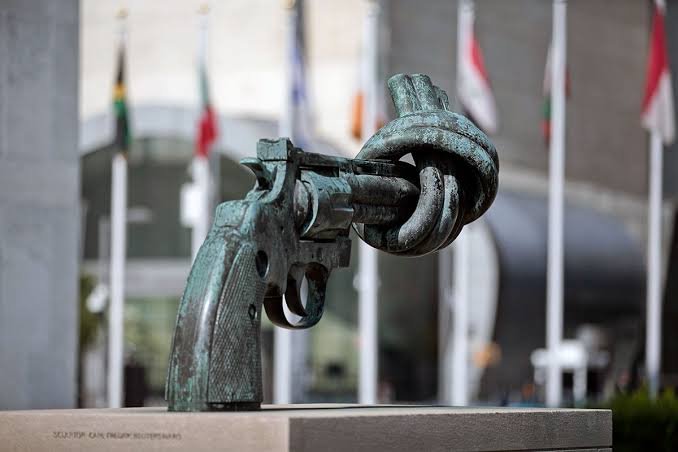
In such circumstances, non-violence is no longer merely a moral ideal; it has become an indispensable necessity for a balanced life and a peaceful world order. Observed on October 2, the birth anniversary of Mahatma Gandhi, the International Day of Non-Violence represents global recognition of this need. In 2007, the United Nations General Assembly designated October 2 as the International Day of Non-Violence, emphasizing the universal relevance of non-violence and the need to promote a culture of peace, tolerance, understanding, and non-violence.
Non-violence is the beauty of life. It is not merely the absence of physical harm. It is the purity of thought, speech, and action. Not harbouring hatred toward anyone, avoiding insulting language, refraining from bitterness in thought, and ensuring that our conduct does not cause unnecessary pain to others are all expressions of non-violence. Where there is violence, there is fear; where there is fear, there is tension; and where tension prevails, lasting happiness and peace cannot flourish.
Non-violence, therefore, is the foundation of a balanced and harmonious life. The most comprehensive and subtle understanding of non-violence is found in Jain philosophy. Lord Mahavira elevated non-violence to the highest principle of life. In Jain thought, non-violence is not merely a principle of preventing human beings from harming one another; it is a profound philosophy based on respecting the existence and sanctity of every living being. That is why the lives of Jain monks and nuns appear as living laboratories of non-violence.
Jain monks walk with extraordinary care. They gently sweep the ground before them with a rajoharan, so that even the smallest living organisms are not unnecessarily harmed. In the Shvetambara tradition, the use of the mukhavastrika is also associated with this deep awareness and concern for minute forms of life. In Jain monastic discipline, mindfulness is essential in walking, speaking, handling objects, and accepting food.
Here, non-violence does not merely mean refraining from outward harm; it means living with constant awareness and sensitivity. Practices such as avoiding food after sunset and exercising care in the consumption of food and water are also rooted in this subtle consciousness of protecting life. The life of a Jain monk conveys a profound message: when a person becomes sensitive even to the smallest form of life, how can there be room in that life for greater violence? This is the grandeur of the Jain vision of non-violence.
The uniqueness of Lord Mahavira’s teaching is that it does not merely restrain physical violence; it challenges violence in speech and thought as well. Harsh words may not wound the body, but they can leave deep scars on the mind. The true expansion of non-violence therefore requires us to make our language compassionate. Our conduct should be such that everyone who comes into contact with us experiences dignity and warmth rather than humiliation, fear, or bitterness.
This teaching has become even more relevant in the age of social media. A harsh word, an insulting comment, or false information can create tension, misunderstanding, and hatred among thousands of people. The digital age therefore demands non-violent communication as much as non-violent conduct. Behind every screen is a human being—with emotions, sensitivities, and dignity. Recognising this is an essential dimension of modern non-violence.
If Lord Mahavira gave non-violence its profound spiritual and philosophical dimensions, Mahatma Gandhi transformed it into a powerful instrument of social and political change. Gandhi placed truth and non-violence at the heart of India’s freedom struggle. Movements such as the Salt Satyagraha demonstrated that injustice could be resisted without resorting to violence.
Gandhi’s non-violence was neither cowardice nor passive acceptance of injustice. It was the strength to stand firmly with truth and resist injustice without hatred or violence. For Gandhi, the relationship between means and ends was fundamental: a peaceful and just society cannot be created through violent means. His legacy continues to demonstrate the power of moral courage, peaceful resistance, and principled action.
Today, wars and terrorism have raised grave questions before humanity. Nations possess weapons of destruction more powerful than ever before, while modern technology has multiplied the capacity for warfare. In such circumstances, non-violence does not mean abandoning the responsibility to protect society or uphold justice. Citizens must be protected from violence and terrorism. Yet lasting peace cannot be secured through a balance of power alone. It requires dialogue, trust, justice, coexistence, and human sensitivity.
Indian civilisation has, for centuries, nurtured this broader vision through concepts such as “Vasudhaiva Kutumbakam” — the world is one family; “Sarve Bhavantu Sukhinah” — may all beings be happy; Anekant — the recognition of multiple perspectives; and Sarva-Dharma Sadbhava — harmony among all faiths. These ideals remind us that lasting peace is impossible without understanding the perspectives of others. Anekant, in particular, teaches intellectual humility—the recognition that our own perspective does not necessarily represent the whole truth. Such an attitude can transform ideological conflict into meaningful dialogue.
The most important arena for practising non-violence is not the world outside us but our own inner world. Anger, jealousy, ego, greed, and revenge create continuous conflict within the human mind. Therefore, the first experiment with non-violence must begin within ourselves. Transforming anger into compassion, competition into cooperation, revenge into forgiveness, and disagreement into dialogue is the essence of modern non-violence.
In the family, non-violence means understanding and respecting one another. In society, it means respecting diversity. In public life, it means ensuring that differences of opinion do not turn into hostility. In international relations, it means keeping the doors of dialogue and diplomacy open. Non-violence is not weakness; it is disciplined strength. Violence may produce immediate results, but it cannot create lasting peace. Violence can generate fear, but not genuine respect; it can silence people, but it cannot transform their hearts. Non-violence, by contrast, creates the possibility of inner transformation. That is its deepest strength.
The Mahaveerayatan Foundation has also been making a meaningful contribution to keeping this broader message of non-violence alive in society. The Foundation undertakes various social and constructive initiatives centred on non-violence, compassion, vegetarianism, kindness toward living beings, environmental protection, sensitivity toward all creatures, and human values. Through seminars, conferences, and dialogue programmes, it seeks to connect Lord Mahavira’s philosophy of non-violence with the realities and challenges of contemporary life. Its endeavour is not merely to speak about non-violence, but to transform it into a living value and a way of life.
My revered Gurudev, Acharya Vidyasagar Ji Maharaj, also inspired people throughout his life to embrace a non-violent, disciplined, compassionate, and self-controlled way of living. His life demonstrated that non-violence is not merely an idea or a sermon; it is a spiritual discipline to be practised every day. Through self-restraint, simplicity, compassion, and reverence for every form of life, he showed how the principle of non-violence can become a living reality.
Today, we need to draw inspiration from Lord Mahavira’s profound philosophy of non-violence, Mahatma Gandhi’s philosophy of Satyagraha, and the life and spiritual discipline of Acharya Vidyasagar Ji Maharaj. Non-violence must evolve from an individual practice into a social culture and from a social culture into a global vision of life. The world needs not merely peace agreements, but peaceful human beings. It needs an education that teaches compassion, a culture that promotes coexistence, and a model of development that remains sensitive to nature and every form of life.
At a time when the world is increasingly concerned about violence, conflict, and division, India must once again give voice to a universal message: Non-violence is not merely India’s heritage; it is the foundation of humanity’s peaceful future. If humanity can transform its thoughts, words, and conduct in the light of Mahavira’s compassion and Gandhi’s Satyagraha, a new world order can emerge—one in which dialogue replaces the mentality of war, friendship replaces hatred, and coexistence replaces conflict. That is the true significance of the International Day of Non-Violence—and the path toward a peaceful, balanced, compassionate, and beautiful future for humanity.
Comments are closed.