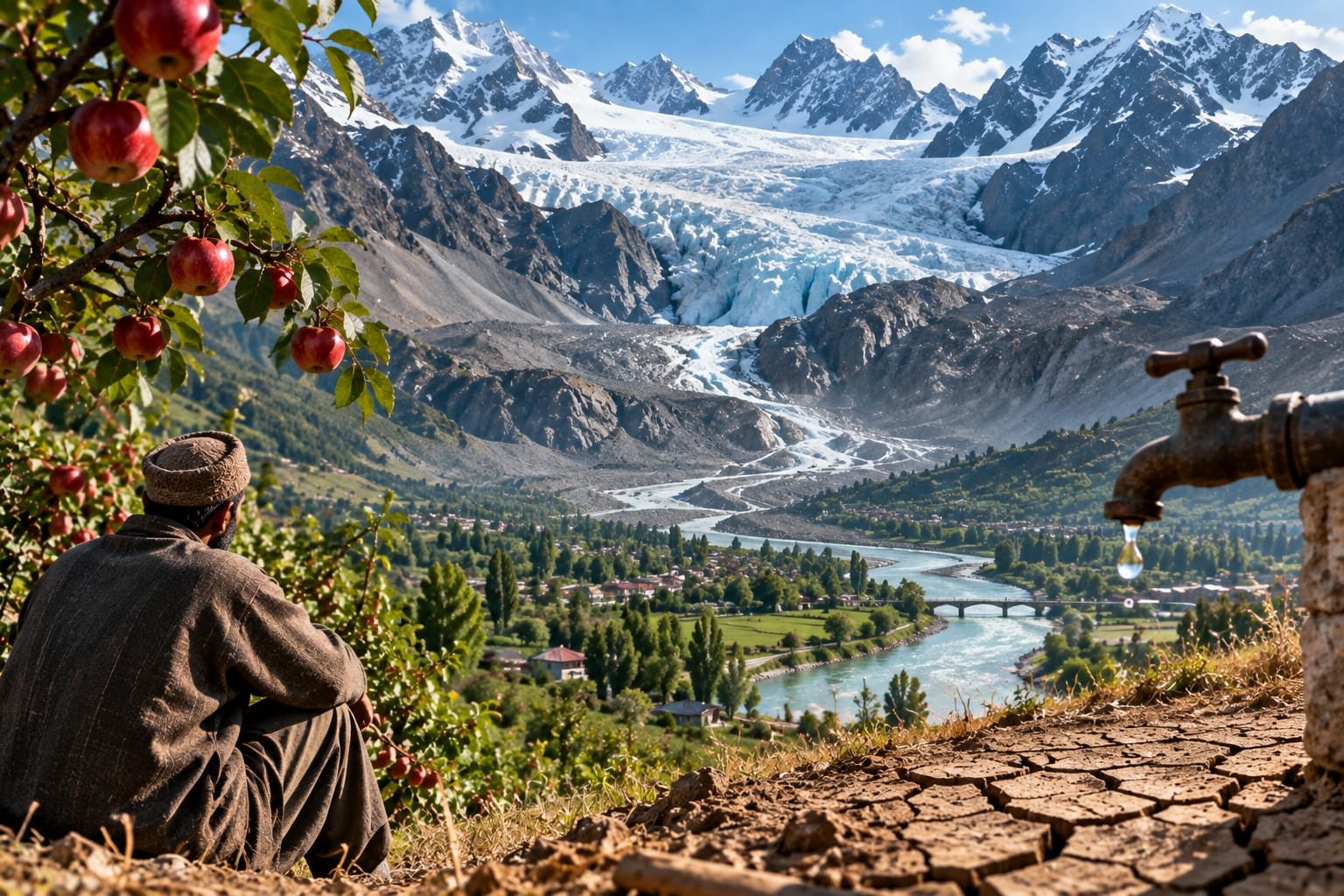
Deep within the glacial catchments above the beaten path of tourists in Pahalgam and Sonamarg, there is a process taking place that one day will affect each farm, home, and hydroelectric plant on the lower Jhelum river system. The Kolahoi glacier, largest in the Jhelum system and the “ice mountain” of Kashmiris for generations, has retreated 784 metres from 1973 to 2022 at an average annual rate of 20 metres per year. The Sheshram glacier, located in the East Lidder glacial basin, has receded 627 metres from 1979 to 2022. In the Vishav-Rembiara glacial basin, the pair of glaciers named Chirsar I and Chirsar II has retreated 339 and 290 metres respectively. These numbers, derived from a 2025 report using remote sensing and field surveys, are not predictions but facts about what has already taken place.
Another study carried out by the Department of Earth Sciences of the University of Kashmir and headed by the glaciologist Professor Shakil Ahmad Romshoo revealed that the mountains of Kashmir are warming faster than its urban areas. This can be seen as an explanation for why glacier melting is speeding up despite the fact that there have only been insignificant changes in overall precipitation trends. When analysing nine benchmark glaciers with the help of Landsat satellite images from 1980 to 2013, researchers concluded that the glaciers in the region had shrunk by almost 17 percent in three decades, while the equilibrium line altitude, i.e. the dividing line between the zone of accumulation of snow and the zone of its melting, had shifted up by 80 to 300 metres.
Whereas the immediate cause identified by the researchers is a growing warmth in the region rather than decreasing amounts of snowfall, the two factors reinforce one another in a vicious circle which is hard to break. The findings of a wider study carried out by the International Centre for Integrated Mountain Development, focusing on some 63,700 glaciers in the Himalayas in the Indus, Ganges, and Brahmaputra basins, indicate that in 2025-26, the snow persistence throughout the region amounted to 27.8 percent below the average for the past, the lowest figure observed in the course of more than 20 years. Snow persistence is the length of time during which the snow stays on the mountain slopes before melting away; the dramatic decrease in this value shows that the mountain ecosystem becomes less capable of renewing itself. As far as rainfall is concerned, the figures collected in Srinagar tell a similar story: rainfall in August decreased to 9.5 millimetres, which is an 87.6 percent fall from the historical average of 76.8 millimetres for the month.
How is this of any relevance to an orchard keeper in Shopian or mill owner in Anantnag who will never step on a glacier? The reason is simple – the river Jhelum and all the rivers that make up the tributary network in Kashmir rely almost exclusively on melt from snow and glaciers in the higher Himalayas to ensure sufficient water in the summer months when there is the highest demand for water in irrigating the orchards, paddy fields and saffron fields in Kashmir. Glaciers are like natural reservoirs that accumulate precipitation in the form of snow in winter and release it in small streams in the summers when the rains do not suffice to meet the demand. Experts have pointed out that in the short run, increased melting may even result in increased river flow because each year more ice gets converted into water. However, this is merely a short term illusion. With each year the reserves of glaciers decreasing, there is bound to be reduced water in the coming years, especially when there is an increase in the demand for water.
On the other hand, a modeling analysis carried out by the University of Kashmir’s Centre of Excellence for Glacial Studies, involving thirteen corrected bias climate models for different emissions scenarios, forecasted a reduction in glacier area in the Jhelum sub-basin ranging from 34.7 percent under moderate emissions scenario and even up to 55.3 percent under the high emissions scenario by 2080s, alongside with a noticeable decrease in glacier-fed streamflow. Such numbers make one rethink the approach to all sorts of issues from water supply infrastructure to hydroelectric potential because Kashmir power generation, which suffers from regular shortages during winter, relies heavily on the flow of its rivers.
The implications extend well beyond agriculture and electricity. Horticulture-dependent livelihoods, which as covered elsewhere in this collection represent one of Kashmir’s largest employment sectors, are directly exposed to any sustained decline in irrigation water availability. Drinking water supply for Srinagar and other urban centres draws on the same river system. And the broader risk of glacial hazards, including glacial lake outburst floods, rises as glaciers retreat and meltwater pools in unstable moraine-dammed lakes, a danger that researchers elsewhere in the Himalayas have already seen materialise in catastrophic landslides and flash floods.
However, what can actually be done at the regional level, when the root cause of the melting glaciers is a global phenomenon which cannot be reversed by any individual Union Territory? The solution seems to be adaptation rather than mitigation. In terms of adaptation, some of the things which can be done include improving water storage facilities for better capture of melted water and rainwater rather than letting it flow away without being put to any use, proper monitoring of the glacial lakes for early warning about outburst floods and water conservation measures such as drip irrigation in agriculture to make optimal use of the diminishing water resources. The World Meteorological Organization has pointed out that global glaciers have melted by about 600 gigatons in just one year of 2023, the highest single-year melting in the last 50 years.
Glacial retreat is not just one more statistical fact about how the climate is changing in a place where everything about its identity – from the rivers to the apple orchards to the snow that attracts visitors in winter – is a result of its mountain geology. It is a ticking clock whose rhythm has only just begun to be measured by scientists, with human cost sure to follow.


Comments are closed.