India’s demographic strength is often described in numbers. The country has one of the world’s largest young populations, and that young population can become one of the country’s greatest economic assets in the decades ahead. But demographics, by themselves, do not create prosperity.
Young people need skills that employers value, jobs that provide dignity, incomes that can support families and opportunities that allow them to build careers rather than simply find temporary employment.
This becomes even more important in rural India.
For millions of young people living in villages and small towns, the distance between education and employment remains considerable. A young person may possess a school certificate, a college degree or considerable practical ability, yet still struggle to find work that matches those capabilities. Others migrate to cities because local opportunities are limited, often entering informal employment without adequate support or protection.
India’s projected youth population of nearly 345 million by 2036 makes this challenge impossible to ignore.
The question is no longer simply how to train India’s rural youth. The more important question is what happens after the training.
That is where the evolution of the Deen Dayal Upadhyaya Grameen Kaushalya Yojana, or DDU-GKY, becomes significant.
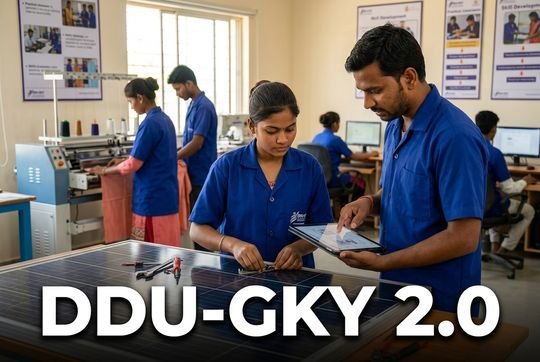
Launched by the Ministry of Rural Development on September 25, 2014, under the National Rural Livelihoods Mission, DDU-GKY was designed to provide placement-linked skill training to rural youth from poor households. Over more than a decade, the programme has trained over 18.47 lakh candidates and placed more than 12.43 lakh across 36 sectors and more than 800 job roles.
As the programme enters its twelfth year, however, the most important development is not simply its scale. It is the shift embodied in DDU-GKY 2.0 towards sustained employment, post-placement support, migration assistance, technology-based monitoring and career progression.
That shift is necessary.
Because training is only the beginning.
The real test begins after certification
For years, the conversation around skilling has often focused on the number of people trained.
Training numbers are easy to count.
Employment is harder.
And sustained employment is harder still.
A candidate may complete a course, receive a certificate and secure a job, but leave that job within a few weeks because of low wages, unsuitable working conditions, distance from home, lack of accommodation, inadequate workplace preparation or a mismatch between training and actual job requirements.
In such circumstances, a programme can technically report a placement while the young person remains economically insecure.
DDU-GKY 2.0 attempts to address this gap by extending the minimum placement duration from three months to six months and by introducing 12 months of post-placement tracking.
This is a welcome conceptual change.
The objective of skill development should not be to produce certificates. It should be to produce employable people who can remain in employment, improve their skills and build a livelihood.
That is a much higher standard.
Under the revised framework, placed candidates can receive financial assistance of Rs 1,270 per month for six months, amounting to Rs 7,620. Candidates who remain employed for 365 days, subject to the prescribed conditions, can receive retention support of Rs 5,000. Opportunities for upskilling and reskilling are also built into the post-placement framework.
Such measures recognise a simple economic reality: entering a job and staying in a job are two different achievements.
Rural youth need more than technical skills
Another important feature of DDU-GKY 2.0 is the structured training framework.
The programme retains a minimum 576-hour training requirement. Of this, 396 hours are devoted to domain-specific training and 180 hours to mandatory non-domain training.
The latter includes English communication, employability and life skills, computer and digital literacy, and entrepreneurship.
This combination matters.
An electrician may know how to repair equipment but still need communication skills to deal with customers.
A healthcare worker needs technical knowledge but may also need digital skills to use modern systems.
A young person entering a formal workplace for the first time may understand the technical aspects of a job but remain unfamiliar with workplace behaviour, financial planning or professional communication.
Employability is therefore broader than occupational skill.
The modern labour market increasingly demands people who can adapt, communicate, use technology and continue learning.
This is particularly relevant as sectors themselves change.
DDU-GKY 2.0 provides training across areas including aerospace and aviation, agriculture, beauty and wellness, green jobs, healthcare, textiles and other sectors aligned with industry requirements.
The diversification is important because rural youth should not be confined to a narrow conception of rural employment.
Agriculture remains fundamental, but the rural economy today is connected to logistics, digital services, tourism, healthcare, construction, manufacturing, renewable energy and a growing service sector.
Skill programmes must evolve accordingly.
The gender dimension cannot be ignored
The success of a rural skilling programme also depends on whether women are able to participate meaningfully.
DDU-GKY includes mandatory coverage targets for women, Scheduled Castes and Scheduled Tribes, and persons with disabilities. Women constitute at least 33 per cent of the programme’s mandated coverage.
The numbers indicate substantial participation. More than 9.71 lakh women have been trained under DDU-GKY, while over 6.34 lakh have secured placements.
But women’s participation in employment cannot be assessed solely by whether they receive training or obtain an initial job.
Social expectations, safety, transportation, childcare, workplace conditions and family attitudes can determine whether a woman remains employed.
This is why post-placement support is particularly important for women.
A job located hundreds of kilometres away may technically be an opportunity, but it may not be practically accessible to a young woman whose family is unwilling to allow long-distance migration.
Similarly, a rural woman may possess excellent tailoring, food-processing, digital or beauty-service skills but require credit, market access and local infrastructure to convert those skills into a sustainable enterprise.
Skilling policy therefore needs to be connected with the realities of women’s lives.
Migration is not failure—but unsupported migration can be
One of the most interesting aspects of DDU-GKY 2.0 is its explicit attention to migration.
Rural youth frequently move to cities because jobs are concentrated there. Migration is not necessarily a negative phenomenon. It can raise incomes, broaden experience and connect workers with new opportunities.
The problem begins when migration occurs without preparation.
A young person arriving in an unfamiliar city may not know where to stay, how to access public services, how to deal with an employer or where to seek assistance if a job does not work out.
Migration Support Centres are intended to address some of these challenges.
State Rural Livelihoods Missions can establish centres in areas where large numbers of placed candidates originate as well as in destination states. These centres can provide accommodation assistance, counselling, placement support, employment information and connections with employers and local authorities.
The increase in annual funding per centre from Rs 10 lakh to as much as Rs 30 lakh under the revised framework indicates that migration is increasingly being treated as a component of employment policy rather than an afterthought.
This is important.
If young people have to leave home to find work, policy should not simply tell them to migrate. It should help them migrate safely, understand their employment conditions, access basic services and remain connected to support systems.
The special case of Jammu and Kashmir
For Jammu and Kashmir, the discussion has a particular significance.
The region has a large young population, but employment opportunities are unevenly distributed. Geography, terrain, seasonal conditions and the concentration of economic activity in specific urban centres can create additional barriers.
This is where Himayat, the special DDU-GKY programme for Jammu & Kashmir and Ladakh, assumes importance.
Himayat covers rural and urban youth, including people from both BPL and APL households, and supports wage, self-employment and gig employment. It is fully centrally funded and implemented with support from the local administration through dedicated Mission Management Units.
The broad design is important because the employment needs of Jammu and Kashmir cannot be addressed through a single model.
One young person may be interested in a private-sector job outside the region. Another may want to establish a tourism enterprise. A third may prefer a digital or gig-based occupation. A fourth may want to develop a local manufacturing or service business.
A good skilling programme should create pathways rather than dictate destinations.
Jammu and Kashmir’s youth also have particular opportunities emerging in tourism, hospitality, horticulture, handicrafts, food processing, healthcare, information technology, renewable energy, logistics and other sectors.
The challenge is connecting young people to these opportunities through credible training and market linkages.
The fact that Jammu and Kashmir allocated 100 per cent of its DDU-GKY 2.0 targets and commenced training for 91 per cent of the allocation in the 2025-26 rollout is significant.
But the next question must be: how many of those young people remain employed after six months, one year and beyond?
That is where the outcome-based approach needs to become visible.
Local employment should remain an important goal
Migration support is valuable, but it should not become an excuse for accepting the permanent outflow of rural talent.
A stronger rural economy should also create opportunities closer to home.
This is especially relevant in regions where young people leave villages for cities not because they necessarily want urban life, but because there are few viable alternatives.
Skill development can become a tool for local economic transformation when it is connected with local resources.
A horticulture-rich district can develop food processing, packaging, cold-chain and marketing skills.
A tourism destination can train young people in hospitality, adventure tourism, guiding, digital marketing and transport services.
Areas with handicraft traditions can combine traditional skills with design, e-commerce and modern branding.
Agricultural communities can benefit from training in machinery, processing, storage, logistics and value addition.
The objective should be to move from selling raw labour or raw produce towards creating greater value locally.
This is where skilling intersects with rural development.
Job Melas can bridge the gap
Job Melas organised at block and Gram Panchayat levels are another useful component.
Their value is not simply that employers and job seekers meet in one place.
They can help bring the labour market closer to rural communities.
For a young person in a village, searching for employment may involve limited information. Local job fairs can provide exposure to employers, counselling and information about available positions.
The framework also provides funding support for such fairs, subject to placement-linked conditions.
But the success of Job Melas should not be measured merely by attendance.
A crowded job fair is not necessarily a successful job fair.
The meaningful indicators are how many candidates are selected, how many actually join, how many remain employed and whether the jobs correspond to the skills for which candidates were trained.
Again, the emphasis must move from events to outcomes.
RSETIs: another pathway beyond wage employment
Not every young person wants a salaried job.
Some want to become entrepreneurs.
This is why the Rural Self-Employment Training Institutes, or RSETIs, are an important complement to DDU-GKY.
RSETIs provide free residential training to rural unemployed youth aged 18 to 50 and offer handholding support for establishing sustainable livelihoods.
According to the government, 647 RSETIs are currently operational across 634 districts in 33 States and Union Territories. Since their inception in 2009, they have trained 63.47 lakh candidates, of whom 45.60 lakh have been settled. Around 94 per cent of those settled have established self-employment ventures, while around 6 per cent have secured wage employment.
The coexistence of DDU-GKY and RSETIs reflects an important policy principle.
There should be multiple pathways from rural youth to livelihoods.
One person may be suited to wage employment.
Another may become an entrepreneur.
Another may combine a small enterprise with gig work.
Another may return to agriculture but apply modern technology and value addition.
The goal should be sustainable income, not uniformity.
Technology can improve accountability
DDU-GKY has used technology since its inception through geo-tagged and time-stamped biometric attendance, computer labs and e-learning facilities.
DDU-GKY 2.0 goes further by attempting to digitise the programme lifecycle—from project registration and training-centre management to candidate assessment, certification, financial management, monitoring and placement tracking.
The introduction of advanced dashboards, a public candidate portal, automated processes, digital attendance, face authentication and integration with the Skill India Digital Hub can improve transparency.
This matters because public programmes involving large numbers of beneficiaries require strong monitoring.
Technology can help identify irregularities, track attendance, monitor training centres and provide information about performance.
The public candidate portal is particularly useful in principle because transparency should not operate only inside government.
If candidates can see training options and performance information about implementing agencies, they can make more informed choices.
However, technology should remain a means, not an end.
A sophisticated dashboard cannot compensate for poor training.
Biometric attendance cannot guarantee that a trainee actually acquires employable skills.
An online certificate cannot create a job.
Technology can make implementation more accountable, but the quality of human institutions remains decisive.
Industry must become a partner
One of the biggest challenges in any skilling programme is ensuring that training matches the labour market.
There is little value in producing large numbers of candidates in occupations where demand is limited.
Industry therefore needs to be involved not only at the recruitment stage but also in curriculum design, assessment and feedback.
Employers know what skills they require.
Training institutions know what can realistically be taught.
Government knows the social and developmental objectives.
The best results will emerge when these three perspectives are brought together.
DDU-GKY 2.0’s emphasis on industry-aligned sectors is a step in this direction.
But the relationship should be continuous.
Employers should be able to communicate changing skill requirements, while training providers should have mechanisms to update courses quickly.
This is particularly important as artificial intelligence, automation, digital platforms and green technologies reshape the labour market.
The jobs available today may not be the same jobs available ten years from now.
Young people therefore need not only a skill but also the ability to learn new skills.
Rural youth should be prepared for the future, not just today’s vacancies
The strongest skilling programmes should create adaptability.
A young person who learns only one narrow task may become vulnerable when technology changes.
Someone who combines occupational expertise with communication, digital literacy, problem-solving and entrepreneurial skills has greater capacity to adapt.
That is why the 180-hour non-domain component under DDU-GKY 2.0 deserves attention.
English communication, life skills, computer literacy and entrepreneurship are not decorative additions to vocational training.
They are part of employability.
A worker today may be expected to use a smartphone-based attendance system, communicate with customers through digital platforms, complete online forms, manage digital payments or participate in virtual training.
Digital literacy is therefore increasingly as important as occupational literacy.
The challenge of quality remains
The expansion of skilling programmes also raises an unavoidable question: how do we ensure that every training centre provides the same quality?
A certificate should have credibility with employers. That requires competent trainers, appropriate equipment, adequate practical exposure, credible assessments and strong industry connections. It also requires monitoring that looks beyond attendance.
The system must be able to identify training centres where candidates repeatedly fail to secure employment or leave jobs quickly.
Public ratings and performance dashboards can contribute to this process, but they must be backed by meaningful evaluation.
A programme that rewards training providers simply for producing certificates can create the wrong incentives.
The incentive must be tied to actual outcomes.
The rural youth dividend will depend on implementation
India’s young population can become a demographic dividend only if the economy is capable of absorbing and rewarding its talent.
Otherwise, a large youth population can also create frustration, underemployment and migration pressures. This is why programmes such as DDU-GKY deserve to be judged by a longer horizon.
The relevant questions are not simply: How many were trained? How many received certificates? How many were placed?
The questions should increasingly be:
How many remained employed? How many increased their incomes? How many progressed in their careers? How many became entrepreneurs? How many returned to their communities and created employment for others? And how many found that their training actually changed the trajectory of their lives?
These are harder questions, but they are the questions that matter.
From a training scheme to a livelihood ecosystem
DDU-GKY 2.0 represents an important change in thinking. Its focus on six-month placement, 12-month tracking, retention support, reskilling, migration assistance, job fairs and digital monitoring suggests that skilling is increasingly being viewed as a complete employment journey.
That is the right direction. But policy frameworks can only create the conditions. The final result depends on implementation at the training centre, the workplace, the district and the village.
For Jammu and Kashmir, the stakes are particularly high.
A young person in Bandipora, Kupwara, Baramulla, Ganderbal, Kishtwar, Rajouri or any other rural district should not have to view migration as the only route to economic dignity.
If migration is chosen, it should be safe and supported. If local opportunities exist, young people should have the skills to seize them. If entrepreneurship is viable, training should be accompanied by access to markets, finance and mentoring.
And if a young person enters wage employment, the system should help that person stay, learn and progress. This is ultimately what rural skilling should mean.
Not merely teaching someone how to do a job, but helping that person build a livelihood. Not merely creating a certificate, but creating confidence. Not merely securing a placement, but creating a career.
India’s projected young population of nearly 345 million by 2036 represents an extraordinary opportunity. But demographic numbers become an economic advantage only when young people have the capabilities and opportunities to participate productively in the economy.
DDU-GKY has already trained more than 18 lakh rural youth and placed more than 12 lakh. Its next chapter should be judged by what happens to those young people after they enter the labour market.
If they remain employed, increase their incomes, acquire new skills and build stable futures, the programme will have achieved something much larger than a training target.
It will have helped convert rural India’s young population into rural India’s economic strength.
That is the real promise of DDU-GKY 2.0: not simply skills for jobs, but skills for livelihoods, resilience and upward mobility.
And for rural India, that distinction could make all the difference.
The article is based on the inputs and background information provided by the Press Information Bureau (PIB). Author is Writer, Policy Commentator. He can be mailed at kcprmijk@gmail.com


Comments are closed.