They Studied to Feed a Nation. They Were Offered Cricket Kits
SKUAST-K agriculture graduates fight for their future; allege 20 years without a single job advertisement, says minister Dar offered cricket kits instead of employment
Sopore, Sep 23 : Imagine spending years studying agriculture earning your master’s, then your doctorate only to be told there are no jobs in your field. Not because you’re unqualified. But because no posts have been advertised in 20 years.
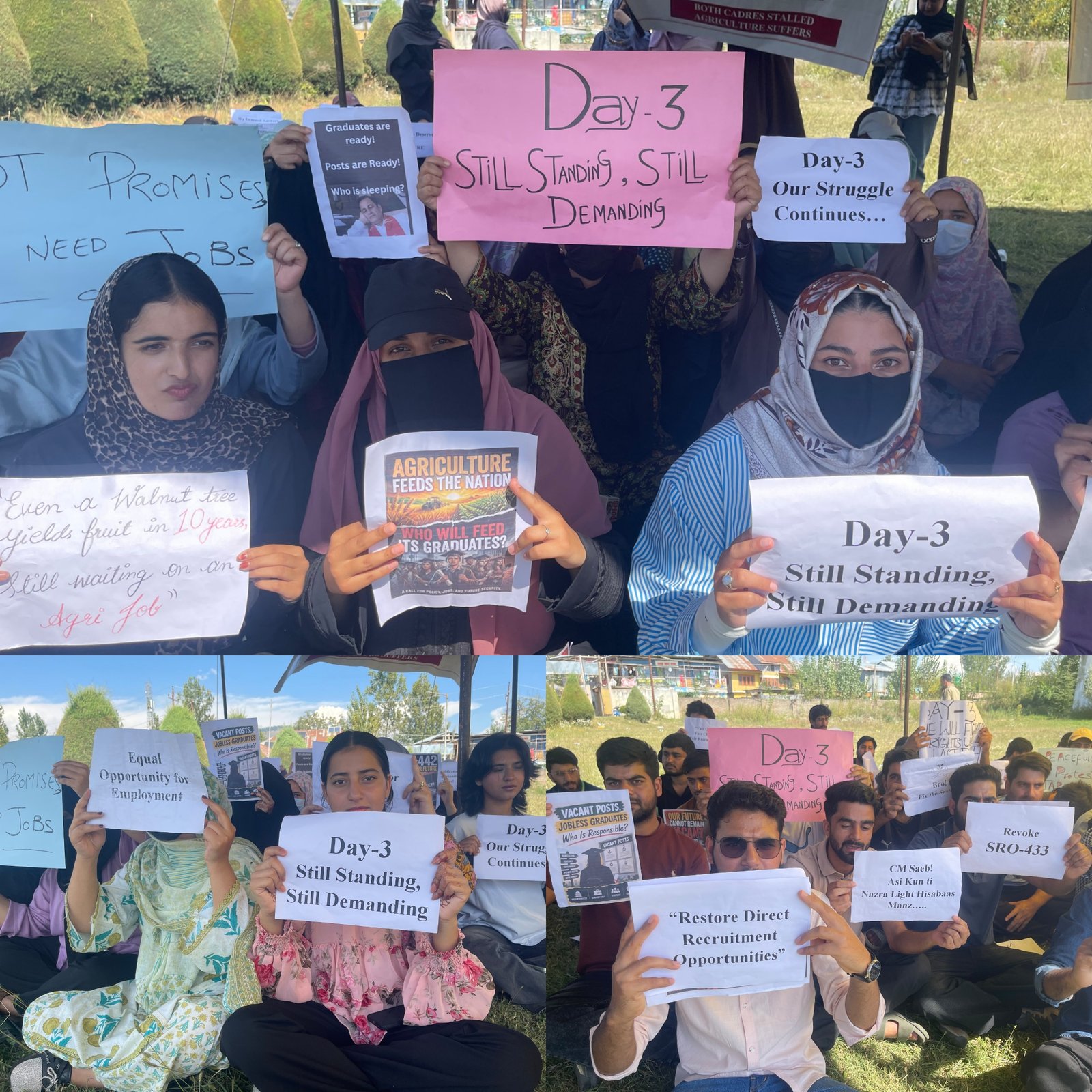
That’s the reality facing a group of young men and women in Sopore of north Kashmir’s Baramulla district who have been standing under the open sky for three consecutive days, their hands raised in protest, their palms carrying a message that says everything “Roots Need Rights.”
They are agriculture graduates from Sher-e-Kashmir University of Agricultural Sciences and Technology (SKUAST-K), Wadura. Many are Ph.D. scholars. Some completed their doctorates as far back as 2012. And they are asking for something remarkably simple — the right to work in the fields they have spent years studying.
A Cricket Kit Instead of Answers
Their frustration deepened after a recent meeting with Agriculture Minister Javed Ahmad Dar. A delegation of students approached him with hope. What they received, they say, was a cricket kit.
“We were astonished to hear him say that if we want cricket kits, he can provide those, but as of now, there are no posts,” a protester recounted while speaking to Kashmir Convener.
The graduates claim that no posts — gazetted or non-gazetted — have been advertised in the Agricultural Production Department for the past 20 years, leaving an entire generation of agriculture professionals without a roadmap.
“Our entry is blocked. A new graduate who completes his B.Sc. Agriculture won’t be able to join here because there are no entry-level posts. The posts that have been vacant for 20 years are not being filled,” said Adnan another protester.
In a region where women’s participation in the workforce remains a hard-fought battle, these graduates say they are not just fighting for employment — they are fighting for the right to use the education they earned, to contribute to the land they grew up on, and to build a future that does not depend on anyone else.
“Most of the students protesting right now are Ph.D. scholars. They are master’s students. Some people completed their Ph.D. in 2012. After 20 years, after 10 years, where will they see themselves? We don’t have any job opportunity because our government is not advertising any kind of jobs in our department,” said Zobiakhanum a female protester.
The graduates are demanding a review or repeal of SRO-442 of 2017, along with changes in the recruitment policy to create greater opportunities for qualified agriculture professionals. They allege that SRO 433 and SRO 442 have reduced direct recruitment to nearly zero per cent.
“Our simple demand is that the SROs should be revoked and the entry that we have been given should be revoked so that new minds and their names are made known and they secure their future,” said another protester.
Meanwhile, the protestors say they will not leave until they are heard.
“We will continue to do this as long as we don’t get any response. We don’t get our rights. Until then, we will be standing here.”
In their hands, the message is clear — roots need rights. And these young graduates, armed with degrees and determination, are not ready to be uprooted.


Comments are closed.