Kashmir’s economic future cannot be secured merely by expanding the sectors that already dominate its economy. Horticulture, tourism, handicrafts, agriculture and government employment have provided livelihoods to generations and will continue to remain important, but an economy that depends predominantly on a limited set of sectors can struggle to generate the scale, diversity and resilience required for long-term prosperity. If Kashmir is to experience a genuine economic renaissance, industrialisation has to become a central part of that transformation. Industrialisation should not, however, be understood narrowly as the establishment of factories. It is a process through which a society changes the way it produces, works, invests, innovates and creates wealth. It can transform existing resources into new economic possibilities and, in doing so, create an economy that is less dependent on a limited number of traditional occupations.
Perhaps the most immediate barrier to such a transformation is not the absence of resources but a deeply rooted social preference for economic security. In Kashmir, government employment has acquired a distinctive position in the social imagination. A government doctor, engineer, teacher, civil servant or other employee is often associated with stability, respect and a secure future, while business, entrepreneurship and private employment are more readily associated with uncertainty and risk. This preference is understandable because individuals naturally seek economic security, particularly in an environment where uncertainty can have serious consequences for families. The problem emerges when a reasonable individual preference becomes a collective social expectation. When an entire generation is encouraged to regard a secure government position as the ideal destination of education, while entrepreneurial and private-sector careers are treated as secondary alternatives, the consequences extend far beyond individual career choices.
A society cannot continuously evolve economically if its people are discouraged from taking calculated risks. Innovation is inherently uncertain because the outcome of an experiment cannot be known in advance. Every enterprise, manufacturing unit, technological innovation and new product involves the possibility of failure. Economic development therefore requires a certain degree of tolerance for uncertainty. This does not mean that reckless risk-taking should be celebrated, but it does mean that calculated risk cannot be treated as inherently undesirable. A society that wants industries to emerge must create space for people who are willing to invest, experiment, fail, learn and try again.Without such a culture, industrialisation can remain a policy objective on paper while the economic behaviour necessary to realise it remains absent.
There is an important paradox here. The preference for government employment may provide security to individuals, but when that preference becomes overwhelmingly dominant it can contribute to economic insecurity at the collective level. If a large proportion of educated young people compete for a relatively limited number of government positions, while fewer people attempt to create private enterprises, the economy becomes increasingly dependent on the state as the principal provider of respectable employment. The limited development of the private sector then reinforces the original preference for government employment because young people see fewer credible alternatives around them. A cycle develops in which the weakness of private enterprise strengthens the attraction of government employment, while the social dominance of government employment makes the development of private enterprise more difficult.
Industrialisation can help break this cycle by creating an economy in which employment is generated through a large number of enterprises rather than concentrated primarily within the state. This does not require the abandonment of government employment or the devaluation of public service. It requires a broader understanding of economic contribution. A government doctor serves society through public healthcare, while an entrepreneur who establishes a hospital creates healthcare infrastructure and employment through another route. An engineer can serve in government, but an engineer who establishes a manufacturing enterprise can also create productive capacity and employment. Both forms of contribution have value. The problem arises only when society recognises one as respectable and the other as inherently risky or inferior.
Kashmir also has an important advantage in beginning this transformation: it does not need to build an industrial economy entirely from unfamiliar foundations. Its traditional economic sectors already contain resources, skills, knowledge and cultural capital that can be transformed into modern industries. Horticulture is an obvious example. Kashmir need not move away from apple production in order to industrialise. Instead, it can move from simply producing apples toward developing industries around grading, storage, processing, packaging, branding and export. The agricultural product can become the foundation for an entire chain of industrial activity. What changes is not necessarily the resource but the amount of value created from it.
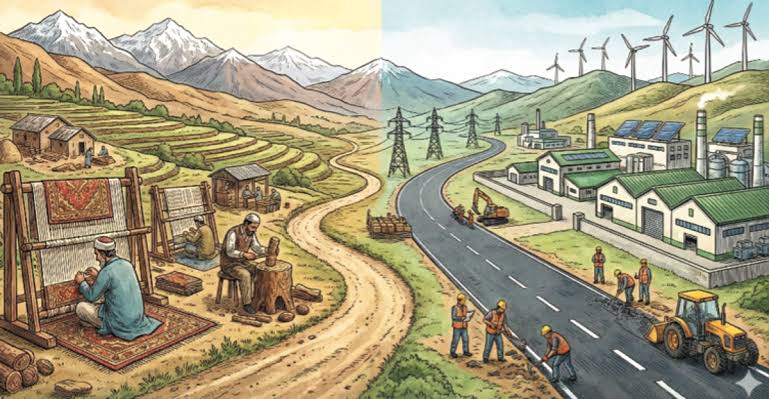
The same principle applies to Kashmir’s handicrafts. Traditional craftsmanship should not be viewed merely as something that must be preserved in its existing form. The knowledge accumulated by generations of artisans can provide the foundation for contemporary design, premium products, organised production and international markets. A traditional craft can become a modern industry without losing its cultural identity. The same logic can be extended to saffron, wool, agriculture and tourism. The objective should be to discover how existing knowledge and resources can be connected with technology, design, finance, marketing and global markets to create new forms of economic value.
This is why tradition and industrialisation should not be treated as opposites. Tradition can provide the starting point for innovation. The economic mistake would be to assume that remaining faithful to tradition requires remaining faithful to the same methods of production and the same markets. A society can preserve its cultural knowledge while transforming its economic application. The important question is therefore not simply what Kashmir produces, but what industries can emerge from what Kashmir already produces. The apple can become a food-processing industry; wool can become a modern textile industry; craftsmanship can become a global design and luxury industry; and tourism can develop into a much broader ecosystem of hospitality, transportation, technology and specialised services.
The geographical diversity of Jammu, Kashmir and Ladakh strengthens this argument further. These regions possess different terrains, climates, ecological conditions, resources and economic traditions, and therefore there is no reason to assume that industrialisation must follow a single model. Jammu can develop an industrial model suited to its plains and connectivity; Kashmir can build upon its horticulture, agriculture, handicrafts and tourism; and Ladakh can pursue industries compatible with its high-altitude environment and ecological limitations. Industrialisation should therefore not mean imposing the same industrial structure everywhere. Each region can develop its own model based on its comparative advantages while remaining connected to larger markets.
This diversity should be understood as an economic opportunity rather than simply a constraint. A modern economy does not require every region to manufacture the same products. Economic strength can emerge precisely from specialisation and interdependence. One region can produce agricultural commodities, another can process them, another can provide logistics, while another develops technology, services or specialised manufacturing. Jammu, Kashmir and Ladakh can similarly develop different productive capacities and become economically interconnected. The objective should not be uniform industrialisation but diversified regional industrialisation.
Yet geography and natural resources alone cannot determine the eventual scale of an industry. They provide possibilities, but human capacity determines how those possibilities are realised. A resource becomes economically transformative only when society develops the institutions, knowledge, technology and entrepreneurial capacity to use it in increasingly productive ways. Two societies can possess similar resources and yet experience completely different economic outcomes because one is more capable of innovation and adaptation than the other. The decisive difference is often not what a society possesses, but what it can imagine doing with what it possesses.
This is perhaps the most important theoretical dimension of industrialisation. Economic development is not a static movement from one fixed stage to another. It is a continuous process of adaptation. Markets change, technologies change, consumer preferences change and methods of production change. An industry that is successful today may become uncompetitive tomorrow if it refuses to evolve. Conversely, a modest industry can grow dramatically when entrepreneurs discover new applications, new technologies or new markets. The scale of an economy is therefore partly determined by its capacity to continuously reinterpret its existing resources.
This suggests a simple principle: resources create possibilities, institutions create opportunities, but innovation creates scale. A society that possesses resources but lacks the willingness to experiment may never realise their full economic potential. Conversely, a society capable of innovation can continually discover new uses for what it already possesses. This is why industrialisation should not be viewed merely as the accumulation of factories. It is the development of an economic ecosystem capable of generating new industries from existing industries.
For Kashmir, this capacity to adapt is particularly important because its economic future cannot be separated from the wider transformations occurring around it. Technology is changing agriculture and manufacturing. Consumers are increasingly connected to global markets. Supply chains are becoming more sophisticated. Businesses can reach customers far beyond their physical location. These changes create challenges, but they also create opportunities that were previously unavailable. The question is whether local society and institutions can adapt quickly enough to make use of them.
This brings the question of industrialisation back to the social mentality surrounding work and success. Economic transformation cannot occur entirely through government policy because policy cannot manufacture ambition. Governments can provide infrastructure, credit mechanisms, industrial estates, connectivity and incentives, but people must ultimately decide whether to use those opportunities. Industrialisation therefore requires both an enabling economic environment and a social culture that is receptive to innovation.
A society that consistently teaches its young people to avoid uncertainty may produce competent employees, but it may struggle to produce enough economic creators. A society that allows calculated risk, experimentation and entrepreneurial failure to become socially legitimate can produce a wider range of economic actors. This does not mean glorifying reckless risk-taking. It means recognising that calculated risk is inseparable from economic progress.
The distinction matters because no society evolves by remaining permanently attached to the economic structures of the past. Economic evolution requires adaptation. Technologies alter production, markets change, occupations disappear and new ones emerge. A society that can respond to these changes can convert disruption into opportunity, while a society that remains rigid can gradually experience stagnation. Industrialisation should therefore be understood not simply as economic growth but as the development of a society capable of continuously adapting its productive system.
Kashmir’s economic renaissance therefore cannot come solely from preserving what already exists. Preservation has its place, particularly when dealing with culture, craftsmanship and ecological heritage. But preservation without innovation can turn an economic asset into a museum piece. The objective should instead be to preserve the knowledge while transforming its economic application.
The Kashmiri artisan should not have to abandon tradition to enter the modern economy. The farmer should not have to abandon agriculture to become part of industrialisation. The entrepreneur should not have to abandon local resources to build a modern business. The opportunity lies in connecting these things. Industrialisation should create an environment in which traditional knowledge, modern technology, entrepreneurial capital and global markets reinforce one another.
The ultimate objective should be an economy in which a young Kashmiri can see multiple legitimate futures: government service, medicine, engineering, research, manufacturing, technology, agriculture, entrepreneurship, finance, design, logistics and countless other possibilities. Economic freedom is not simply the freedom to choose a job; it is the freedom to participate in an economy that offers many different ways of creating value.
Extensive industrialisation should therefore be seen as part of a broader transformation in Kashmir’s economic culture. It can create new employment, encourage entrepreneurship, strengthen technical skills, increase value addition, generate new markets and reduce excessive dependence on a single source of employment. More importantly, it can change the aspirations of future generations by making economic creation as socially meaningful as economic security.
The objective, however, should not be industrialisation at any cost. Kashmir’s geography and ecological characteristics demand an industrial strategy that is sustainable, diversified and suited to local conditions. The future cannot simply be measured by the number of factories established. What matters is whether those industries generate value, develop skills, create sustainable employment, encourage innovation and become capable of competing beyond the local market. Industrialisation should strengthen the economy without destroying the environmental and cultural characteristics that make the region distinctive.
Ultimately, Kashmir’s economic renaissance will depend upon its ability to move from an economy that primarily asks how existing opportunities can be secured to one that also asks how new opportunities can be created. Its traditional sectors should not be discarded but reimagined. Its geographical limitations should not simply be treated as barriers but as conditions around which specialised industries can be developed. Its educated population should not be viewed only as a pool of future employees but also as a potential source of entrepreneurs, innovators and economic institutions.
The central question is therefore not whether Kashmir possesses enough resources to industrialise. It possesses a diverse resource base, accumulated knowledge, human capital and distinctive regional advantages. The more important question is whether it can develop the capacity to continuously transform these advantages into new forms of economic activity. Resources provide the foundation, geography provides the possibilities, institutions provide the conditions, but innovation and adaptation determine the scale of transformation.
Extensive industrialisation can consequently become much more than an economic programme. It can become the foundation of a social and economic renaissance in which tradition becomes a source of innovation rather than a barrier to it, entrepreneurship becomes as socially legitimate as secure employment, and each region develops an industrial model suited to its own strengths. The real measure of Kashmir’s economic future will not simply be what it produces today, but its capacity to discover what else it can produce tomorrow.


Comments are closed.