

S Ahmad
India’s livestock economy is often discussed through the familiar figures of milk production, cattle population and dairy output. But behind those numbers lies a less visible determinant of rural prosperity: animal health. A healthy cow, buffalo, sheep or goat is not merely an agricultural asset. For millions of rural households, it is a source of income, nutrition, employment and economic security.
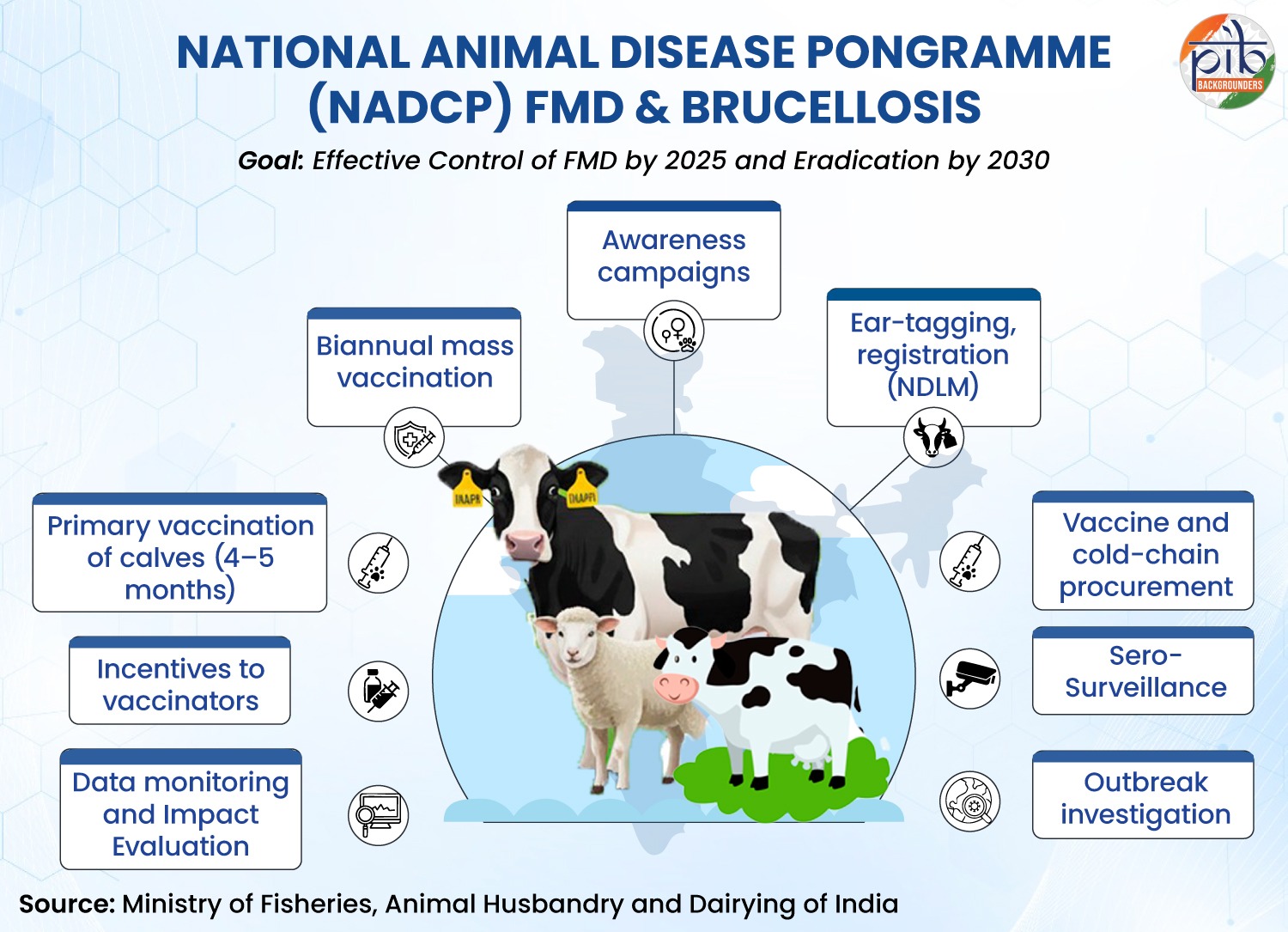
This is why the National Animal Disease Control Programme (NADCP), launched in 2019, deserves to be viewed not simply as a vaccination programme but as an important pillar of India’s agricultural and rural development strategy. Its effort to control Foot and Mouth Disease (FMD) and Brucellosis demonstrates how preventive animal healthcare can protect livelihoods, improve productivity and strengthen the resilience of the wider economy.
India has one of the world’s largest livestock populations. According to the 20th Livestock Census 2019, the country’s total livestock population stood at 535.78 million, including 302.79 million bovines. Such a vast animal population represents enormous economic potential, but it also creates an equally significant responsibility. When infectious diseases spread across livestock populations, the consequences do not remain confined to veterinary clinics or farms. They affect household incomes, milk availability, food security, agricultural productivity and, in some cases, public health.
FMD is a particularly serious threat because of its highly contagious nature. It affects cattle, buffaloes, sheep, goats and pigs, reducing milk production, slowing growth, affecting reproduction and diminishing the working capacity of draft animals. It can also impose restrictions on livestock and livestock-product trade.
Brucellosis presents a different but equally serious challenge. It affects reproduction in cattle and buffaloes and can cause fertility problems and reduced milk and meat production. Since there is no curative treatment for bovines, vaccination becomes a crucial preventive tool.
The lesson is straightforward: preventing disease is economically wiser than dealing with its consequences after an outbreak.
The NADCP was built around this principle. Its objective is ambitious—nationwide vaccination against FMD twice a year and one-time vaccination of female bovine calves aged four to eight months against Brucellosis. Such a programme requires more than vaccines. It requires logistics, cold chains, trained personnel, disease surveillance, digital records, laboratories, farmer awareness and coordination between central and state institutions.
The scale of the campaign is therefore significant.
Under NADCP, cumulative FMD vaccination has reached 147.16 crore doses, benefiting 8.04 crore farmers. The reported number of FMD outbreaks has declined from 132 in 2019 to 40 in 2025. Brucellosis outbreaks have similarly fallen from 22 to 15 over the same period.
These figures are important because disease-control programmes must ultimately be judged by outcomes. Vaccination numbers show reach; declining disease incidence indicates impact.
The improvement in immunity provides another measure. Sero-monitoring has recorded average protective immunity against FMD serotypes O, A and Asia1 at 78.1%, 71.7% and 77.6%, respectively. The decline in NSP antibody prevalence—from 20.8% in 2019 to 8.1% in 2025—also points towards reduced circulation of FMD virus.
Particularly notable is the fact that there has been no reported outbreak of FMD caused by the Asia1 serotype in India for three years.
For farmers, however, the real significance of these statistics is not statistical. It is economic.
Every disease prevented can mean milk that is not lost, a calf that survives, reproduction that is not disrupted and an animal that continues to contribute to household income.
This becomes especially important when viewed against the broader transformation taking place in Indian livestock production.
Indigenous and non-descript cattle productivity increased from 927 kilograms per animal per year in 2014-15 to 1,343.2 kilograms in 2024-25, an increase of 44.89%. Buffalo productivity rose from 1,880 kilograms to 2,365.2 kilograms over the same period. Overall bovine productivity increased from 1,640 kilograms to 2,250 kilograms per animal annually.
Milk production has also risen sharply, from 146.31 million tonnes in 2014-15 to 247.87 million tonnes in 2024-25.
These gains cannot be attributed to one programme alone. Genetics, breeding, nutrition, feed availability, dairy infrastructure, farmer practices and market development all matter. But animal health is a necessary foundation underneath all of them.
A highly productive animal that is repeatedly affected by disease cannot realise its productive potential.
This is why the future of Indian dairy and livestock development must increasingly move from a reactive approach to a preventive one.
For decades, rural animal healthcare has faced a basic last-mile problem. Veterinary services have not always been easily accessible to farmers, particularly those living in remote villages, mountainous areas or pastoral communities. By the time an animal reaches a veterinary facility, a preventable condition can become a serious economic loss.
The expansion of Mobile Veterinary Units attempts to address precisely this problem.
There are now 4,019 operational Mobile Veterinary Units across 29 States and Union Territories. Through the toll-free number 1962, these units have provided doorstep services to 136 lakh farmers and treated 276 lakh animals.
This is more than a service-delivery statistic. It represents a shift in the way veterinary healthcare reaches rural India.
Healthcare works best when it moves closer to the beneficiary. The same principle applies to animals.
For a small farmer, taking a cow or buffalo over a long distance to a veterinary centre may mean losing a day’s work, spending on transport and delaying treatment. A doorstep service reduces these barriers and can encourage earlier intervention.
The same logic applies to vaccination.
Disease control cannot depend only on farmers voluntarily bringing animals to facilities. Large-scale vaccination requires systematic mobilisation and tracking. This is where digital infrastructure has begun to play an increasingly important role.
More than 39 crore livestock have been registered on the Bharat Pashudhan Portal as of July 2026. Each registered animal is assigned a unique 12-digit Tag ID, allowing authorities to connect livestock identification with vaccination and disease information.
This represents a major change from a paper-based or fragmented system.
A digital livestock database can provide authorities with information about where animals are located, which animals have been vaccinated and where gaps remain. Over time, such information can improve planning, outbreak investigation and resource allocation.
The next step should be to make this digital ecosystem increasingly intelligent.
Artificial intelligence and advanced analytics could help identify disease patterns, map high-risk zones and anticipate potential outbreaks. Real-time dashboards can support faster decisions, while geospatial information can help authorities understand how diseases move across districts and animal populations.
But technology must remain a tool, not a substitute for veterinary expertise.
A sophisticated digital platform cannot replace a trained veterinarian who can examine an animal, speak to a farmer and understand local conditions. India’s challenge is therefore to combine digital systems with strong human capacity.
The training of 39,810 Multi-Purpose Artificial Insemination Technicians in Rural India (MAITRIs) is part of this broader effort to strengthen the rural animal-health workforce.
The importance of this last-mile workforce will only increase as India seeks to raise livestock productivity.
There is also a particular challenge posed by migratory livestock.
Pastoral communities move animals across geographical boundaries, creating potential pathways for infectious diseases to travel over long distances. Since 2024, FMD vaccination has been extended to migratory sheep and goat populations in Haryana, Himachal Pradesh, Uttarakhand, Jammu & Kashmir and Ladakh.
This is an important recognition that disease control cannot stop at administrative borders.
An animal does not understand a state boundary. A disease does not either.
Therefore, veterinary surveillance must increasingly be coordinated across states, districts and migratory routes.
This is particularly relevant for Jammu & Kashmir and Ladakh, where pastoral communities and migratory livestock form an important part of the rural economy. Extending vaccination and veterinary services to these populations is not only about disease control; it is about protecting a traditional livelihood system.
The larger framework under which NADCP now operates is equally significant.
The government has brought NADCP, the Livestock Health and Disease Control component and the Pashu Aushadhi initiative under the Livestock Health and Disease Control Programme (LHDCP). The budget allocation for LHDCP for 2026-27 is ₹2,010 crore.
This integrated approach recognises that animal health cannot be addressed through vaccination alone.
Vaccines require cold chains. Disease detection requires laboratories. Treatment requires veterinary infrastructure. Prevention requires awareness. Surveillance requires data. Outbreak management requires trained personnel and coordinated institutions.
A comprehensive animal-health system must therefore connect all these components.
Research institutions have an important role in this architecture. Financial support to ICAR institutions for vaccine research, quality testing, surveillance, sero-surveillance, disease modelling and state-wise sampling can help ensure that disease-control strategies remain science-based.
The engagement of the private sector through the Animal Husbandry Infrastructure Development Fund can also strengthen India’s capacity to manufacture veterinary vaccines and medicines.
A disease-control programme of this scale should ultimately strengthen domestic capacity rather than leave critical supplies vulnerable to external disruptions.
The COVID-19 pandemic offered a wider lesson in the importance of resilient health systems. Although animal and human health systems are different, the principle of preparedness is shared.
This is where the One Health approach becomes particularly important.
Human health, animal health and environmental health are deeply interconnected. Diseases that circulate among animals can sometimes cross into human populations. Environmental changes can alter disease patterns. The misuse of antimicrobials can contribute to antimicrobial resistance, creating another long-term public-health challenge.
Animal disease control must therefore be considered part of national health security.
The National One Health Mission reflects this understanding by seeking greater coordination across sectors and institutions.
The Pandemic Fund Project on “Animal Health Security Strengthening in India for Pandemic Preparedness and Response” adds another layer to this effort. Launched in 2024 with US$25 million from the G20 Pandemic Fund and implemented in partnership with the Asian Development Bank, FAO and World Bank, the project seeks to strengthen surveillance, including genomic and environmental surveillance, laboratory infrastructure and cross-border cooperation.
Such investments may appear distant from the daily concerns of a farmer. In reality, they are directly connected.
When a disease is detected early, the probability of containing it increases. When an outbreak is contained quickly, farmers suffer fewer losses. When veterinary medicines are used responsibly, antimicrobial resistance can be better managed. When livestock remain healthy, household incomes become more stable.
Thus, animal health is not a narrow veterinary issue. It is an economic policy issue.
India’s ambition to become a developed economy by 2047 will depend heavily on the prosperity of its rural population. Agriculture and allied activities will remain important sources of employment and income, particularly for small and marginal farmers.
Livestock can provide farmers with a regular income stream that complements seasonal crop cultivation. Dairy animals, goats, sheep and other livestock can act as economic buffers, particularly when crops are affected by weather or market fluctuations.
Disease can undermine that buffer overnight.
A sick animal can reduce milk income. Reproductive disease can reduce herd size. Mortality can destroy household assets. An outbreak can affect entire communities.
Preventing those losses is therefore a form of income protection.
This is why the decline in FMD and Brucellosis outbreaks should be understood in the broader context of farmer welfare.
There is also a nutritional dimension.
India’s growing milk production supports household nutrition and contributes to national food availability. Maintaining animal health is therefore connected to the reliability of this food supply.
But the task ahead is not complete.
Disease-control programmes require sustained vaccination coverage. A lapse in vaccination can create immunity gaps and allow infections to return. Surveillance must remain continuous even when outbreaks decline. Laboratories need to remain capable of identifying emerging variants. Cold-chain systems must function reliably, particularly in difficult terrain.
The temptation after successful disease reduction is to treat the problem as solved.
That would be a mistake.
Disease control is a continuing process.
India should therefore increasingly focus on moving from controlling disease towards achieving internationally recognised disease-free status for major livestock diseases wherever feasible. This will require stronger laboratory accreditation, genomic surveillance, reliable vaccination coverage and rapid outbreak response.
The next phase should also be climate-aware.
Climate change can influence animal health by altering disease vectors, water availability, animal stress and patterns of livestock movement. Heat stress itself can reduce livestock productivity and reproductive performance.
Future disease surveillance will therefore need to integrate climatic and environmental information alongside veterinary data.
This is where AI-enabled disease intelligence could become particularly valuable. If properly designed, such systems could combine vaccination records, animal movement, climate information, laboratory findings and historical outbreak data to identify areas requiring early intervention.
But such innovation must remain accessible to the farmer.
The ultimate test of any government programme is what happens at the farm gate.
A farmer should not have to understand the architecture of NADCP, LHDCP or the Bharat Pashudhan Portal. What matters to the farmer is whether the animal is vaccinated on time, whether veterinary help arrives when needed, whether medicines are available and whether the family can continue earning from healthy livestock.
That is where the success of the programme will ultimately be measured.
The story of India’s livestock sector is changing. It is no longer simply about increasing the number of animals or the quantity of milk produced. It is increasingly about productivity, traceability, disease prevention, scientific breeding, digital monitoring and resilient markets.
The NADCP fits into this transformation by addressing one of the most fundamental conditions for productivity: health.
Its achievements are significant. More than 147 crore FMD vaccine doses administered, millions of farmers covered, declining disease outbreaks, strengthened immunity, expanded veterinary services and a livestock database covering more than 39 crore animals together demonstrate the scale of India’s effort.
Yet the real achievement will be if these systems become permanent features of rural life rather than temporary interventions.
India’s livestock wealth is too large and too important to be protected through fragmented responses.
The country needs a veterinary system that is preventive rather than reactive, digital but human-centred, scientifically driven but accessible at the village level, and capable of responding to both familiar diseases and emerging threats.
That is the direction in which NADCP is pointing.
A healthier livestock population means healthier rural economies. It means more stable dairy incomes, stronger food security, better animal welfare and greater resilience against future disease threats.
The journey towards Viksit Bharat@2047 will not be built only in factories, technology hubs and cities. It will also be built in dairy sheds, cattle shelters, village farms and pastoral communities.
A disease-free livestock sector may sound like a veterinary ambition.
In reality, it is a farmer-welfare ambition, an economic ambition and a public-health ambition.
India has begun building the systems required to pursue it. The challenge now is to sustain the momentum, strengthen the last mile and ensure that every vaccination, every veterinary visit and every piece of disease data ultimately serves the farmer whose livelihood depends on a healthy animal.
Because when livestock is healthy, the rural economy is stronger—and when rural livelihoods are stronger, India’s development journey becomes more secure.
Comments are closed.